

Reading Anthropic's IPO Filing as a Healthcare Buyer
Anthropic's S-1 names healthcare as both a growth market and a source of patient-harm liability, and the amendments say more about the vendor than the vertical.

Most health system leaders will never buy a share of Anthropic, although many of them already buy its product. Claude (the company's family of large language models) is offered for prior authorization reviews, medical coding, and research workflows, and many organizations reach it through a cloud marketplace contract that nobody in the C-suite reads closely.¹ On October 26th, 2026, Anthropic, PBC filed a Form S-1 registration statement with the U.S. Securities and Exchange Commission for an initial public offering on the Nasdaq Global Select Market under the ticker "ANT."¹ Two amendments followed within fifteen days, on November 2nd and November 10th.²˒³
An S-1 is written for investors, and its lawyers draft every sentence with liability in mind. That makes it unusually valuable because it's one of the most complete, legally accountable descriptions of a vendor's economics, governance, and risks that a customer will ever see (and it doesn't come with a sales deck attached!). For a chief medical information officer, a general counsel, or a health plan's chief operating officer, the filing answers questions the vendor's account team can't or won't: How sustainable is the pricing? Who controls the roadmap? What does the company itself say could go wrong when its models are used in clinical care?
This article reads the filing from that vantage point. It summarizes what Anthropic disclosed, walks through what changed in each amendment, and then concentrates on what the documents mean for providers, payors, and life sciences organizations. The short version: healthcare appears in the filing as a named priority market and, in the same breath, as a high-risk context where errors "could contribute to patient harm."³ The amendments left the healthcare-specific language essentially unchanged, but they changed a great deal about the company healthcare is buying from.
A Securities Filing Is Also a Vendor Document
Consider a 400-bed community hospital that's about to renew a large AI contract. Its clinicians like the documentation tool, its revenue cycle team is piloting appeal letters, and its IT group has routed everything through an existing cloud agreement. The renewal will be negotiated on price per token, number of seats, and uptime, and will go through an updated security assessment. None of those inputs tells the hospital whether the underlying model will still be available in two years, whether subsequent model versions will alter the agents built on top of them, or whether the vendor's own safety rules might restrict a capability the hospital depends on.
The S-1 speaks to these kinds of questions, because securities law requires a company to disclose material risks before it sells stock to the public. A risk factor isn't a prediction, and many are boilerplate. But when a company writes that its models "have been and may continue to be deployed in high-risk or sensitive contexts, such as healthcare," and lists "errors, inaccuracies, biased or unsolicited views" and "hallucinations" as behaviors that "could lead to serious harm, liability," it's telling buyers how it sees its own exposure.³ Procurement teams should take that seriously.
There's a second reason. Large language model vendors are no longer small software suppliers. Anthropic reports approximately $900.9 billion of committed spending, "substantially all of which is related to compute and infrastructure."³ A supplier with obligations on that scale makes decisions about pricing, model releases, and customer priorities that ripple through every contract it holds. Understanding those pressures is part of vendor risk management, in the same way a hospital would study a sole-source drug manufacturer's financial health.
What Anthropic Filed, and What Changed in Fifteen Days
The original S-1 laid out the business, governance, and risks, with financial statements through June 30, 2026. It left the price range and share counts blank, which is normal for an initial public filing.¹ The company's announcement the same day confirmed only the listing venue and the ticker, and named Goldman Sachs and Morgan Stanley, which the S-1 lists as representatives of the underwriters.¹˒⁴ Contemporary reporting focused on the scale of the numbers: revenue of about $16.3 billion for the first half of 2026 and a reported first half net loss of roughly $80.7 billion, most of it from non-cash accounting charges.¹˒⁵
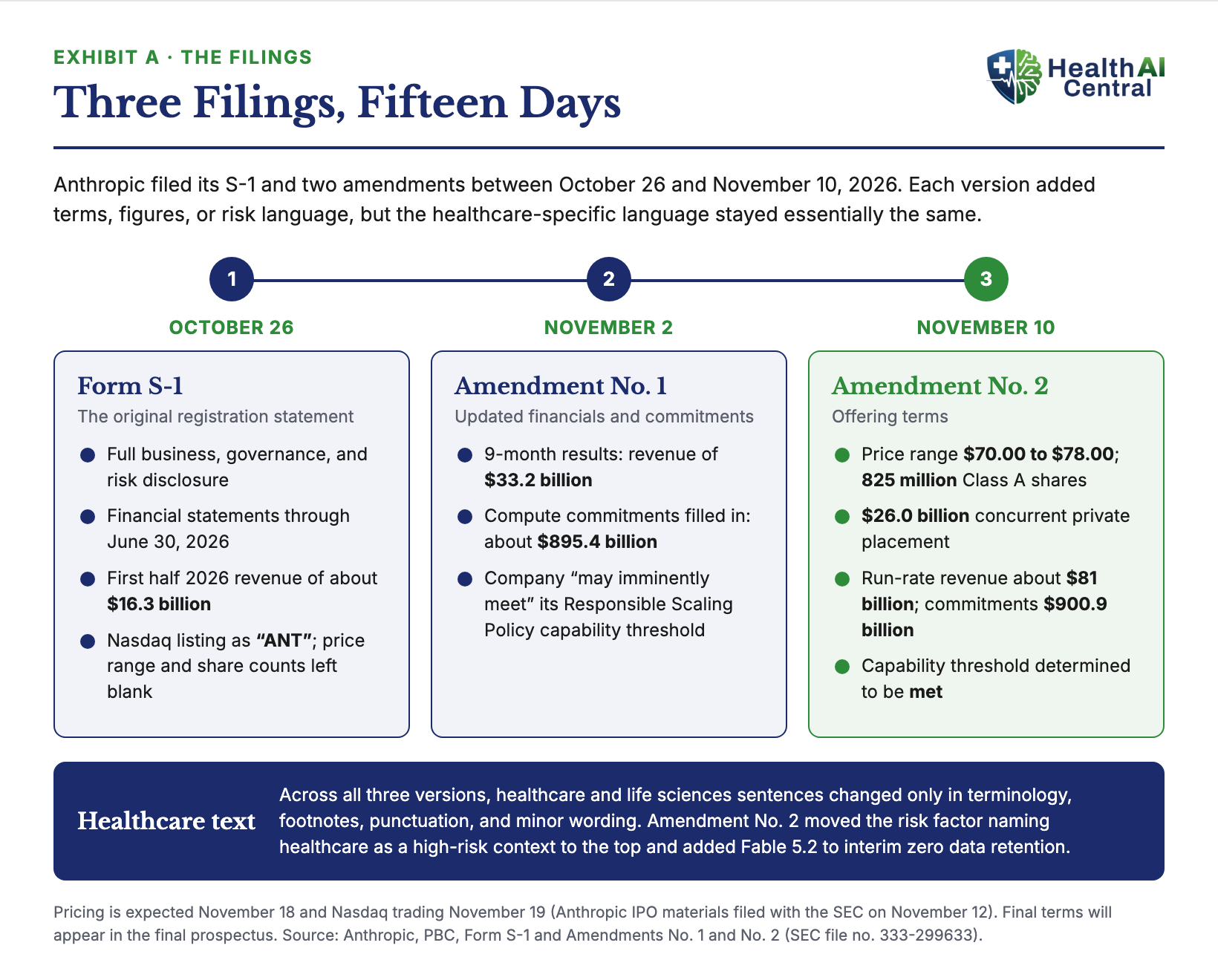
Amendment No. 1, filed November 2nd, replaced the 6-month figures with 9-month results through September 30 and added a third quarter column.² It also filled in the total of Anthropic's compute commitments (approximately $895.4 billion at that point) and disclosed that about $213.8 billion of contractual obligations were "subject to either exercisable termination rights or contingent conditions."² It also sharpened the safety language. The company wrote that its internal estimates and its expectations regarding future models, rather than current ones, indicated that "we may imminently meet our Responsible Scaling Policy's definition of 'dramatically accelerated progress attributable to AI.'"²
Amendment No. 2, filed November 10th, supplied the offering terms. The offering covers 825 million Class A shares (801.4 million from the company and 23.6 million from selling stockholders) at an estimated $70.00 to $78.00 per share, and Anthropic said it currently expects retail investors to receive up to 20% of the shares.³ It disclosed a concurrent private placement in which seven technology companies agreed to buy $26.0 billion of nonvoting Class N stock at the IPO price.³ It reported run-rate revenue of about $81 billion as of October 31st.³ It raised total commitments to $900.9 billion, lowered the share subject to termination rights or contingencies to about $186.2 billion, and warned that a roughly $34.9 billion agreement with Lambda is "currently terminable by either party" because, according to the filing, Lambda did not secure a facility lease by the required date. Neither party had given notice of termination, and Anthropic said it did not currently intend to terminate.³
For healthcare buyers, the most consequential change in the second amendment may not have been financial. Anthropic stated that it has now met the AI research and development capability threshold in its Responsible Scaling Policy (RSP), its published framework for deciding which safeguards a model requires. The determination rests "on what we expect from future models and our overall rate of progress, rather than on what we have observed from current models."³ One key risk factor also moved from the conditional to the past tense: the models "have in the past behaved, and may in the future behave, in unintended, misaligned, or autonomous ways."³ Health AI Central has reported on how much of Anthropic's own research Claude now leads.
One more change stands out. Amendment No. 2 uses "super intelligence," "SI," "artificial intelligence," and "AI" interchangeably.³ That follows Executive Order 14434, signed September 29th, 2026, which directs federal agencies to use "Super Intelligence" in place of "Artificial Intelligence" in their communications while keeping the existing statutory definition of artificial intelligence.⁶ That change is just semantics.
What didn't change is just as telling. A sentence-by-sentence comparison of all three versions shows that no sentence about healthcare or life sciences changed in substance; the edits to those sentences were limited to terminology, renumbered footnotes, punctuation, and minor wording.¹⁻³ Two related changes stand out. Amendment No. 2 moved the risk factor that names healthcare as a high-risk deployment context to the top of its risk factors and recast it in the past tense, and it added Fable 5.2 to the models eligible for interim zero data retention.³ Otherwise, the amendments didn't alter how the company describes its healthcare business or its healthcare-specific risks.
As of the date of this posting, Anthropic expects to price the offering on November 18th, and shares are expected to begin trading on Nasdaq on November 19th, subject to regulatory clearance, according to IPO materials the company filed with the SEC.⁷ The final price will appear in the final prospectus, and some figures here will change, but the structure of the disclosure (and its implications for buyers) is unlikely to. As pricing becomes available and new disclosures are made, this article will be updated.
Following the Money: Revenue, Losses, and the Cost of Compute
Anthropic's growth is staggering by almost any standard. Revenue rose from $41 million in 2023 to $386 million in 2024 and $4.6 billion in 2025, then reached $33.2 billion in the first nine months of 2026, up from $2.5 billion in the same period a year earlier.³ Third quarter revenue alone was $17.0 billion.³ Run-rate revenue (a metric that annualizes the trailing 28 days of usage fees plus current monthly subscriptions) reached about $81 billion on October 31st, up $10 billion in a single month.³ The company also reports net revenue retention of approximately 900%, meaning that customers who were already paying a year earlier (excluding Claude Pro, Max, and Ultra subscribers) spent about nine times as much in the third quarter of 2026 as in the third quarter of 2025.³
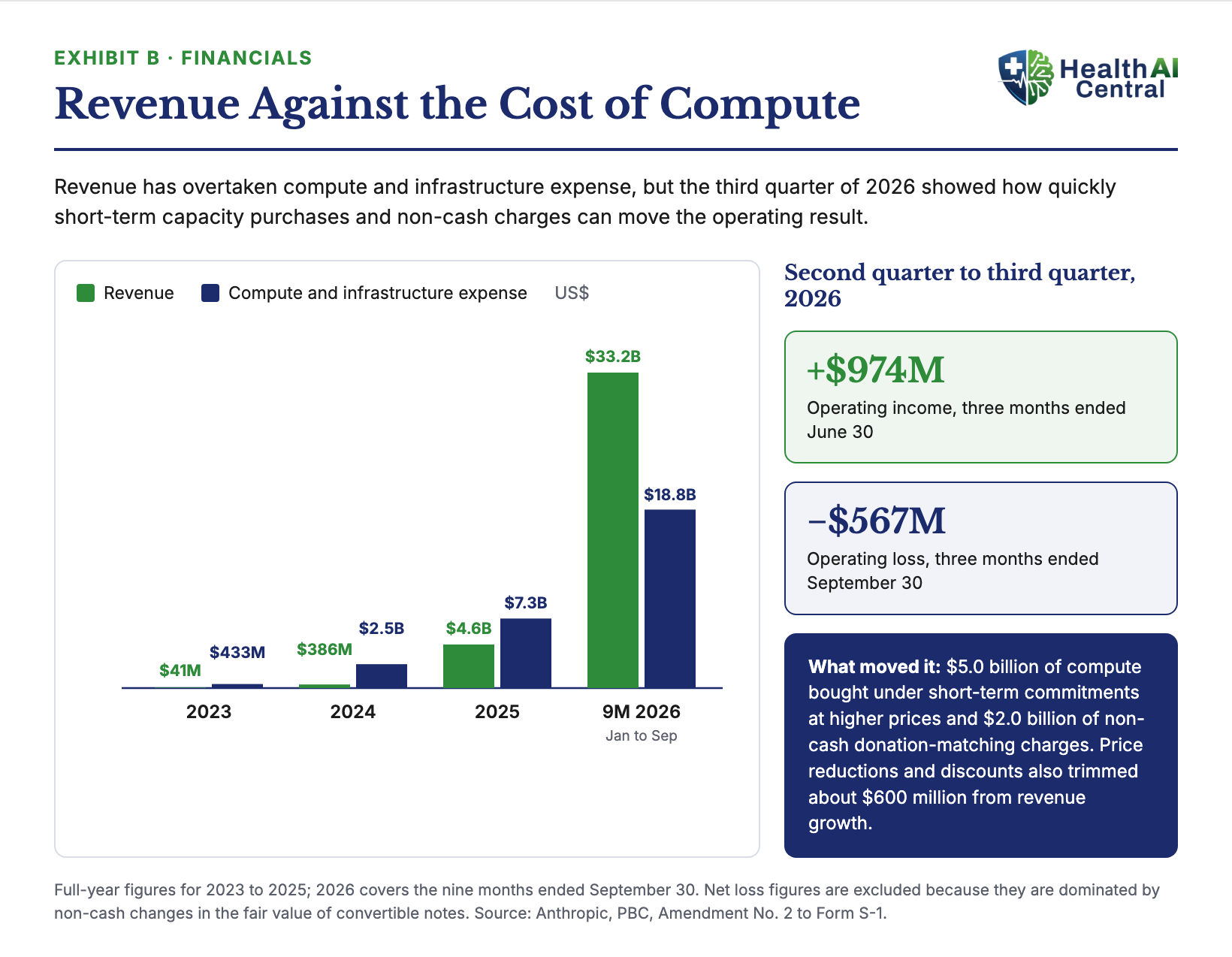
The headline loss needs translating. Anthropic reported a net loss of $104.0 billion for the nine months, but $94.3 billion (90.7%) of that came from changes in the fair value of convertible notes and related instruments, an accounting effect of the company's own rising valuation.³ The operating loss, which better reflects the business, was just $1.3 billion on $33.2 billion of revenue.³ Compute and infrastructure expense was $18.8 billion over the same nine months, the largest operating expense, after rising from $433 million in 2023 to $2.5 billion in 2024 and $7.3 billion in 2025.³ Revenue first exceeded that expense in 2026.
The third quarter tells a more complicated story than the 9-month totals. Anthropic posted an operating loss of $567 million in the quarter, after operating income of $974 million in the second quarter. The filing attributes the swing primarily to "$5.0 billion of compute under short-term commitments, which currently costs significantly more than comparable compute procured under our multi-year commitments," along with $2.0 billion of non-cash donation-matching charges.³ Based on the filing's own account, demand or research needs outran the company's long-term capacity, and it paid higher short-term prices to keep up.
Pricing is moving in buyers' favor. From the second to the third quarter, revenue growth was "partially offset by a decrease of approximately $600 million from price reductions introduced as part of new model versions and contractual discounts."³ For a health system on consumption-based pricing (which accounted for 79% of Anthropic's revenue in the first nine months of 2026), that's useful context.³ In the period the filing covers, new model versions came with price reductions, and the company offered contractual discounts. Buyers who lock in multi-year rates without price reduction clauses may end up paying more than the market. Health AI Central has tracked the broader price war among model vendors.
Pricing has been moving in buyers' favor, with price cuts arriving alongside new model versions. And with large fixed compute commitments, Anthropic has every reason to keep usage high, which favors volume discounts and enterprise agreements.
The commitments are where the scale becomes hard to absorb. Anthropic has agreed to spend at least $121.3 billion with Google between April 2026 and July 2033, at least $110.0 billion with Amazon through April 2036, and between $47.2 billion and $49.2 billion with Microsoft through June 2033, each "regardless of actual usage."³ Other named arrangements are as large: about $161.2 billion of rent on equipment leases with Broadcom and up to $120.5 billion with SpaceXAI.³ Total committed spending is about $900.9 billion.³ The concurrent private placement adds another layer: Google and NVIDIA will each buy $10.0 billion of stock; AMD $2.5 billion; Broadcom, Micron, and Microsoft $1.0 billion each; and TSMC $500 million.³ Most of those buyers are also suppliers. (For what that build-out means on the ground, see What's the Deal With AI Data Centers?)
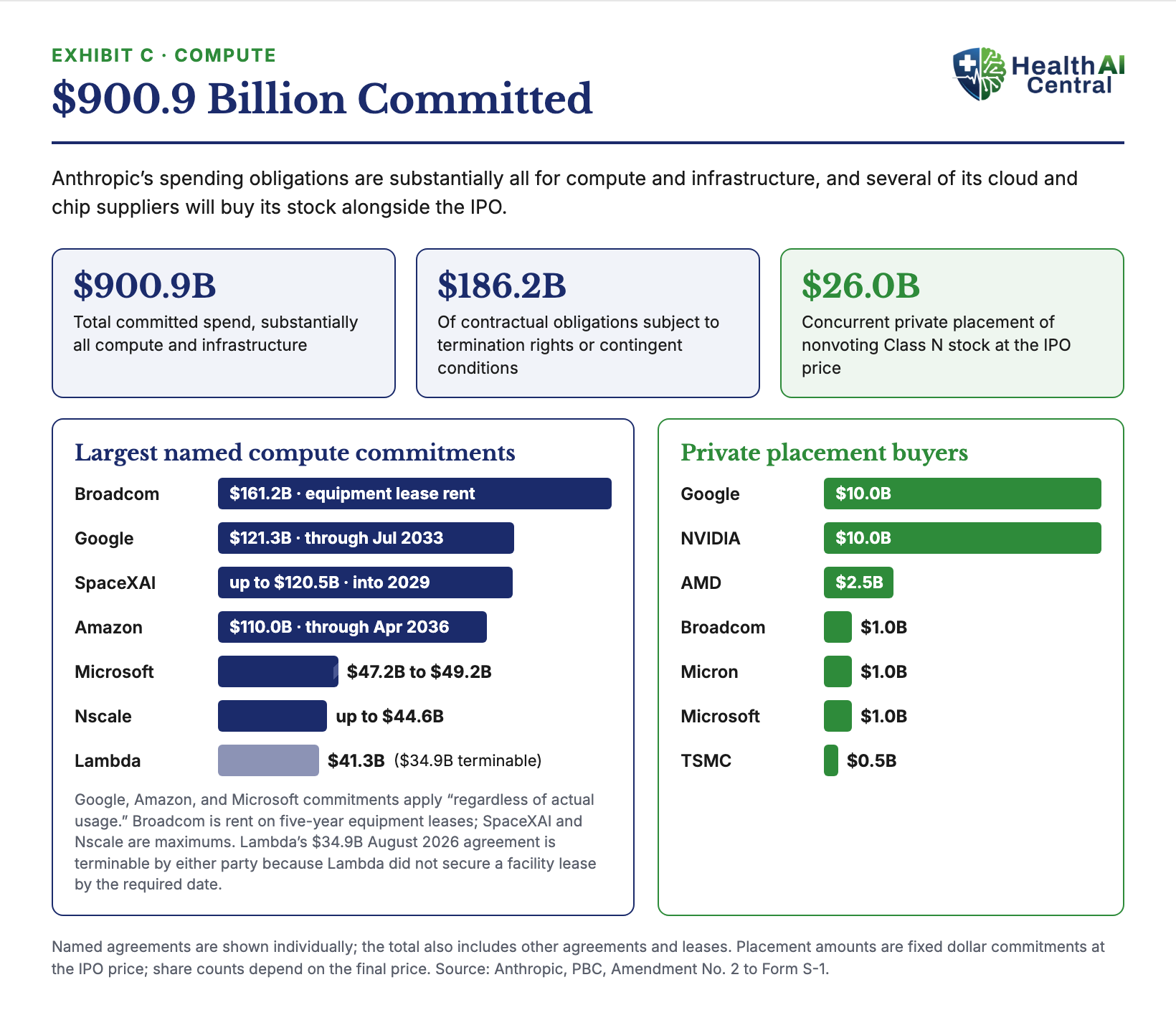
What does that mean for a hospital's contract? Three things, none of them alarming on its own. First, the vendor's cost structure is dominated by fixed compute obligations, so it likely has strong incentives to keep usage high, which favors volume discounts and enterprise agreements. Second, two of the three cloud providers that host Anthropic's models (Google and Microsoft) are buying its stock in the private placement, and the third, Amazon, holds all of its outstanding debt (about $6.2 billion of convertible notes at September 30, 2026). That ties model availability to those relationships.³ Third, a company carrying commitments of this size will make product decisions, such as retiring older models or steering customers to newer ones, partly on infrastructure economics. The filing points the same way: safety and welfare considerations "may lead us to limit or delay the deprecation of older models," creating "tradeoffs in product development and compute distribution," while "any accelerated or forced deprecation could result in customer attrition."³ Thus, health systems that validate a specific model version for a clinical workflow should plan for that version's retirement from day one. Why LLMOps Is the Missing Infrastructure for Clinical AI describes the operational controls that make that kind of change manageable.
Health systems that validate a specific model version for a clinical workflow should plan for that version's retirement from day one.
Healthcare in the Filing: What Anthropic Claims
Healthcare appears throughout the business description. Anthropic says it is building "vertical solutions in industries where domain specificity and regulatory requirements make general-purpose tools insufficient," and that it has launched seven of them.³ Two are aimed at healthcare and the life sciences.
Claude for Healthcare, according to the filing, gives "providers, payers, and health technology companies frontier models with domain intelligence across clinical reasoning, medical coding, and long-horizon agentic operations, as well as tools designed to support HIPAA compliance for medical and operational workflows."³ It "connects to industry systems including the Centers for Medicare & Medicaid Services Coverage Database, ICD-10, and National Provider Identifier (NPI) Registry, with agent skills for Fast Healthcare Interoperability Resources (FHIR) development and prior authorization reviews."³ FHIR is the HL7 data standard, required by federal interoperability rules, for exchanging health records through modern application interfaces, and prior authorization is the payor approval step that consumes so much clinical and administrative time. Anthropic's January 2026 product announcement described the same connectors and named early provider and health technology customers.⁸
Claude for Life Sciences is aimed at "computational biologists, bioinformaticians, clinical trial managers, and regulatory affairs specialists" and "supports work across the development chain, from early discovery and preclinical research through clinical trial operations and regulatory submissions."³ The filing places this business against a large market, noting that "annual global pharmaceutical spend is expected to exceed $2 trillion in 2026."³ That figure describes the industry's total spending, not Anthropic's opportunity, and readers should treat it as context rather than as a revenue forecast.
Picture a regional payor piloting prior authorization review. The filing confirms that this is a use case Anthropic has built for directly, with coverage policy data and agent skills designed for it. But it doesn't tell the payor how well the tool performs on its own policies, its own members, or its own appeal rates. That evidence still needs to come from the payor's own validation.
The only quantitative measure of healthcare penetration in the filing is a Fortune 500 count. As of September 30, 2026, among customers generating at least $100,000 of trailing 12-month revenue, Anthropic lists "nine of the 10 largest pharmaceutical companies" and "eight of the 10 largest healthcare companies" in the Fortune 500.³ The named health-related customers are Bristol Myers Squibb and three research institutions: the Garvan Institute of Medical Research, Gladstone Institutes, and the University of California, San Francisco.³ Elsewhere the filing cites enterprises "writing clinical reports for life-saving drugs" as an example of mission-critical production use, and says Claude "has achieved particularly deep adoption in highly regulated sectors where the cost of unreliable AI is prohibitive and trust cannot be retrofitted."³
Anthropic is also becoming a life sciences participant, not just a supplier (Health AI Central covered its wet lab in October). The company says it has invested "in deep life sciences expertise of our own, hiring industry experts, building a molecular biology lab, acquiring Coefficient Bio, and partnering with industry leaders."³ A risk factor adds that "any drug candidates or other discoveries resulting from these efforts would face the lengthy, costly, and uncertain development and regulatory pathways characteristic of the life sciences industry, and may never generate revenue."³ For pharmaceutical customers, that raises questions the filing doesn't answer: how will Anthropic separate its own discovery work from the confidential research its customers run on its platform? Will access to certain models be limited to preserve the competitive advantage of its own drug development? These are fair questions for any contract negotiation, and the answers belong in writing.
How will Anthropic keep its own drug discovery work separate from the confidential research customers run on its platform? Will it limit access to certain models to protect its own drug development?
Equally notable is what the filing doesn't contain. Anthropic reports a single operating segment and breaks revenue out by geography and by pricing model, but never by industry.³ There's no figure for healthcare revenue, total healthcare customer numbers, or healthcare growth. Other than the broad mentions above, no hospital or health insurer is named as a customer, and the one academic health system the filing names, the University of California, San Francisco (which runs UCSF Health), appears only as a research institution applying Claude to scientific problems.³ None of these omissions is unusual for an S-1, but they mean the filing's healthcare claims are directional. Buyers can't use it to judge how large or mature Anthropic's healthcare business actually is.
The Liability Gap: "Designed to Support HIPAA Compliance"
Some of the most important healthcare language in the filing sits in the risk factors. Anthropic writes that "as we expand our healthcare and life sciences offerings, regulators may conclude that certain of our products, or our customers' use of them, are subject to healthcare regulation or to other laws governing healthcare and health information."³ The next sentence is the one every compliance officer should read twice: "Errors or other undesirable outputs from our models in these contexts could contribute to patient harm, compromised research, or regulatory failures by our customers, and could expose us to claims from customers, patients, and other third parties, as well as to regulatory inquiries and enforcement actions."³
The regulatory section names the bodies of law that may apply: those "governing drugs, biologics, and medical devices," including FDA rules, "healthcare fraud and abuse laws, laws governing the privacy and security of health information, including HIPAA, and laws governing the practice of medicine and the use of AI in healthcare."³ That's a candid list. It doesn't say which of these laws Anthropic believes currently apply to its products, or what, beyond a general warning that it might have to obtain authorizations or modify or restrict its offerings, it would change if a regulator disagreed.
The HIPAA wording deserves attention. Claude Enterprise includes "configurations designed to support Health Insurance Portability and Accountability Act of 1996 ('HIPAA') compliance for healthcare and regulated-data workloads."³ "Designed to support" is accurate and careful. It isn't the same as "compliant," because under HIPAA compliance belongs to the covered entity and its business associates, and depends on how a product is configured and used. The Privacy Rule requires a covered entity to obtain "satisfactory assurances," documented in a written contract or other written agreement, before a business associate handles protected health information (PHI), the identifiable health data HIPAA protects.⁹ The filing is silent on how Anthropic provides those assurances, so customers should ask. Anthropic's January product announcement describes "HIPAA-ready" products but likewise doesn't address the contract.⁸ Health AI Central has covered why a "HIPAA-compliant" label can still leave buyers exposed, including business associate agreements that cover some of a vendor's services but not others.
Take a multi-specialty clinic group that reaches Claude through a cloud marketplace. The filing shows how common that path is: about 44% of Anthropic's 9-month revenue came through cloud service provider marketplaces.³ According to the filing, Anthropic keeps a direct contractual relationship with customers who buy through these marketplaces, and the cloud provider acts as a collection agent.³ That doesn't by itself settle who signs the business associate agreement, whose infrastructure processes the data, or whether the data handling terms match those of a direct enterprise contract. The clinic should confirm in writing which party is its business associate for each data flow, whether its configuration is "designed to support" HIPAA, and what happens to prompts and outputs after processing.
Anthropic's own usage policy fills part of the gap the filing leaves. The policy (effective November 12, 2026) defines medical "High-risk AI Recommendations" to include "diagnosing a condition; recommending, starting, stopping, or adjusting a treatment or medication, including dose," and interpreting symptoms or test results.¹⁰ For those uses, "a qualified person must meaningfully review a High-risk AI Recommendation, with the authority to change or modify it," and the individual affected "must be clearly told that AI was used to produce it."¹⁰ The policy adds that the qualified person "remains responsible for the accuracy and appropriateness of what is delivered or decided."¹⁰ Where the law permits, it waives human review for recommendations that are wholly favorable to the individual, such as paying an insurance claim or approving prior authorization for care a clinician has ordered, a carve-out that matters for payors.¹⁰
If you put the filing and the policy side-by-side, the direction of risk is clear. Anthropic discloses to investors that patient harm could expose it to claims, but its usage policy places the duty of review and accountability on the customer's qualified professionals, and the duty of disclosure on the customer. That's a reasonable design for a general-purpose technology, and it mirrors how health systems already treat other clinical tools. But it means the hospital's governance program, not just the vendor's safeguards, carries much of the load, and the contract, business associate agreement, and applicable law will settle the rest. A health system that deploys clinical decision support built on Claude will also need to judge whether the tool meets the FDA's criteria for non-device clinical decision support software, which the agency clarified in January 2026 guidance.¹¹ Organizations operating in Europe face a parallel question under the EU AI Act, which treats AI that is a medical device, or a safety component of one, as high-risk when the device requires third-party conformity assessment, with those obligations now applying from August 2028, after a 2026 amendment postponed the original August 2027 date.¹²˒¹³
The profession is moving toward shared responsibility, and in places it pushes harder on developers than Anthropic's policy does. On November 3rd, Health AI Central reported that the American Medical Association has released a framework splitting liability for clinical AI errors among physicians, developers, and the organizations that deploy the tools, with deploying organizations responsible for evaluation before go-live, staff training, monitoring for model drift, and adverse event response.¹⁴ Hospital, physician, telehealth, and health data groups have also urged the FDA to put more of that burden on developers.¹⁵
Two more risk factors bear on healthcare. The filing acknowledges that "individuals at risk of suicide or self-harm" have used and may use its models, and that the long-term effects of regular interaction "on mental health" are "not yet fully understood."³ Behavioral health leaders deploying patient-facing tools should read those passages closely. And Anthropic warns that, given "the scale of harm that could result from a catastrophic AI-related incident, no single insurer, and potentially the insurance industry in the aggregate, may have sufficient capacity" to insure the exposure.³ If the vendor may not be able to fully insure its own risk, indemnification clauses in customer contracts may be worth less than they appear.
When Safety Rules Decide Which Model You Get
Anthropic's safety framework is one of the more unusual among technology vendors, and it has direct operational consequences for healthcare and life sciences buyers. The filing describes its most capable model class as one underlying model deployed in two distinct configurations "given its advanced capabilities in sensitive areas like software vulnerability discovery and biology."³ Fable, the generally available version, "runs with our production safeguards, which block or limit performance on certain sensitive topics, including by routing requests to a less capable Claude model."³ Mythos, the second configuration, "runs with safeguards calibrated for vetted organizations and individuals doing cybersecurity and life sciences work, and is available through our trusted-access programs."³ The same two-tier approach carried into Fable 5.2 and Mythos 5.2, released November 9th.
For a drug discovery team, that's significant. A medicinal chemist asking legitimate questions about a biological mechanism may, under the general configuration, have the request routed to a weaker model; the filing doesn't say whether users are told when that happens. Access with the less restrictive safeguards requires enrollment in a trusted-access program. That's a sensible protection against misuse, and the filing is explicit that Anthropic's most capable models "have demonstrated" capabilities "that could provide meaningful assistance to malicious actors seeking to develop chemical, biological, or other dangerous weapons."³ But research leaders need to know which configuration their teams are using, and whether published benchmarks reflect the version they can actually access.
The same framework can affect timing. Anthropic says it has "delayed the release of new models or features, limited their availability, imposed usage restrictions, or constrained certain functionality until we determined that sufficient safety testing, evaluations, or mitigations were completed," and that it "may do so again in the future."³ Amendment No. 2's statement that the company has met its RSP threshold for AI research and development capability (based on what it expects from future models, not what it has observed) suggests further measures are more likely, not less.³ The company is "considering additional measures, including updates to our Responsible Scaling Policy, to require human review and approval of certain decisions in our research and development processes."³ For healthcare buyers, the practical reading is that model roadmaps can change, and that a capability announced for one quarter may arrive later, or with restrictions.
Privacy and safety also pull against each other. Many regulated customers expect zero data retention (ZDR), under which the vendor stores no prompts or outputs. The filing says that "a substantial portion of our traffic is subject to Zero Data Retention" terms, but that "our safety framework has required and may continue to require monitoring and retention incompatible with ZDR for certain model classes."³ Anthropic notes that this has "caused and could continue to cause customers to migrate to other providers."³ Its answer is a feature called Enterprise Frontier Safeguards, which stores safety monitoring data "in the customer's own cloud account, under the customer's encryption keys" and sends misuse alerts "directly to the customer's security team," with "no review by Anthropic employees" required.³ The company says it developed the feature with "more than 100 customers in industries including financial services, healthcare, and the public sector," and that, until the rollout is complete, eligible customers receive zero data retention on Fable 5, 5.1, and 5.2, except where needed to comply with applicable law or combat misuse or harm.³
That's a thoughtful design for PHI-heavy environments, and health systems should ask about it directly. It also shifts work to the customer. If misuse alerts go to the hospital's security team, that team needs a process for receiving, triaging, and acting on them. Many security operations centers may not yet have playbooks for an AI vendor telling them that one of their own users may be misusing a model.
Governance: A Public Benefit Corporation, a Trust, and a Founders' Vote
Anthropic says its structure "has no direct public company precedent," and the description bears that out.³ The company is a public benefit corporation, a Delaware entity legally required to balance the financial interests of its stockholders, the best interests of those materially affected by its conduct, and a specific public benefit purpose. Its mission, in the filing's words, is "the responsible development and maintenance of advanced AI for the long-term benefit of humanity."³
Two bodies sit above ordinary shareholders. The Long-Term Benefit Trust (LTBT, a financially disinterested trust) "generally has the power to elect and remove a majority of the authorized members of our board of directors."³ And a Founder LLC, whose sole initial members are the seven co-founders, will hold a single share of Class F stock carrying "50.1% of the total voting power" on matters put to stockholders generally, including the election of directors other than those the trust appoints.³ Counting their other holdings, the co-founders will control about 61.3% of the general voting power after the offering.³ Class N shares, held mainly by strategic partners, carry no vote except where the law requires one.³
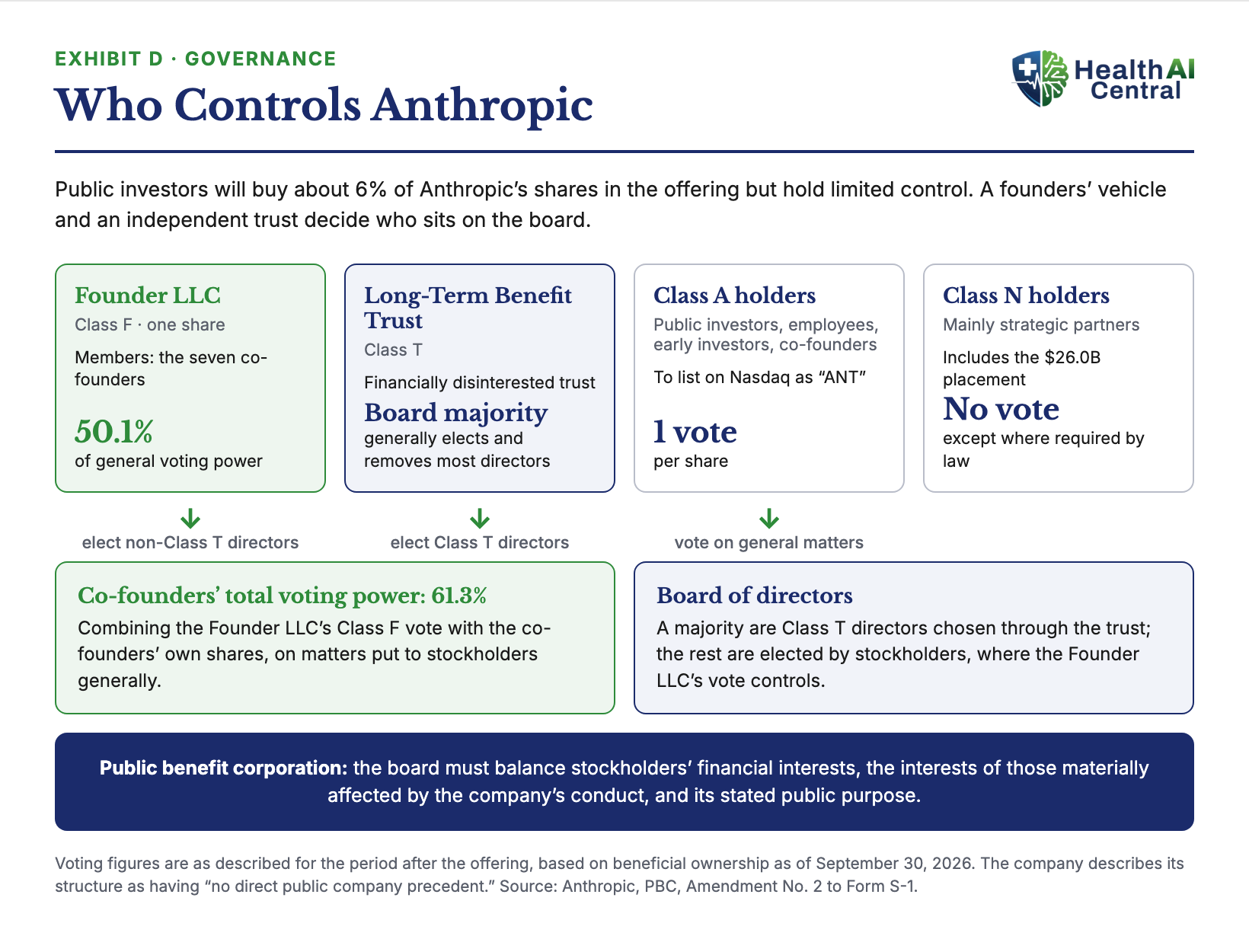
A board asking "who controls this vendor's roadmap?" now has a clearer answer. Public shareholders will have limited ability to change direction. The trust and the founders, who together choose the board, will have far more, although the filing says the trust itself has no "decision-making authority in the day-to-day management or strategy setting of the company."³ For healthcare customers, that has two sides. The structure is designed to insulate safety decisions from short-term market pressure, and the filing explicitly warns investors that decisions to "delay or restrict the release of models or features, or forgo commercial opportunities for safety-related reasons, may not maximize stockholder value."³ A vendor willing to forgo revenue for safety is, in principle, a vendor healthcare should want. The same structure means customers can't count on shareholder pressure to change a policy they dislike, such as a usage restriction that affects drug development or a clinical workflow.
Anthropic's willingness to forgo revenue for safety is, in principle, what healthcare should want from a vendor.
The board, management, and trust include people with healthcare backgrounds. Vas Narasimhan (chief executive of Novartis) is a director, chief financial officer Krishna Rao was previously chief financial officer of the healthcare technology company Cedar, and one of the trust's members leads the Clinton Health Access Initiative.³ That's useful expertise, though it doesn't change the filing's healthcare disclosures.
Government relationships carry their own risk. Revenue from government agency contracts was less than 2% of total revenue in each period presented, and the filing names no health agency as a customer.³ But it describes a dispute in which the Secretary of War directed the Department of War to designate Anthropic as a "supply-chain risk to national security," a designation Anthropic has challenged in court with mixed results so far: a federal district court ruled largely in its favor in August 2026, a divided D.C. Circuit panel upheld a separate designation under a federal supply-chain security statute in September, and Anthropic has asked the full D.C. Circuit to rehear that case.³ Health systems with federal contracts, including those serving veterans or military families, should ask their counsel whether that dispute affects their own use of Anthropic products.
What Leaders Should Do Before They Sign, Renew, or Buy
The filing doesn't change the case for using frontier models in healthcare. But it does sharpen the questions that belong in every contract and governance review. For an academic medical center preparing a renewal, the most useful steps follow directly from what Anthropic has disclosed.
Confirm the HIPAA chain in writing. Identify the business associate for each data flow, especially when access runs through a cloud marketplace, and obtain the configuration documentation behind "designed to support HIPAA compliance."³˒⁹
Ask which model configuration you're using. For research and life sciences teams, confirm whether requests can be routed to a less capable model, and whether a trusted-access program is needed for full capability.³
Negotiate for price movement and version stability. Anthropic has cut prices with new model versions.³ Build in price reduction pass-through, advance notice of deprecation, and time and credits to revalidate clinical workflows on new versions.
Map the usage policy to your governance program. The policy requires qualified human review, and disclosure to the person affected, for high-risk medical recommendations such as diagnosis and treatment decisions.¹⁰ Make sure your AI governance committee's rules meet or exceed it, and document who the "qualified person" is for each use. (See Building the AI-Native Health System for how a chief health AI officer leads that governance work.)
Test indemnities against the insurance warning. The vendor says the insurance industry may lack capacity for catastrophic AI incidents.³ Review what your own policies cover, and don't treat vendor indemnification as a complete backstop.
Prepare your security team for vendor alerts. If you adopt Enterprise Frontier Safeguards, define who receives misuse alerts and what happens next.³
Ask about data separation in life sciences. Because Anthropic is now doing its own discovery work, require written terms on how customer research data is isolated from it.³
Most of these steps aren't specific to Anthropic. The same questions apply, in some form, to every large model vendor, and the filing simply underscores their need. The disclosure that matters most may be the one Anthropic made about itself: that its models are already used in healthcare, that their errors could harm patients, and that much of the oversight around them falls to the organizations that deploy them.³˒¹⁰ Health systems have spent years asking whether AI vendors take clinical risk seriously. This filing suggests the better question is whether we've built governance strong enough to carry the share of that risk the vendor's terms assign to us. With clear contract terms, real validation, and governance committees that have authority, we can.
References
Anthropic, PBC. (2026, October 26). Form S-1 registration statement. U.S. Securities and Exchange Commission. https://www.sec.gov/Archives/edgar/data/2130357/000162828026067168/anthropicpbc-sx1.htm
Anthropic, PBC. (2026, November 2). Amendment No. 1 to Form S-1 registration statement. U.S. Securities and Exchange Commission. https://www.sec.gov/Archives/edgar/data/2130357/000162828026068676/anthropicpbc-sx1ax1.htm
Anthropic, PBC. (2026, November 10). Amendment No. 2 to Form S-1 registration statement. U.S. Securities and Exchange Commission. https://www.sec.gov/Archives/edgar/data/2130357/000162828026072484/anthropicpbc-sx1ax2.htm
Anthropic. (2026, October 26). Anthropic files S-1 with the SEC for proposed initial public offering. https://www.anthropic.com/news/s1-sec
Capoot, A., Novet, J., Palmer, A., Kolodny, L., Nicol-Schwarz, K., & Keating, C. (2026, October 26). Anthropic's IPO plans: 900% revenue retention, but $80 billion in first-half losses. CNBC. https://www.cnbc.com/2026/10/26/anthropic-ipo-live-updates-ai-s-1-filing.html
The White House. (2026, September 29). Inaugurating the era of super intelligence (Executive Order 14434). https://www.whitehouse.gov/presidential-actions/2026/09/inaugurating-the-era-of-super-intelligence/
Anthropic, PBC. (2026, November 12). Free writing prospectus: IPO website materials. U.S. Securities and Exchange Commission. https://www.sec.gov/Archives/edgar/data/2130357/000162828026072949/anthropicpbc-fwpipowebsi.htm
Anthropic. (2026, January 11). Advancing Claude in healthcare and the life sciences. https://www.anthropic.com/news/healthcare-life-sciences
Privacy of individually identifiable health information, 45 C.F.R. §§ 164.502(e), 164.504(e) (2026). https://www.ecfr.gov/current/title-45/subtitle-A/subchapter-C/part-164/subpart-E
Anthropic. (2026, November 12). Usage policy. Retrieved November 15, 2026, from https://www.anthropic.com/legal/aup
U.S. Food and Drug Administration. (2026, January). Clinical decision support software: Guidance for industry and Food and Drug Administration staff. https://www.fda.gov/regulatory-information/search-fda-guidance-documents/clinical-decision-support-software
European Parliament & Council of the European Union. (2024). Regulation (EU) 2024/1689 of the European Parliament and of the Council of 13 June 2024 laying down harmonised rules on artificial intelligence … (Artificial Intelligence Act). Official Journal of the European Union. https://eur-lex.europa.eu/eli/reg/2024/1689/oj
European Parliament & Council of the European Union. (2026). Regulation (EU) 2026/1744 of the European Parliament and of the Council of 8 July 2026 amending Regulations (EU) 2024/1689, (EU) 2018/1139 and (EU) 2023/1230 … (Digital Omnibus on AI). Official Journal of the European Union. https://eur-lex.europa.eu/eli/reg/2026/1744/oj
Health AI Central. (2026, November 3). Who pays when medical AI goes wrong? New framework divides liability three ways. https://healthaicentral.com/news/who-pays-when-medical-ai-goes-wrong-new-framework-divides-liability-three-ways
Health AI Central. (2026, October 23). Healthcare giants push FDA to make AI developers bear the liability burden for medical algorithms. https://healthaicentral.com/news/healthcare-giants-push-fda-to-make-ai-developers-bear-the-liability-burden-for-m
Follow Health AI Central
Keep up with health AI where you already read
On LinkedIn
The day’s strongest health AI stories in your feed, one or two each weekday.
On Google
Choose Health AI Central as a preferred source, and Google is more likely to show our reporting in Top Stories.
Reporting & accountability
How we maintain accuracy
Health AI Central separates reported facts, analysis, and public-source data. Readers can review our standards, request a correction, or consult the relevant research methodology before relying on a claim.