

What's the Deal With AI Data Centers?
A practical guide to the infrastructure behind AI, the local trade-offs it creates, and why U.S. communities are reaching sharply different conclusions.
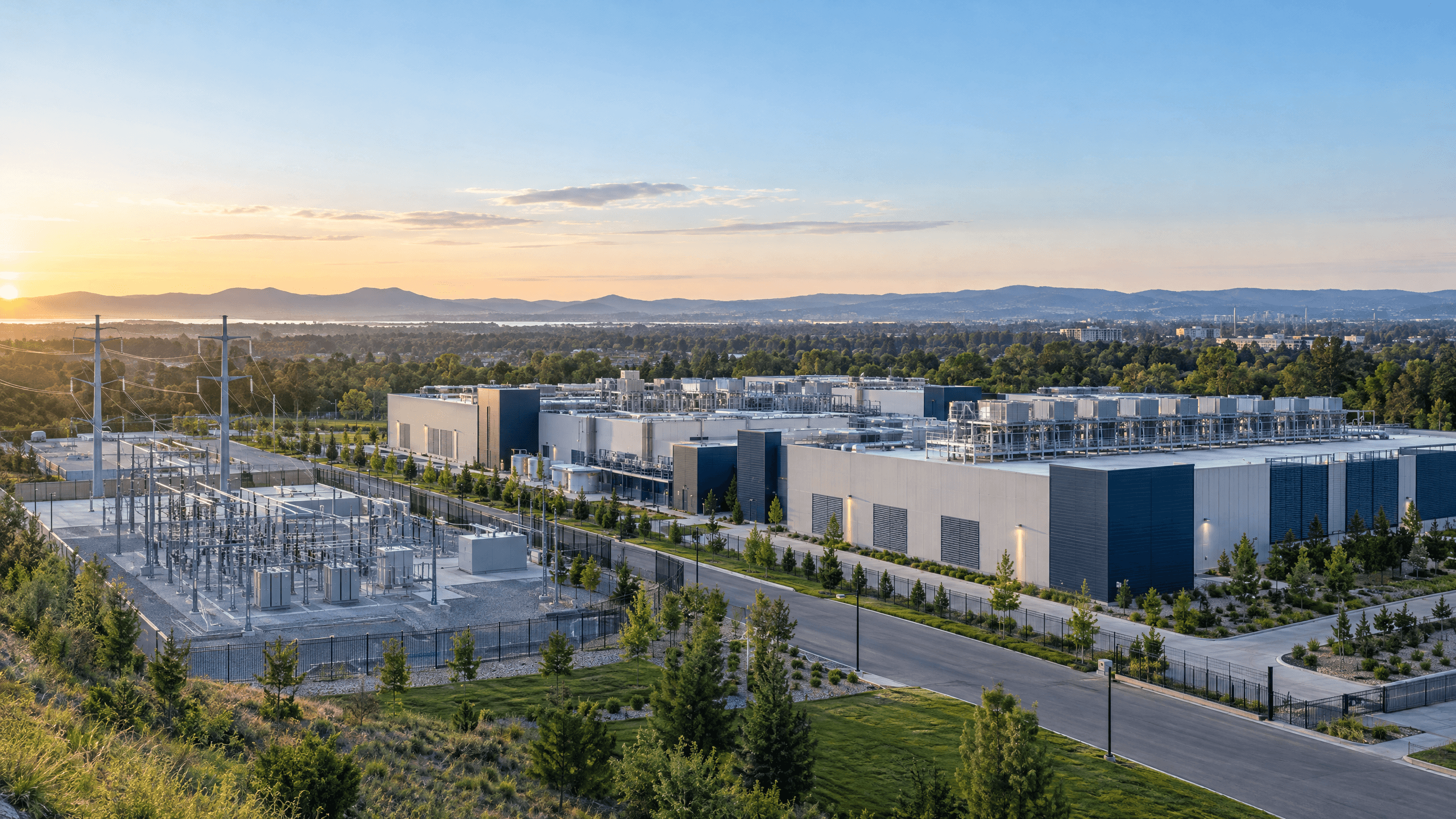
The phrase “AI data center” can make a project sound remote: part of the cloud, somewhere else, serving an invisible economy. In practice, it's an industrial campus with a street address, utility connections, cooling equipment, backup power, roads, and a 24-hour operating rhythm. Its effects are felt locally even when its users are everywhere.²
That matters to healthcare. A clinician may use an AI-enabled imaging workflow, a health system may host protected data in the cloud, and a payer may run a large model to streamline administrative work. None of those uses requires a hospital executive to become an electrical engineer. But the infrastructure that makes them possible competes locally for finite things: land, grid capacity, water, permitting attention, construction labor, and community trust.
The national scale is no longer trivial. The U.S. Department of Energy estimated that data centers used about 176 terawatt-hours of electricity in 2023 (roughly 4.4% of total U.S. electricity consumption) and projected a range of 325 to 580 terawatt-hours by 2028. That would be approximately 6.7% to 12% of total U.S. electricity use.¹ AI is not the only cause of that growth, but high-density AI computing is a major new source of that demand.
The debate over AI data centers is often described as a clash between “technology” and “the environment,” or between economic development and local resistance. That framing is too reductive. The same facility can create a sizable tax base and construction pipeline, while also raising legitimate questions about its water source, generator emissions, night-time sound, grid costs, or proximity to homes. A project on a former industrial site with a robust transmission connection and a binding community benefit agreement is not the same proposition as a project proposed next to a neighborhood under a nondisclosure agreement.
The more useful question is not whether we need data centers. We clearly rely on them for clinical systems, financial transactions, public safety, research, communications, and a growing set of AI services.² The question is which facilities belong in which places, under what operating conditions, and with which protections for the people who live nearby.
The Cloud Has a Street Address
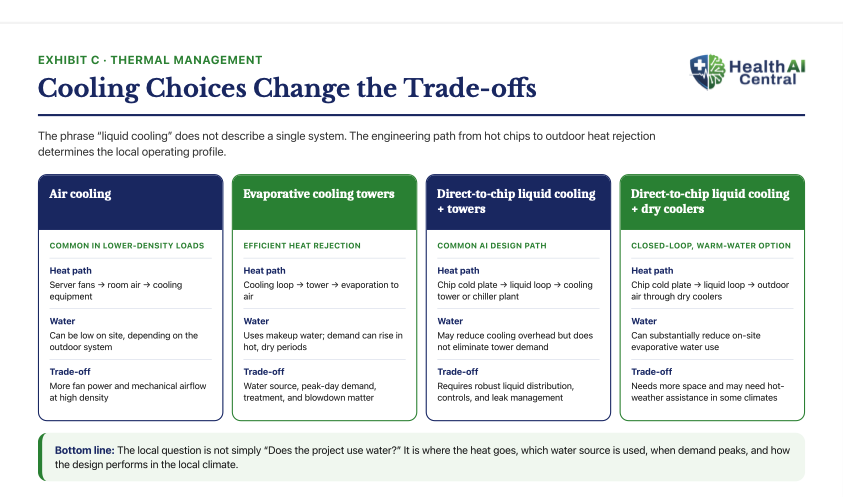
Data centers are the physical infrastructure of digital services. They house servers, storage, networking equipment, cooling systems, power backup, fire suppression, and security systems.² A modest facility may occupy a portion of an office or industrial building. A hyperscale campus—the kind often associated with cloud and AI workloads—may contain several large buildings, substations, miles of fiber, a cooling plant, fuel storage, and land reserved for later phases.
AI changes the physical problem inside those buildings. Traditional enterprise computing is often dispersed across many relatively predictable workloads. AI training and some AI inference workloads use powerful graphics processing units (GPUs) and other specialized accelerators packed at much higher density. Those chips generate intense heat and can create large, synchronized swings in power demand. In turn, developers must design around heavier equipment, larger electrical systems, and more sophisticated cooling than a conventional server room needs.³
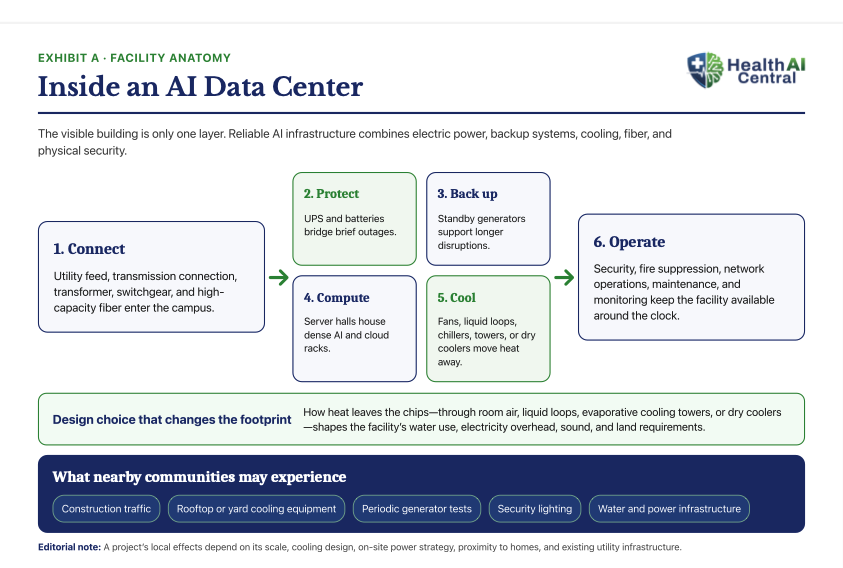
The building’s basic purpose is simple: keep computing equipment powered, connected, and within safe temperature limits, continuously. The engineering to accomplish that is not simple. A high-availability facility usually has more than one electricity feed, transformers and switchgear to step down and distribute power, uninterruptible power systems (usually involving batteries to bridge very short interruptions), and standby generators for longer outages. It may also have an on-site substation or require off-site transmission and distribution work before it can connect.²,³
Cooling is equally central. Heat must travel from the chip to the room, from the room to a cooling loop or outdoor equipment, and then into the surrounding air or water. In older or lower-density designs, the equipment is mainly air-cooled. In newer AI facilities, direct-to-chip liquid cooling has become increasingly common because liquid can carry much more heat than air in a compact space.³ The choice of cooling system shapes the facility’s electricity load, water demand, noise profile, footprint, and resilience in hot weather.
Construction also occurs in phases. Before a server is installed, a developer may grade the site, build access roads, trench fiber, erect the shell of the building, reinforce slabs for dense racks and mechanical equipment, and install electrical and cooling systems. The most visible impacts are often temporary—truck traffic, earth moving, dirt and dust, construction sound and smoke, and visual change. The operational questions are different: continuous fan and cooling noise, water use, electricity demand, periodic generator testing, lighting, and, in some projects, on-site power generation.²,³
Electricity: The First Constraint (and the most contested one)
Most current disputes with AI data centers begin with electricity. A data center’s headline power number is usually expressed in megawatts (MW), a measure of instantaneous capacity or demand. It should not be confused with the actual electricity it consumes over a year, which is measured in megawatt-hours or terawatt-hours. A 100-MW project that operates near full load around the clock is a very different grid customer from a 100-MW project with much lower utilization.⁴
The pressure on the system comes from three related needs: generation to make electricity, transmission to move bulk power across long distances, and local distribution equipment to deliver it to the campus. The needed investments depend on what is already available at a specific site. A facility near a large transmission line or retired industrial plant may be easier to connect than one that requires a new substation, long transmission extensions, or generation that does not yet exist.⁴
This is why blanket statements about an AI data center's impact on household power bills can be misleading. The Congressional Research Service notes that data center demand can affect retail electricity prices if it changes a utility’s costs or sales. New grid infrastructure can raise costs that a utility seeks to recover through rates. However, if a system has spare capacity, more sales can spread fixed costs across a larger volume. A Lawrence Berkeley National Laboratory (LBNL) analysis covering 2019 through 2025 did not identify data centers as major price drivers in most regions during that period, while warning that the relationship can vary as large loads arrive and infrastructure needs change.⁴
The practical policy issue is cost allocation. If a data center requires a new substation, feeder, transmission upgrade, or generation resource, who pays? Communities and regulators increasingly ask developers to cover project-specific infrastructure and to accept dedicated large-load rate structures. The objective is not to declare that data centers never benefit the grid. A planned upgrade can improve reliability for other customers. It is to document which upgrades are needed for the project, what the project pays, what benefits are shared, and how ordinary customers are protected if the project uses more or less power than anticipated or never reaches full buildout.
Tennessee offers a useful example of how rapidly this issue has entered local decision-making. Reporting by the Tennessee Lookout described a 2026 state law requiring data centers of at least 50 MW to pay for the electrical infrastructure upgrades needed to serve them, while also noting disputes about facilities’ ability to self-generate power.⁵ In Pennsylvania, a 2026 executive order requires developers seeking state permits to make legally binding commitments to cover the full cost of new power infrastructure required by their projects, among other conditions.⁶ These are policy models, not proof that every state should use the same rule. They show the question communities want answered before construction begins.
On-site generation complicates the picture. A project may propose diesel generators strictly for emergency backup, natural-gas engines or turbines for ongoing generation, batteries for short-duration support, or a mixture. “Off-grid” does not mean “impact-free.” It changes the mix of questions—from transmission upgrades and ratepayer cost allocation to fuel supply, emissions permits, noise, water, and reliability during adverse weather.¹⁰,¹¹
Water: Measure the Pathway Before Judging the Number
Water claims are among the hardest to compare because several different measurements are often collapsed into one number. The most important distinction is between withdrawal—water taken from a source—and consumption—water not returned to the immediate watershed because it evaporates or is otherwise removed. There is also a difference between direct water used at the facility and indirect water associated with generating the electricity the facility buys.⁷
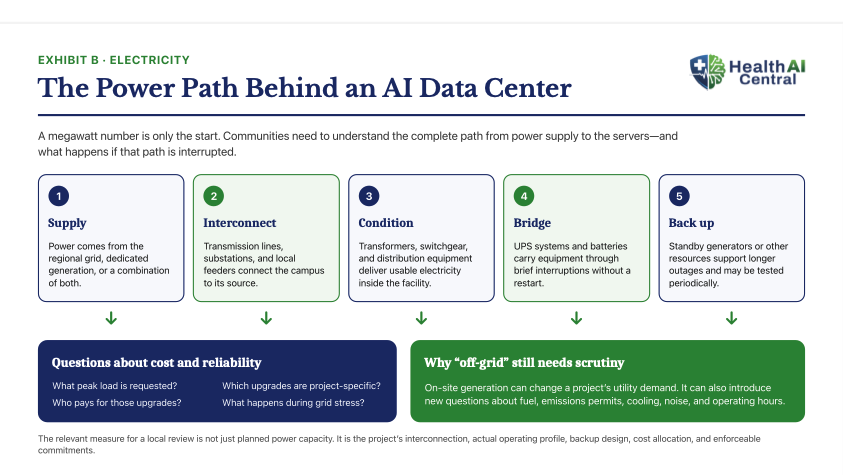
Data centers use water chiefly to remove heat, although needs vary sharply with computer load, climate, cooling design, water quality, and local operating practice.⁷ In a conventional evaporative cooling configuration, heat moves from the IT equipment into a chilled-water loop, then to a condenser-water loop, and ultimately to a cooling tower. The tower ejects heat by evaporating some water into the air. It also requires makeup water and periodic discharge (known as blowdown) to prevent minerals from concentrating in the recirculating system.⁸
This system can be highly effective in hot climates and for large, constant heat loads. It can also turn a data center into a significant local water customer, particularly during the hottest and driest periods when a community may be most concerned about its own water supply.⁷ That does not make every cooling tower proposal untenable. It does mean an application should identify the source (potable water, groundwater, surface water, reclaimed wastewater, or another supply), the peak-day usage, annual demand, drought contingencies, and what is available and permissible in local jurisdictions.
The federal government uses water usage effectiveness (WUE) as one way to track operating performance. The metric divides annual site water use by annual IT energy use, expressed in liters per kilowatt-hour.⁸ It is useful because it links water to the computing load, but it does not answer every local question. A facility can report an efficient WUE and still be unsuitable for a particular aquifer, drought-prone area, or small utility system. Conversely, a facility with a relatively high WUE may use reclaimed water that does not compete directly with household drinking water supplies. Source, seasonality, and local scarcity matter.
Newer designs can reduce direct potable water demand. Direct-to-chip liquid cooling transfers heat into sealed liquid loops near the server, rather than using large volumes of room air as the first cooling medium. Warm water designs can pair those loops with dry coolers (large radiator-like devices that release heat to outside air). The American Society of Heating, Refrigerating and Air-Conditioning Engineers (ASHRAE) describes how high-temperature, closed-loop systems can operate without evaporative cooling water at the site in many climates, though dry cooling needs more space and may need limited adiabatic assistance during extreme heat (spraying water mist into the air stream to assist with cooling before it hits the dry cooler's coils).³
Operational choices also matter. U.S. Department of Energy guidance identifies hot-aisle/cold-aisle containment, higher temperature set points where equipment tolerances allow, wider humidity control bands, air-side and water-side economizers, improved tower chemistry, and reuse of cooling-tower blowdown as strategies that can lower energy and water demand.⁸ In other settings, reclaimed wastewater can replace potable water for cooling. Each approach has its own costs, site requirements, and maintenance implications, and other trade-offs.
Sound, Light, and Air Quality: the Effects People Notice
When facilities are built far from homes, their mechanical systems can fade into the background. When they are built close to homes, schools, parks, or rural properties with low ambient sound, even a steady hum becomes a central quality-of-life issue.⁹
The day-to-day sound usually comes from cooling equipment: fans, chillers, compressors, pumps, dry coolers, and air handling systems. Some equipment runs constantly, while others ramp up during hot weather or heavier computing loads. Generator testing introduces another sound (often louder, more intermittent) and is concentrated during scheduled test periods. During construction, heavy equipment, trucking, and site activity introduce more sound in the surrounding area.⁹
Sound is not adequately described by a single decibel figure. Frequency, duration, time of day, background sound, directionality, building design, terrain, and distance from homes all matter. The Environmental and Energy Study Institute notes that data center noise comes primarily from cooling systems, fans, and generators, and that state and local zoning rules typically govern its management.⁹ The practical planning point is clear: projects near residents need pre-construction acoustic modeling, enforceable performance limits, monitoring, and a defined process for correcting problems.
Sound mitigation can be physical and operational. Acoustic louvers, silencers, sound curtains, enclosure walls, equipment placement, landscaped buffers, and greater setbacks can reduce impacts. So can cooling designs that require less high-velocity airflow. The right performance metric should be tailored to the site, including nighttime limits and low-frequency assessment, where relevant. A promised buffer is meaningful only if it is measured from the actual equipment likely to generate sound, not merely from the edge of a large property, and includes the myriad factors that can hinder or facilitate sound transmission.
Backup generators are another important component of sound and air quality management. Data centers are designed for continuous service, so most use standby generation to bridge prolonged utility outages. Diesel has historically been a common choice because fuel can be stored on site. The U.S. Environmental Protection Agency (EPA) explains that stationary engines and turbines are subject to federal emissions standards, but most air permits are issued by state and local agencies.¹⁰ Permits and operating limits are therefore site-specific, and the distinction between emergency use, maintenance testing, demand response, and routine prime-power operation must be part of the conversation.
That distinction is under pressure as grids become more constrained. Inside Climate News reported in 2025 that Texas developers and regulators were confronting the possibility that large facilities' energy supplies could be curtailed during periods of peak system demand, increasing the practical importance of backup systems.¹¹ The appropriate takeaway is not that every standby generator will operate frequently. It is that a project’s backup-power plan should be examined together with its interconnection agreement, expected curtailment, fuel supply, testing schedule, and permit conditions.
Continuous on-site natural gas generation presents another set of questions. It can reduce a project’s draw from a local grid but can also create ongoing combustion emissions and engine noise, like diesel generators. In Vineland, New Jersey, local reporting described resident complaints about a large facility’s continuous hum and reported that the project planned extensive on-site natural gas generation.¹² The report is a useful local illustration, not a basis for generalizing the project’s specific operating conditions to every data center. It also underscores why public disclosure before—not after—construction is so important.
Although less commonly cited as reasons communities reject AI data centers, light, visual character, stormwater management, traffic impact, and land conversion also belong in the same conversation. A low-rise building may look simple on a rendering, but a campus can include tall cooling equipment, transmission structures, fuel tanks, security lighting, long access roads, and multiple future phases. The largest effects may occur beyond the building footprint if a project drives new transmission corridors, utility facilities, or road improvements.²
Why Some Communities Want AI Data Centers
AI data centers can bring real benefits. Construction relies on electricians, pipefitters, concrete workers, equipment operators, engineers, security personnel, and many supporting trades. Host governments can receive property, equipment, sales, and other taxes, depending on their tax code and negotiated incentives. A county with a small tax base may see the prospect of a new large taxpayer as a way to finance schools, emergency services, road maintenance, libraries, or lower tax rates.
The benefits are most credible when they are specific. How much is the projected taxable value after abatements? Which revenues flow to the county, city/town, school district, or special districts? How many construction jobs, for how long, and under what workforce conditions? How many permanent jobs exist at maturity, at what wages, and what local training pathway leads to them? Which utility and road investments will remain useful if the project slows down? Those questions separate an economic development case from a flashy press release.
Research from The Brookings Institution provides useful context. An analysis of roughly 1,500 U.S. facilities found local jobs effects, but not the broad employment transformation sometimes implied by project announcements. A typical county receiving its first large data center gained an estimated 100 to 200 jobs over a decade (depending on facility type) and construction effects are more immediate, but temporary.¹³ The figures are empirical estimates, not a forecast for a particular proposal.
Georgia offers a clear example of a community choosing to accept growth, but with conditions. Reporting by Georgia Public Broadcasting and the Ledger-Enquirer described counties that paused projects to update their rules. In Bartow County, officials welcomed a major data-center investment while adopting a 200-foot property buffer and specified daytime and nighttime noise standards. The county administrator cited anticipated tax revenue and the potential to reduce residents’ tax burden.¹⁴
Loudoun County, Virginia, the country’s most mature data center market, makes a related point. It has derived a substantial tax base from the sector while continuing to tighten land use controls as development approaches residential areas.¹⁵ Neither its revenue scale nor its past siting decisions can be copied wholesale elsewhere. Its experience shows that a location can value a sector’s tax contribution and still revise rules as cumulative impacts become clearer.
Why Other Communities Pause, Condition, or Reject Proposals
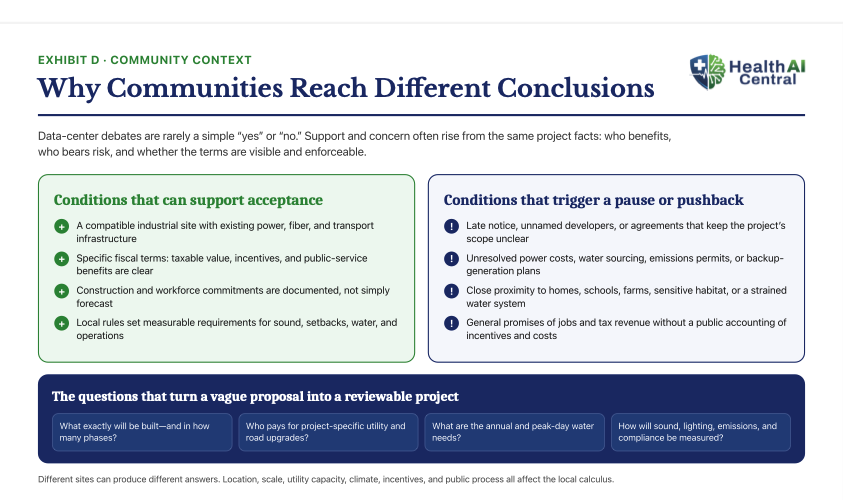
Opposition is often described as reflexive, anti-growth or anti-technology sentiment. The local reporting tells a more precise story. Residents tend to react most strongly when they believe the project was disclosed late, the developer is unclear, a zoning category treats a hyperscale facility like an ordinary office building, or the burdens are close and the public return is distal or vague.
In Chesapeake, Virginia, National Public Radio (NPR) and WHRO (a local public radio station) reported that residents opposed a proposed data center near homes because of potential round-the-clock cooling noise, water use, pollution, and the project’s proximity to a water retention pond. The developer argued that tax revenues would benefit the city and that the project could capitalize on regional fiber investments. City Council ultimately voted unanimously to block it.¹⁶ The key lesson is not that public opposition will always prevail--it's that site proximity, notice, and enforceable operating commitments change the conversation.
In New Jersey, the state Economic Development Authority has created a technical-assistance hub that explicitly directs municipalities to assess grid and interconnection filings, peak-day water demand, fiscal assumptions, fire protection readiness, air permitting, noise, lighting, and community-benefit terms before finalizing agreements.¹⁸ This recognizes that small municipal planning offices may not have an in-house power engineer, hydrologist, acoustician, and tax analyst--key technical expertise needed for thoughtful deliberation and planning.
New Jersey’s Vineland dispute illustrates the cost of discovering key facts late in the process. New Jersey Monthly reported that a 2.6-million-square-foot DataOne campus began operating while still expanding, with 300 MW of power capacity and a history of limited public awareness. The magazine also reported a state environmental enforcement action involving unpermitted natural-gas generators and subsequent local lawsuits over noise.¹⁹ Those specific allegations and enforcement matters should be judged through their proper legal channels. However, the broader lesson is clear: communities should not need viral videos or a permit controversy to learn how a facility is powered, cooled, or monitored.
Pennsylvania has become a test case for statewide guardrails combined with local control. Spotlight PA reported that Hampden Township commissioners rejected a proposal to permit data centers in office park zones after resident opposition; a developer also withdrew a Blakely proposal after protests.²⁰ Later, Pennsylvania’s governor issued requirements conditioning state permitting and tax-exemption eligibility on local approval, power-infrastructure cost commitments, water conservation, transparency, community engagement, and annual energy and water reporting.⁶ While those rules do not guarantee agreement in every town, they do give communities a more concrete set of documents and commitments against which to evaluate projects.
In Florida, reporting by WUSF (the NPR affiliate in Tampa Bay) on a prospective Jackson County project showed how lack of information can be as consequential as a disclosed engineering plan. Residents worried about groundwater and creek conditions, while county officials said documents initially associated with solar or battery storage might involve a large data center. Commissioners adopted a one-year moratorium to study the proposal and await a state law concerning power-infrastructure costs, water protections, and local siting authority.²¹ Florida planning guidance similarly emphasizes local decision-making, clear standards, full information, and an open process rather than a blanket pro- or anti-development position.²²
Utah’s Stratos proposal, associated with investor Kevin O’Leary, is an unusually visible example of how process can become the story. The proposal initially involved a 40,000-acre project area in Box Elder County and could require several gigawatts of power. Reporting by The Verge documented rapid approvals, large public meetings, a referendum effort, a later reduction in the project area, and continuing uncertainty about key agreements and tenants.²³ Other subsequent reporting focused on the unanswered design questions: water volumes, emissions, final electricity demand, and the actual significance of a reduced land footprint before the project’s design is fixed.²⁵ The Salt Lake Tribune reported that Governor Spencer Cox acknowledged the project’s rollout “was not good.”²⁴ The appropriate conclusion is not to pre-judge Stratos; it is that the project’s scale, public process, tax structure, resource commitments, and ability to answer basic questions can determine whether it becomes a planning case study or a trust crisis.
Moratoria have become an increasingly common response in local communities; however, they are often better understood as a planning tool than as a final verdict. In Georgia, local officials used moratoria to first determine how data centers should fit into zoning codes that did not previously define the use. The ensuing ordinances varied: some required closed-loop water systems, others adopted buffer and sound conditions, and some classified projects by floor area or power demand.¹⁴ In Tennessee, McMinnville’s 18-month moratorium was framed around time to study grid capacity, water and stormwater, environmental and public-health issues, noise, and community fit.⁵ In Ohio, the Capital Journal reported that communities have considered developer-funded third-party reports, power caps, setbacks, sound limits, proof of utility agreements, and public performance dashboards.¹⁷ Moratoria can provide time for communities to understand the issues and create regulatory frameworks that govern the important and impactful relationships between AI data centers and their new neighbors.
Technology Can Reduce Impacts, But it Does Not Eliminate the Trade-offs
The data center industry is not standing still. AI’s thermal density has pushed developers toward designs that are more efficient (i.e., more compute per unit of electricity, water, and floor space). Many of the most useful improvements are not glamorous, but are necessary: improved airflow, containment, better controls, higher allowable temperatures, efficient pumps, right-sized equipment, and real-time monitoring.
Direct-to-chip liquid cooling is more consequential. Capturing heat close to the processor reduces the amount of fan energy and air movement needed at the rack. If it is paired with warm water operation and dry heat rejection, it can sharply lower or nearly eliminate on-site evaporative water use in suitable climates.³ If it is paired with cooling towers, it may still save energy and water compared with a conventional room-air design, but will not eliminate the need for water. The engineering question is not whether a project says it uses “liquid cooling.” It is what comes after the liquid leaves the rack.
Hybrid systems can switch between dry cooling and limited evaporative or adiabatic support during the hottest periods. Reclaimed wastewater can reduce competition for potable water. Thermal storage can shift some cooling demand to lower-cost or lower-stress hours. Batteries can provide immediate short-duration backup, reduce reliance on generator starts for brief outages, and in some configurations help a facility respond to grid stress. None of these technologies is costless, universal, or necessarily appropriate for every climate. They are design options that require transparent performance data.
Noise can also be engineered down. Equipment selection, low-noise fans, acoustic enclosures, silenced intakes and exhausts, interior placement of mechanical systems, rooftop screening, sound walls, and setbacks all make a difference. Facilities should model sound before construction and measure it after commissioning, especially at the nearest sensitive receptors. The same discipline applies to light: fixture selection, shielded lighting, curfews where feasible, and verification of spillover can prevent an industrial campus from changing a neighboring community’s nighttime environment.
Power systems are changing as well. DOE is supporting development of more efficient cooling, water-reuse approaches, demand flexibility, storage, grid upgrades, and other resources intended to manage large loads.²⁶ The policy relevance is straightforward: an operator’s ability to reduce demand during grid stress, procure or build additional supply, and fund required delivery infrastructure may matter as much as the total megawatt usage in a project announcement.
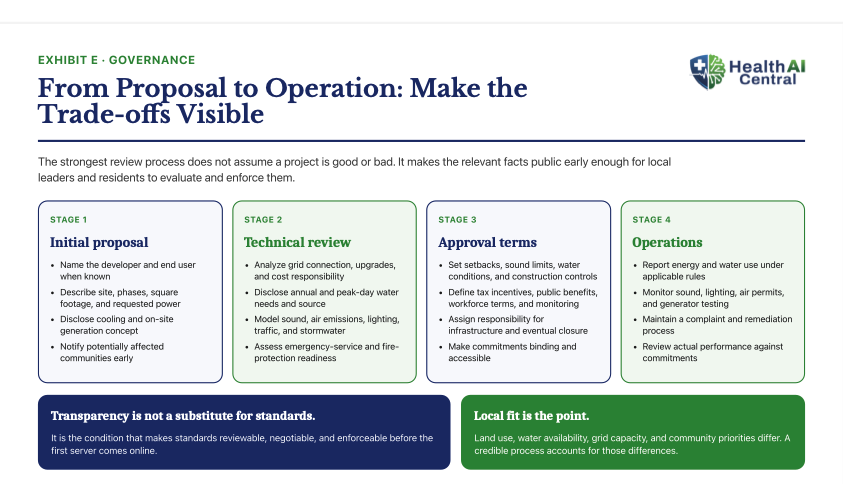
Transparency about honest, real-world impacts is a mitigation tool in its own right. At a minimum, communities need to know the expected power draw; utility interconnection plan; on-site generation and fuel strategy; annual and peak-day water need and source; cooling technology; sound study; air permits; site plan; phases and buildout assumptions; tax incentives; permanent and construction employment estimates; public-service demands; and decommissioning or restoration responsibilities. Testing must be conducted in real-world scenarios that are important to residents:
Include "rush hour" and seasonal surges in traffic analysis, not just during low peak times.
Conduct sound testing across 24 hours and when other industrial areas are active, not just during quiet hours. Include areas with minimal obstruction where sound carries further.
Assess light impact across the entire community, not just at the edge of the property line.
What Healthcare Leaders Should Take From the Debate
Healthcare is not a bystander to the AI infrastructure buildout. Hospitals and health tech companies are increasingly consumers of cloud and AI capacity, and their patients benefit when critical digital systems are accurate and reliable. At the same time, health organizations have longstanding commitments to community health, emergency preparedness, environmental stewardship, and public trust.
That does not mean a hospital should decide whether a local data center is approved--that is up to the community. It does mean, however, that health-system leaders can be sophisticated customers and credible participants. When assessing an AI or cloud relationship, they can ask where high priority workloads are hosted, how resilience is achieved, what backup power approach is used, how the provider manages heat and water, and whether the provider discloses relevant sustainability metrics. For facilities teams, the conversation may also include competition for skilled electricians, grid upgrades, and local utility capacity.
Clinicians can bring a useful habit of mind: distinguish a plausible concern from a demonstrated exposure, and distinguish an average measure from the risk in a particular setting. A water use number without a source, season, or local water balance context is incomplete. A generator count without expected operating hours and permit conditions is incomplete. A jobs claim without differentiating construction from permanent work is incomplete. A tax revenue claim without the incentive agreement and infrastructure costs is incomplete.
For communities, the same discipline is a path away from false choices and towards informed decision-making. Data centers may support valuable services and create tangible local revenue. They may also impose costs that are easy to overlook when approval moves quickly. The projects most likely to earn durable acceptance are not those that ask residents to ignore those trade-offs. They are the ones that define them, price them, mitigate them, monitor them, and make commitments enforceable before the first server comes online.
References
U.S. Department of Energy. Domestic Energy Usage from Data Centers Expected to Double or Triple by 2028. Published December 20, 2024. https://www.energy.gov/articles/doe-releases-new-report-evaluating-increase-electricity-demand-data-centers
World Resources Institute. From Energy Use to Air Quality, the Many Ways Data Centers Affect US Communities. Published February 17, 2026. https://www.wri.org/insights/us-data-center-growth-impacts
ASHRAE. AI Data Center: Integrated Design Principles. Accessed October 12, 2026. https://www.ashrae.org/technical-resources/topics-and-initiatives/ai-data-center/integrated-design-principles
Congressional Research Service. Data Centers and Their Energy Consumption: Frequently Asked Questions. Updated May 12, 2026. https://www.congress.gov/crs-product/R48646
Tennessee Lookout. Local Tennessee Officials Are Putting Data Center Plans on Ice to Consider Regulations. Published June 15, 2026. https://tennesseelookout.com/2026/06/15/local-tennessee-officials-are-putting-data-center-plans-on-ice-to-consider-regulations/
Office of the Governor of Pennsylvania. Governor Shapiro Signs Executive Order on Data Center Development. Published August 18, 2026. https://www.pa.gov/governor/newsroom/2026-press-releases/governor-shapiro-signs-executive-order-on-data-center-developmen
Congressional Research Service. Data Centers and Water: Frequently Asked Questions. Updated July 31, 2026. https://www.congress.gov/crs-product/R49057
U.S. Department of Energy Federal Energy Management Program. Cooling Water Efficiency Opportunities for Federal Data Centers. Published January 9, 2019. https://www.energy.gov/cmei/femp/cooling-water-efficiency-opportunities-federal-data-centers
Environmental and Energy Study Institute. Communities Are Raising Noise Pollution Concerns About Data Centers. Published March 23, 2026. https://www.eesi.org/articles/view/communities-are-raising-noise-pollution-concernsabout-data-centers
U.S. Environmental Protection Agency. Clean Air Act Resources for Data Centers. Accessed October 12, 2026. https://www.epa.gov/stationary-sources-air-pollution/clean-air-act-resources-data-centers
Inside Climate News. Data Centers’ Use of Diesel Generators for Backup Power Raises Concerns. Published November 12, 2025. https://insideclimatenews.org/news/12112025/data-center-diesel-generators-noise-pollution/
New Jersey 101.5. NJ Neighbors Furious as Giant AI Data Center Hums 24/7—and That’s Not All. Published March 12, 2026. https://nj1015.com/vineland-nj-data-center-concerns/
Brookings Institution. New Evidence on Data Center Employment Effects. Published May 4, 2026. https://www.brookings.edu/articles/new-evidence-on-data-center-employment-effects/
Hunter K. A “Wave” of Data Center Ordinances Sweep Through GA Counties: How Strict Are They? Georgia Public Broadcasting and Ledger-Enquirer. Published October 22, 2025. https://www.gpb.org/news/2025/10/22/wave-of-data-center-ordinances-sweep-through-ga-counties-how-strict-are-they
Loudoun County, Virginia. Data Centers: The Loudoun Story. Accessed October 12, 2026. https://www.loudoun.gov/6408/Data-Centers-The-Loudoun-Story
Murphy R. Why More Residents Are Saying “No” to AI Data Centers in Their Backyard. NPR and WHRO. Published July 17, 2025. https://www.npr.org/2025/07/17/nx-s1-5469933/virginia-data-centers-residents-saying-no
Ohio Capital Journal. Ohio Now Has Over 125 Active Moratoriums on Data Centers. Published September 18, 2026. https://ohiocapitaljournal.com/2026/09/18/ohio-now-has-over-125-active-moratoriums-on-data-centers-see-where-they-are/
New Jersey Economic Development Authority. Data Center Municipal Resource Hub. Accessed October 12, 2026. https://www.njeda.gov/datacenterta/
New Jersey Monthly. New Jersey’s AI Data Center Boom Sparks Pushback From Residents. Published September 23, 2026. https://njmonthly.com/articles/news/new-jerseys-ai-data-center-boom-sparks-pushback-from-residents/
Spotlight PA. Pennsylvania Data Centers Face Community Opposition. Published October 17, 2025. https://www.spotlightpa.org/news/2025/10/pennsylvania-data-centers-community-opposition-ai-development-environment/
WUSF. A Potential AI Data Center Sparks Debate in Jackson County. Published June 5, 2026. https://www.wusf.org/environment/2026-06-05/a-potential-ai-data-center-sparks-debate-in-jackson-county
1000 Friends of Florida. Planning for Data Centers in Florida: Tools for Informed Local Decisions. Accessed October 12, 2026. https://1000fof.org/priorities/planning-for-data-centers-in-florida/
The Verge. The People of Utah vs. Kevin O’Leary. Published October 1, 2026. https://www.theverge.com/cs/features/993343/stratos-utah-kevin-oleary-data-center-backlash
Carlisle N. Rollout of Controversial Box Elder Data Center Project “Was Not Good,” Gov. Cox Says. The Salt Lake Tribune. Published May 21, 2026. https://www.sltrib.com/news/environment/2026/05/21/utah-gov-spencer-cox-says-rollout/
KSL.com. Utah’s Stratos Project Draws Warnings From Virginia’s “Data Center Alley.” Published July 8, 2026. https://www.ksl.com/article/51595304/data-center-alley
U.S. Department of Energy. Powering America’s AI Future—Data Center Resource Hub. Accessed October 12, 2026. https://www.energy.gov/powering-americas-ai-future-data-center-resource-hub
Reporting & accountability
How we maintain accuracy
Health AI Central separates reported facts, analysis, and public-source data. Readers can review our standards, request a correction, or consult the relevant research methodology before relying on a claim.