

Ten Minutes to Diagnosis: AI System Slashes Sleep Apnea Testing Time While Outperforming Existing Models by 18%
New framework validated across 35,000 patients achieves over 91% accuracy using brief physiological recordings, potentially transforming access to obstructive sleep apnea screening.
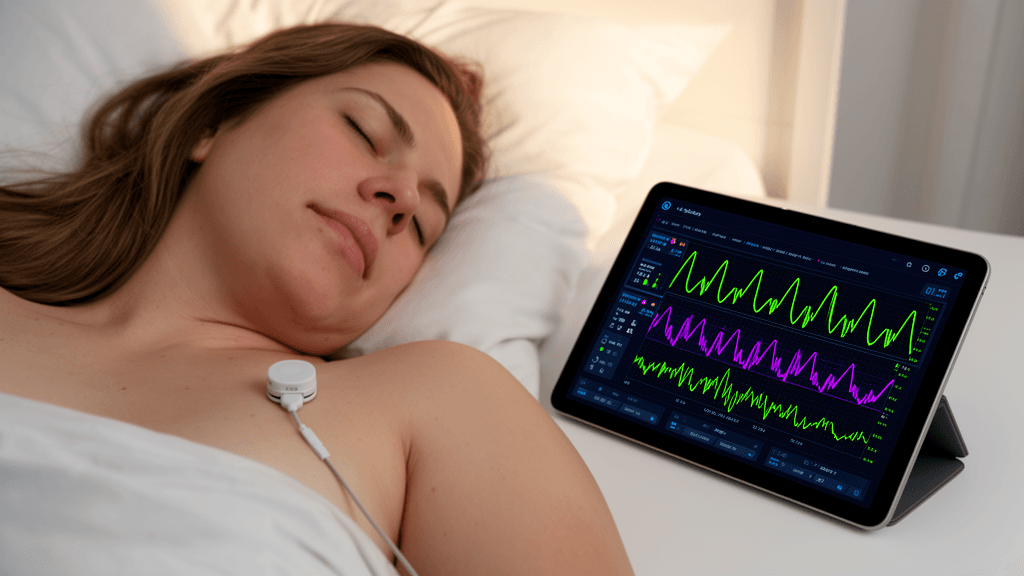
Obstructive sleep apnea affects millions worldwide, but diagnosing it remains a logistical challenge. The gold standard—full-night polysomnography in a sleep lab—is laborious, expensive, and operationally complex. Now, researchers have developed an AI framework that can predict OSA severity from just 10 minutes of physiological data, achieving accuracy rates that surpass existing state-of-the-art models by up to 18%.
The Long-Range Interdependencies Aware (LRIA) framework, published in Nature Communications, was validated across five diverse cohorts totaling over 35,000 subjects. According to the study, the system achieved AUROC values exceeding 0.91 across all datasets, with performance reaching 95% in the Sleep Heart Health Study cohort—a 13-percentage-point improvement over the existing SleepFM model.
How the Technology Works
The LRIA framework takes a fundamentally different approach to analyzing physiological signals. Rather than requiring hours of overnight data, it uses fractional dynamic modeling to extract coupling matrices that represent spatial relationships between different physiological processes. These coupling matrices stabilize after approximately 10 minutes of recording, as validated through Wasserstein distance analysis.
The system employs an Expectation-Maximization algorithm that converges within 5-10 iterations to separate genuine physiological dynamics from noise. Some configurations integrate these coupling matrices with raw signal data using a Two-Tower Transformer architecture, classifying OSA into four severity categories: normal, mild, moderate, and severe.
Validated Performance Across Diverse Populations
The framework's robustness was demonstrated across multiple cohorts representing different demographics and clinical settings. In the Multi-Ethnic Study of Atherosclerosis (MESA) dataset, LRIA achieved 94% AUROC, 88% accuracy, 87% sensitivity, and 89% specificity. The system maintained 92% AUROC in both the elderly Osteoporotic Fractures in Men Sleep Study (MrOS) and the hospital-based Massachusetts General Hospital (MGH) cohort.
Performance advantages over existing models were particularly striking in challenging clinical populations. In the MrOS and MGH datasets, LRIA outperformed SleepFM by up to 18% in AUROC. The framework also consistently exceeded the Informer model across all validated datasets, and outperformed baseline architectures including DNN, CNN, CNN-LSTM, and STFT-CNN in the Western Romanian clinical cohort.
Clinical Implications and Limitations
The researchers acknowledge important limitations. Short-window analysis does not substitute for full-night PSG in detecting REM- or position-dependent OSA, and the system does not differentiate between obstructive and central apnea subtypes. It also does not address less common sleep-disordered breathing forms such as hypoventilation syndromes, and night-to-night variability is not fully resolved by within-night analysis.
Future validation in cohorts with higher proportions of non-OSA subjects is needed, along with stratified analyses across demographic subgroups and integration studies within clinical workflows.
Despite these limitations, the technology could transform OSA screening by reducing diagnostic burden and enabling more accessible testing in primary care or home settings. The 10-minute requirement, combined with computational efficiency and strong performance across diverse populations, positions LRIA as a potential screening or triage tool that could identify patients who need comprehensive overnight studies while sparing others from unnecessary testing.
For health technology companies, the framework demonstrates the viability of short-duration monitoring for OSA assessment, potentially enabling next-generation wearable or home-based diagnostic devices. The significant performance margin over existing AI models and validation across heterogeneous datasets provides evidence that could support regulatory pathways and accelerate clinical adoption.
Sources
Follow Health AI Central
Keep up with health AI where you already read
On LinkedIn
The day’s strongest health AI stories in your feed, one or two each weekday.
On Google
Choose Health AI Central as a preferred source, and Google is more likely to show our reporting in Top Stories.
Reporting & accountability
How we maintain accuracy
Health AI Central separates reported facts, analysis, and public-source data. Readers can review our standards, request a correction, or consult the relevant research methodology before relying on a claim.