

AI Framework Achieves Near-Perfect Accuracy in Alzheimer's Detection by Fusing Brain Scans and Clinical Data
New DIABLO multimodal approach reaches 99.2% accuracy distinguishing Alzheimer's from other conditions, outperforming single-imaging methods by wide margin.
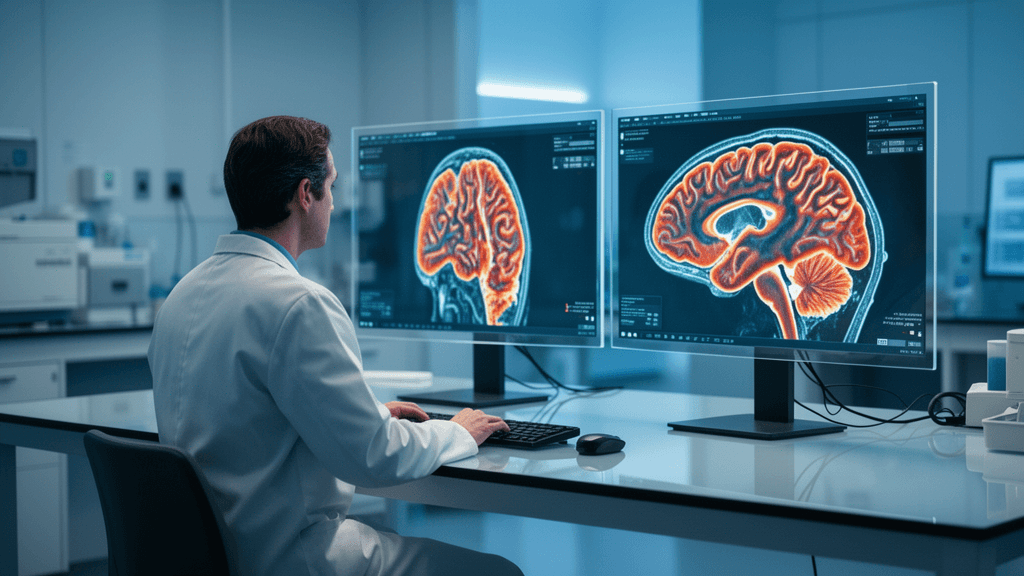
Researchers have unveiled a sophisticated artificial intelligence framework that integrates multiple types of brain imaging with clinical information to classify Alzheimer's disease with unprecedented accuracy, according to a study published in Translational Psychiatry. The approach, called DIABLO (multiblock partial least squares discriminant analysis), achieved 99.2% accuracy in distinguishing Alzheimer's disease from non-AD cases and 93.4% accuracy in separating cognitively normal individuals from those with mild cognitive impairment—a critical early detection challenge where conventional methods often struggle.
The framework addresses a fundamental limitation in current neuroimaging AI: most systems analyze brain scans in isolation or simply concatenate different data types, missing deeper biological relationships between imaging modalities and clinical markers. By contrast, DIABLO performs feature-level fusion that captures complementary signals across structural MRI, functional MRI, and clinical data.
Hierarchical Classification Mirrors Clinical Practice
The research team, led by Cui, Mou, Xiao, Qin, Chen, and Yu, designed their system to follow the diagnostic pathways clinicians actually use in practice. Rather than attempting to classify all disease stages simultaneously, the hierarchical approach evaluates patients through sequential decision points—first distinguishing Alzheimer's disease from other conditions, then differentiating between normal cognition and mild cognitive impairment.
The study validated the framework on 872 participants from the Alzheimer's Disease Neuroimaging Initiative (ADNI) dataset, including 443 cognitively normal controls, 300 individuals with mild cognitive impairment, and 129 with Alzheimer's disease. The researchers tested three different diagnostic sequences and compared DIABLO against traditional kernel principal component analysis fusion methods and single-modality approaches.
The performance gap proved substantial: while single-modal functional MRI achieved an AUC of 0.797 for distinguishing normal cognition from MCI, the three-modal DIABLO fusion reached an AUC of 0.934 for the same task. For AD versus non-AD classification, DIABLO achieved an AUC of 0.992.
Clinical Deployment Requires Further Validation
The framework's ability to accurately identify mild cognitive impairment represents a particularly meaningful advance, as this early stage of cognitive decline offers the greatest window for therapeutic intervention. Current diagnostic methods often struggle to reliably detect MCI, leading to delayed treatment and missed opportunities for disease-modifying therapies.
However, the authors emphasize that validation in larger, more diverse patient populations is required before clinical deployment. The ADNI dataset, while widely used in Alzheimer's research, represents a relatively homogeneous research cohort that may not reflect the full spectrum of patients seen in real-world clinical settings.
Implications for Neuroimaging AI Market
For health AI companies developing neuroimaging solutions, the study demonstrates the commercial and clinical advantages of sophisticated multimodal fusion architectures over simpler approaches. The DIABLO framework's feature-level integration methodology—which extracts complementary biological signals rather than merely combining raw data—suggests a technical direction for next-generation diagnostic tools.
The hierarchical classification structure also aligns with established clinical workflows, potentially easing regulatory pathways and clinical adoption. As the neuroimaging AI market expands, solutions that mirror physician decision-making processes while delivering measurably superior accuracy may gain competitive advantage in both regulatory approval and market acceptance.
Sources
Follow Health AI Central
Keep up with health AI where you already read
On LinkedIn
The day’s strongest health AI stories in your feed, one or two each weekday.
On Google
Choose Health AI Central as a preferred source, and Google is more likely to show our reporting in Top Stories.
Reporting & accountability
How we maintain accuracy
Health AI Central separates reported facts, analysis, and public-source data. Readers can review our standards, request a correction, or consult the relevant research methodology before relying on a claim.