

Paralyzed Man Regains Hand Function Through AI-Powered Brain Implant That Rewires the Nervous System
A groundbreaking \"double neural bypass\" combining brain-computer interface technology with spinal stimulation restored movement and sensation in complete tetraplegia, with improvements persisting even when the device is turned off.
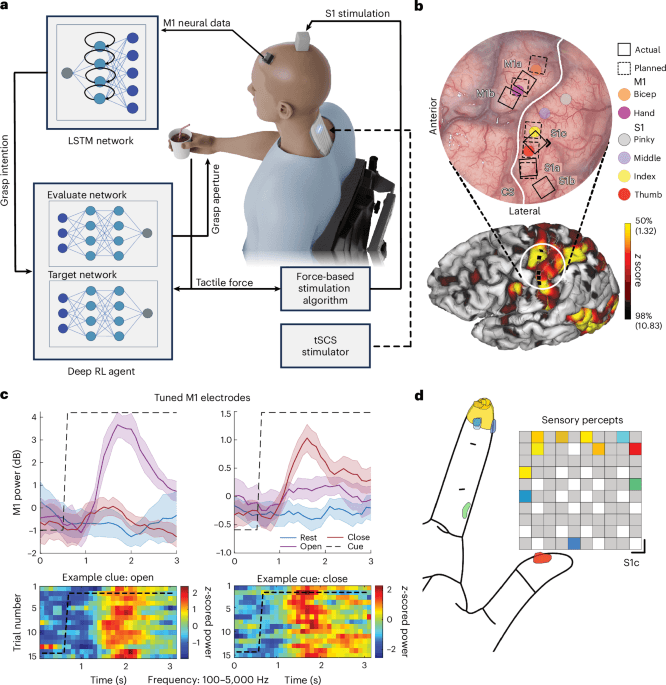
In a medical first that challenges long-held assumptions about spinal cord injury recovery, researchers have enabled a 45-year-old man with complete tetraplegia to feed himself and manipulate objects using a hybrid neuroprosthesis that bridges his brain directly to his paralyzed muscles. The breakthrough system doesn't just provide temporary assistance—it appears to rewire the nervous system itself, with functional gains persisting even when the technology is switched off.
The participant, who suffered complete C5 tetraplegia from a surfing accident, enrolled in the clinical trial 9 months after his injury. Over three years of treatment with the "double neural bypass" (DNB) system, he experienced an 86% increase in right elbow flexion force and regained the ability to perform tasks that directly impact independence and quality of life.
From Assistive Device to Therapeutic Intervention
What distinguishes this neuroprosthesis from previous brain-computer interfaces is its dual approach to restoring function. The system combines microelectrode arrays implanted in both the motor and sensory regions of the brain with transcutaneous spinal cord stimulation delivered through a custom electrode patch targeting the C5-C8 spinal nerve roots.
The motor cortex arrays decode the participant's movement intentions using long short-term memory (LSTM) neural networks and deep reinforcement learning algorithms, while arrays in the somatosensory cortex deliver tactile feedback through intracortical microstimulation. This bidirectional communication restored not just movement commands but also the sensation of touch localized to specific fingers.
The research team from Northwell Health's Feinstein Institutes for Medical Research, Johns Hopkins Applied Physics Laboratory, and collaborating institutions used advanced fMRI imaging and Human Connectome Project cortical mapping to precisely target implantation sites before surgery—a level of precision that proved critical to the system's success.
Neuroplasticity: The Game-Changing Discovery
Perhaps most remarkable is what happened when researchers turned the system off. Unlike purely assistive devices that only work when activated, the DNB system promoted lasting neurological recovery. By pairing brain activity patterns with targeted spinal stimulation during training sessions, the system appears to have strengthened dormant neural pathways.
Within 15 weeks of combined brain-computer interface and spinal stimulation therapy, the participant showed a 61% increase in right elbow flexion force and 25% increase on the left—gains that continued growing to 86% and 62% respectively by week 35. Critically, a baseline period before intervention confirmed these improvements weren't due to spontaneous recovery, which is exceedingly rare in complete spinal cord injuries.
The spinal stimulation component, delivered at 50 Hz frequencies during motor training, proved sufficient to drive significant motor recovery even before the brain-computer interface was fully integrated.
Implications for Clinical Practice
This first-in-human demonstration validates a fundamentally different approach to neuroprosthetics—one that treats the technology not as a permanent assistive device but as a therapeutic intervention that could eventually be reduced or discontinued as natural function returns. For the estimated 5.4 million people in the United States living with paralysis, this represents a clinically proven path to regaining upper limb function in complete high-level tetraplegia.
The successful integration of multiple AI architectures with bidirectional brain-computer interfaces and neuromodulation suggests that hybrid platforms may offer advantages over single-modality approaches. The findings also raise questions about optimal timing for intervention, as the participant was enrolled relatively soon after injury—potentially opening a therapeutic window that current rehabilitation protocols don't exploit.
For healthcare systems, the persistent functional gains even with the device deactivated could shift the cost-benefit analysis of these expensive interventions from assistive devices requiring lifelong maintenance to therapeutic interventions that promote durable recovery.
Sources
Reporting & accountability
How we maintain accuracy
Health AI Central separates reported facts, analysis, and public-source data. Readers can review our standards, request a correction, or consult the relevant research methodology before relying on a claim.