
Compact AI Models Prove Just as Accurate as Heavyweight Rivals in Stroke Detection
Chinese researchers demonstrate that a neural network 7.7 times smaller than standard models achieves identical diagnostic performance while running nearly 10 times faster on bedside computers.
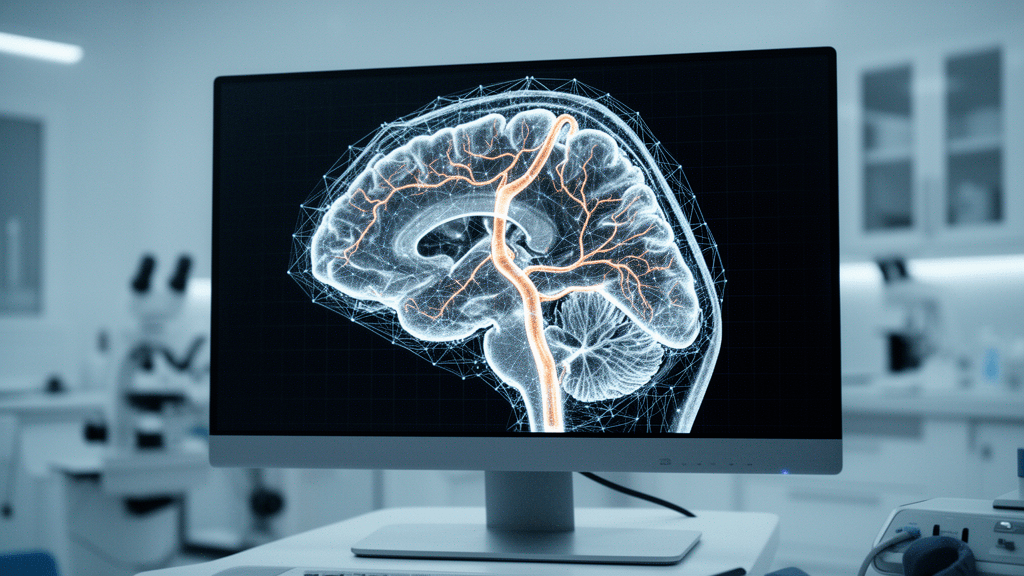
The medical AI community's assumption that bigger models deliver better clinical results has been challenged by new research from China showing that lightweight neural networks can match the diagnostic accuracy of their heavyweight counterparts while operating dramatically faster on standard hospital hardware.
A retrospective study from Central Hospital Affiliated to Shenyang Medical College analyzed 1,835 transcranial Doppler ultrasound images to detect middle cerebral artery stenosis—a leading cause of stroke in Asian populations. The research compared four neural network architectures ranging from 3.10 million to 23.77 million parameters, with surprising results: the smallest model, MobileNetV3-Large, achieved statistically identical performance to models 7.7 times larger.
Lightweight Champion Outpaces Heavyweight Rivals
MobileNetV3-Large delivered an area under the curve (AUC) of 0.9999 and 99.48% accuracy on the 194-image held-out test set, making only one false positive and zero false negatives. By comparison, the much larger ResNet50 model—with 23.77 million parameters and requiring 91.0 MB of storage—achieved 98.45% accuracy with an AUC of 0.9996.
Statistical testing using 2,000-iteration stratified percentile bootstrap confirmed no significant differences in diagnostic performance across all four architectures tested. The models analyzed transcranial Doppler spectral images acquired between 2024 and 2025 using a Delica EMS-9 pulsed-wave system, with stenosis defined as 50% or greater lumen reduction confirmed by radiologist consensus using MRA, CTA, or DSA imaging.
The computational advantage proved even more striking than the equivalent accuracy. MobileNetV3-Large completed inference in just 9.10 milliseconds under single-threaded CPU conditions—9.5 times faster than ResNet50's 86.42 milliseconds. The compact model's 12.0 MB checkpoint size makes it deployable on tablets, mobile ultrasound carts, and resource-limited clinical settings without GPU acceleration or cloud connectivity.
Efficiency Trumps Complexity in Real-World Deployment
The research team employed identical training protocols across all models, including stratified 5-fold cross-validation, AdamW optimization, and aggressive data augmentation designed to prevent shortcut learning. Augmentation techniques included vertical spectral shifts, background erasure, and top-region cropping alongside standard transformations like random downscaling and Gaussian blur.
One unexpected finding challenged conventional wisdom about computational efficiency: EfficientNetV2-S required 30% fewer floating-point operations than ResNet50 but ran 1.8 times slower due to memory bandwidth bottlenecks created by depthwise separable convolutions. This discrepancy highlights that theoretical computational savings don't always translate to real-world speed improvements.
The study focused on middle cerebral artery stenosis detection because this represents the most frequent intracranial narrowing site in Asian populations. Traditional transcranial Doppler interpretation remains operator-dependent with high waveform variability, making AI-assisted screening particularly valuable for standardizing diagnostic quality.
Implications for Clinical AI Strategy
These findings establish a new evaluation framework for medical AI deployment that prioritizes practical implementation factors over marginal discrimination improvements. For stroke screening programs, the research demonstrates that real-time AI interpretation can run on standard bedside computers without sacrificing diagnostic accuracy, eliminating infrastructure barriers that have limited point-of-care AI adoption.
The work suggests that medical AI product development should emphasize inference speed, model size, hardware compatibility, and deployment feasibility rather than pursuing diminishing returns in AUC metrics. This approach proves particularly relevant for emergency departments, ambulances, and rural clinics where GPU infrastructure remains unavailable and every minute of diagnostic delay increases patient disability risk.
By proving that "smaller is sufficient" for transcranial Doppler stroke screening, the Shenyang Medical College team has challenged the field's bias toward ever-larger models and established computational efficiency as a primary selection criterion for bedside diagnostic AI.
Sources
Follow Health AI Central
Keep up with health AI where you already read
On LinkedIn
The day’s strongest health AI stories in your feed, one or two each weekday.
On Google
Choose Health AI Central as a preferred source, and Google is more likely to show our reporting in Top Stories.
Reporting & accountability
How we maintain accuracy
Health AI Central separates reported facts, analysis, and public-source data. Readers can review our standards, request a correction, or consult the relevant research methodology before relying on a claim.