

Privacy-Preserving AI Reads Mammograms Across Hospital Networks Without Sharing Patient Data
New federated learning framework achieves 91.9% accuracy in breast cancer classification while keeping medical images locked inside each institution's firewall.
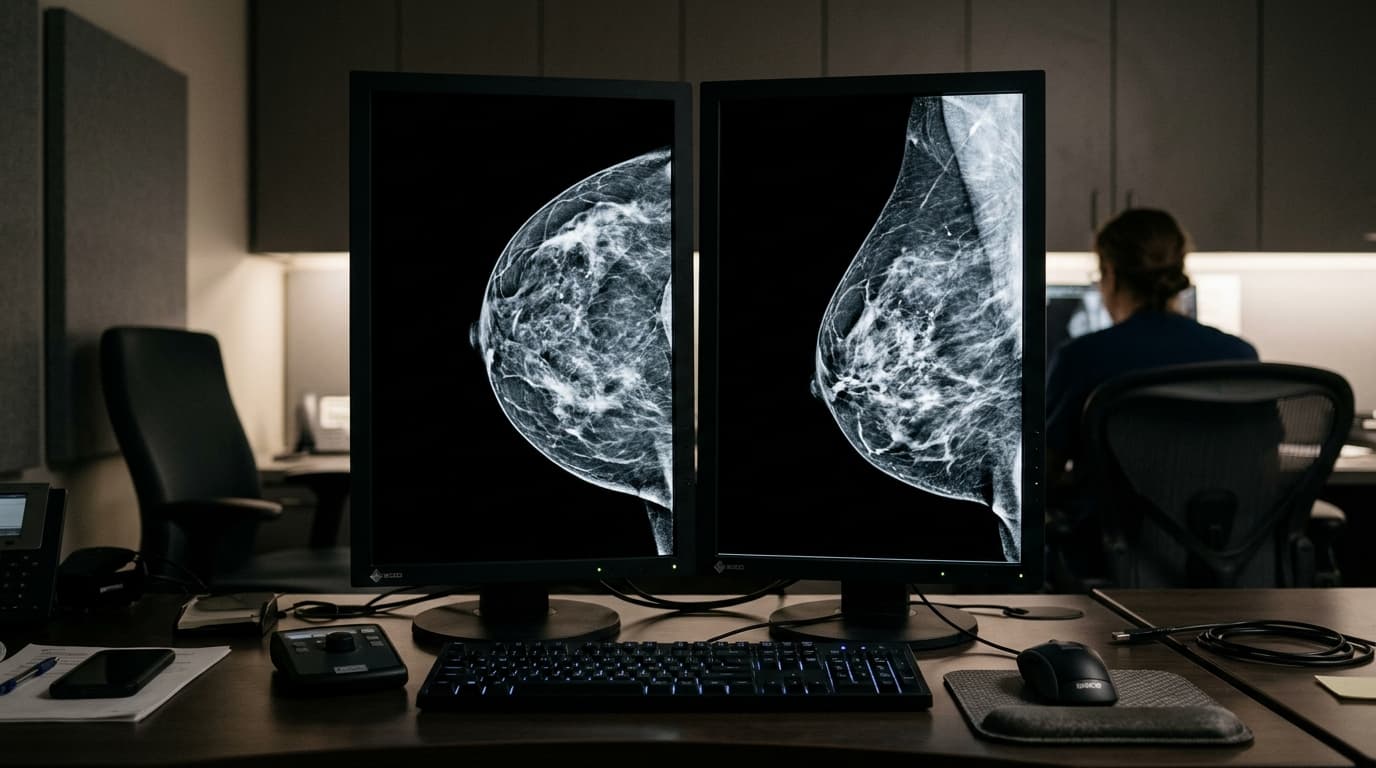
A research team has unveiled a decentralized artificial intelligence system that enables hospitals to collaboratively train breast cancer detection models without ever pooling patient mammograms in a central database. The DDan framework, published in Discover Artificial Intelligence, achieved 91.9% diagnostic accuracy on validation data while addressing three critical challenges: varying imaging equipment across institutions, data heterogeneity, and stringent patient privacy regulations.
Federated Learning Meets Domain Adaptation
The DDan architecture combines DenseNet-121 feature extraction with domain-adversarial training and the Federated Averaging (FedAvg) algorithm across decentralized nodes. According to the research, this approach allows multiple medical centers to jointly improve a shared diagnostic model while each institution's mammography data remains on local servers, never transmitted or centralized.
On the INbreast validation dataset, the system demonstrated 91.9% accuracy, 91.5% precision, 91.4% recall, and 91.4% F1-score. Statistical analysis across 10 independent runs with 10,000 bootstrap resamples established a 95% confidence interval of 91.61%–92.19%. The framework significantly outperformed alternative approaches, with p-values of 1.24×10⁻⁶ versus standard convolutional neural networks, 3.87×10⁻⁴ versus basic federated learning, and 2.16×10⁻² versus standalone domain-adversarial models.
The training configuration involved 10 global communication rounds, 5 local epochs per round, and batch size 32 using horizontal federated learning. Researchers trained the system on CBIS-DDSM data (1,696 patients: 1,187 training, 254 validation, 255 test) and INbreast data (115 patients, 410 images split 70% adaptation/30% validation), with patient-level partitioning to prevent data leakage.
The Privacy-Performance Tradeoff
While DDan's federated approach preserved institutional data sovereignty, it came with a modest accuracy penalty. A centralized DenseNet-121 with domain-adversarial neural network (DANN) achieved 93.8% accuracy—a 1.9 percentage point advantage over the federated implementation. More significantly, when tested on completely unseen external datasets, DDan's accuracy dropped 6.16 percentage points, highlighting generalization limitations that the research indicates would require site-specific validation before clinical deployment.
The framework employed DenseNet-121's efficient architecture—featuring a 7×7 initial convolution, 4 dense blocks with 1×1 transition layers, and global pooling—which requires significantly fewer parameters than alternatives like VGG16 or ResNet50. Input images were standardized at 224×224 pixel resolution with preprocessing including mask removal, contrast-limited adaptive histogram equalization (CLAHE) using an 8×8 tile grid, and min-max normalization.
Data augmentation expanded Client 1's dataset from 1,187 to 5,000 images and Client 2's from 287 to 2,500 images, though validation and test sets remained unaugmented. An important technical constraint: domain classifier parameters were frozen during local training due to data sovereignty requirements, with alignment achieved through FedAvg weight aggregation across institutions.
Implications for Multi-Institutional AI
The research demonstrates that multi-institutional AI collaboration for breast cancer screening—which accounts for approximately 1 in 4 female cancer diagnoses globally—is technically feasible without violating HIPAA, GDPR, or institutional data governance policies. For healthcare providers, the 91.9% accuracy approaches clinically useful thresholds for computer-aided detection, potentially reducing radiologist workload.
However, the documented 6.16 percentage point external validation gap underscores that such AI systems require site-specific testing and should function as decision support tools under radiologist oversight rather than autonomous diagnostic systems. The framework provides a reproducible blueprint for federated medical imaging products targeting radiology networks and oncology centers that cannot centralize patient data due to regulatory or competitive constraints, with the 1.9 percentage point accuracy penalty compared to centralized training establishing realistic performance expectations for privacy-preserving architectures.
Sources
Follow Health AI Central
Keep up with health AI where you already read
On LinkedIn
The day’s strongest health AI stories in your feed, one or two each weekday.
On Google
Choose Health AI Central as a preferred source, and Google is more likely to show our reporting in Top Stories.
Reporting & accountability
How we maintain accuracy
Health AI Central separates reported facts, analysis, and public-source data. Readers can review our standards, request a correction, or consult the relevant research methodology before relying on a claim.