

General-Purpose Humanoid Robot Successfully Performs Live Surgery in Medical First
UC San Diego researchers adapted a lightweight consumer robot to remove a pig's gallbladder, challenging the dominance of expensive specialized surgical systems.
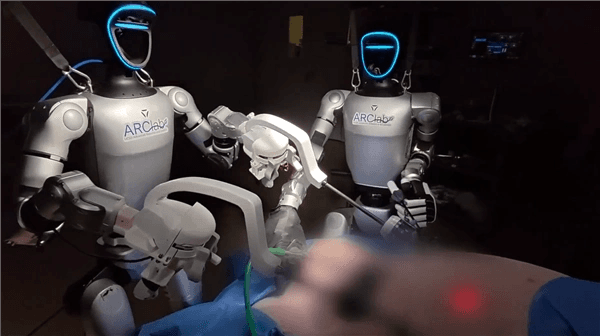
In a landmark achievement that could reshape the economics of robotic surgery, researchers at the University of California, San Diego have successfully performed a live gallbladder removal using a modified general-purpose humanoid robot. The procedure, published in Nature on July 8, 2026, marks the first time a commercially available humanoid platform has completed complex surgery on a living animal.
The research team adapted "Surge," a surgical platform based on Unitree's G1 humanoid robot, to perform laparoscopic cholecystectomy on a laboratory pig. At 27 kilograms and 150 centimeters tall, the system represents a dramatic departure from dedicated surgical robots like Intuitive Surgical's da Vinci system, which typically weighs over 800 kilograms and costs upward of $2 million.
Dual-Robot Configuration Shows Promise
The UCSD team tested two operational configurations. In the first, a single humanoid robot worked alongside a human surgical assistant to complete the procedure in 56 minutes. The second configuration deployed two robots operating in tandem under remote control, reducing surgery time to 32 minutes—a 43 percent improvement demonstrating potential for coordinated robotic surgical teams.
Surgeons controlled the humanoid robots through real-time transmission of hand movements, enabling remote operation that could prove valuable in battlefield medicine, disaster response, or telemedicine applications where transporting massive surgical systems is impractical.
Minor complications including bile leakage and liver bed bleeding occurred during the second surgery but were resolved without serious consequences, highlighting both the promise and current limitations of humanoid surgical platforms.
Significant Technical Barriers Remain
Despite the successful proof-of-concept, substantial technical hurdles must be overcome before humanoid robots can operate on human patients. The research team identified restricted range of motion, limited force output, and frequent recalibration requirements as key limitations. Most concerning, the robots experienced intermittent overheating during extended procedures—a critical safety issue requiring resolution.
Integration into sterile surgical environments also presents challenges, as general-purpose humanoid robots were not designed with the stringent contamination controls required in operating rooms. These obstacles suggest clinical deployment remains years away pending substantial engineering refinements and regulatory approval.
Potential to Democratize Surgical Access
The implications extend beyond technical achievement. Traditional surgical robots represent capital investments of hundreds of thousands to millions of dollars, limiting availability to well-funded hospitals in developed regions. Lightweight, adaptable humanoid platforms could democratize access to minimally invasive surgery by offering portable, affordable alternatives suitable for rural hospitals, military field operations, and humanitarian missions.
This "platform approach"—adapting general-purpose robots for medical applications rather than building purpose-designed systems—could accelerate development timelines and reduce research costs, potentially disrupting the specialized surgical robotics market. However, the technology must prove it can match or exceed the safety and efficacy standards established by dedicated systems before gaining widespread clinical acceptance.
The successful demonstration opens new research directions for robotic surgery while underscoring the substantial work required to translate laboratory success into clinical reality.
Sources
Companies in this article

Reporting & accountability
How we maintain accuracy
Health AI Central separates reported facts, analysis, and public-source data. Readers can review our standards, request a correction, or consult the relevant research methodology before relying on a claim.