

Body Composition Emerges as Missing Link in AI-Powered Gastric Cancer Treatment Predictions
Multicenter study shows machine learning model combining CT tumor features with muscle and fat measurements achieves 86-88% accuracy in forecasting chemotherapy response, outperforming tumor-only approaches.
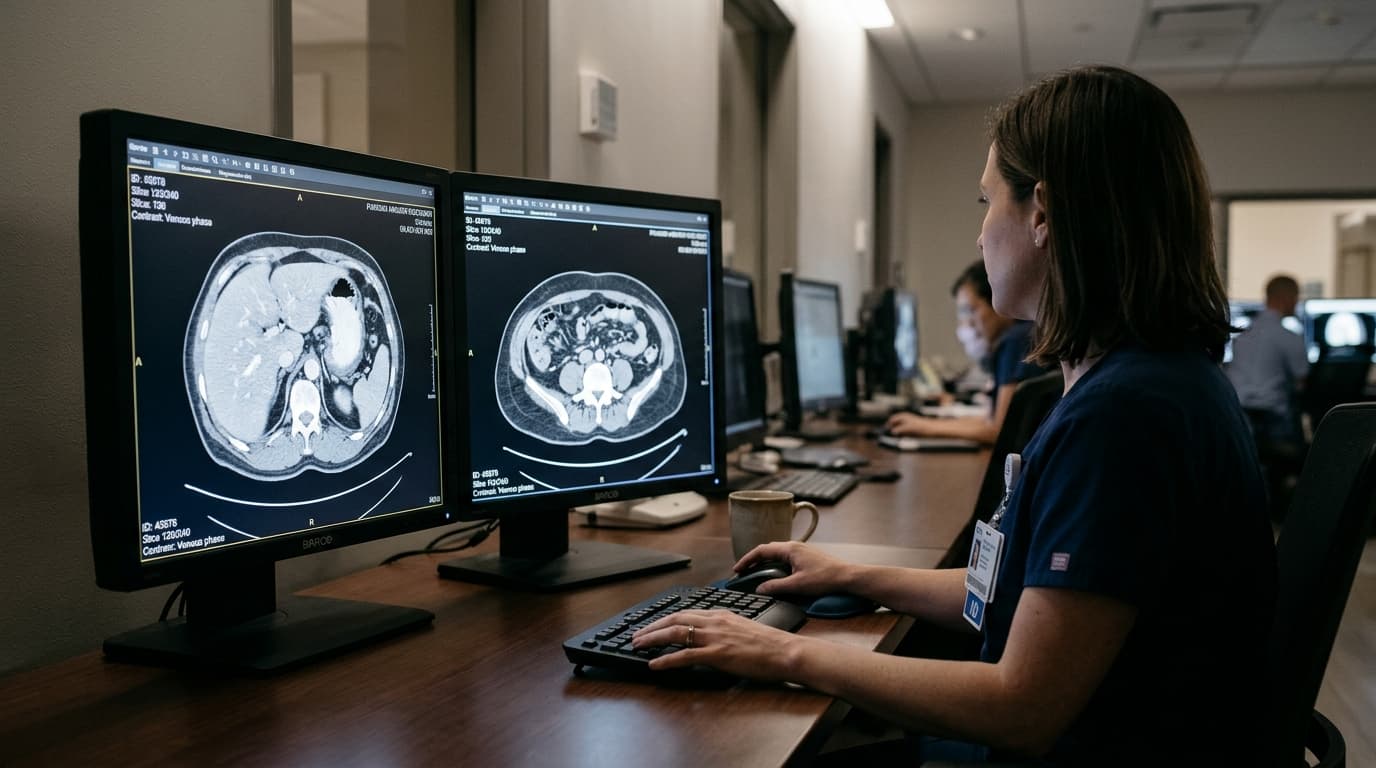
Gastric cancer treatment decisions may soon benefit from an overlooked imaging biomarker hiding in plain sight on routine CT scans. A multicenter study published in BMC Medicine reports that NeoGEM—a machine learning model integrating tumor characteristics with body composition measurements—predicted neoadjuvant chemotherapy response with area-under-curve (AUC) scores of 0.859–0.888 across multiple validation cohorts, according to Scienmag.
The research, involving 1,568 patients with locally advanced gastric cancer across multiple centers, demonstrates that host factors like muscle and fat distribution—routinely visible on staging CT scans but typically ignored in prediction models—add meaningful predictive value beyond tumor features alone.
Multimodal Architecture Outperforms Single-Feature Models
NeoGEM (Neoadjuvant Gastric cancer Ensemble Model) combines three distinct data streams: clinical features, tumor radiomics extracted from pre-treatment CT scans, and body composition radiomics measured at the L3 vertebral level. The model was developed using 1,150 patients from six centers, then validated across 352 real-world patients and prospectively tested in 66 patients enrolled in clinical trials (ChiCTR2000030414 and NCT03718624), according to the source.
Performance remained consistent across validation sets: training AUC reached 0.888 with 80.9% accuracy, internal validation achieved AUC 0.870–0.875, external validation showed AUC 0.859–0.877, and prospective validation demonstrated AUC 0.864–0.867. Even in the real-world incremental cohort—which used radiological rather than pathological response assessment—the model maintained an AUC of 0.840, the source reports.
The model's discrimination remained stable across different chemotherapy regimens and treatment cycle subgroups, suggesting it captures generalizable biological signals rather than protocol-specific patterns.
Survival Differences Underscore Clinical Stakes
The model's predictive scores correlated strongly with long-term outcomes. Patients with high NeoGEM scores demonstrated five-year overall survival of 62.4% compared to 35.5% for low-scoring patients (P < 0.001), according to the study. Five-year disease-free survival showed similar divergence: 50.8% versus 21.5% (P < 0.001).
Exploratory transcriptomic analysis offered biological insight into these differences. High-score tumors showed enrichment for immune pathways with increased CD4+ and CD8+ T cells and FCGR3A+ cells, suggesting the model may identify tumors with more favorable immune microenvironments, the source notes.
The lead authors—Ding, P., Guo, H., Yang, J., and colleagues from the multicenter collaboration—published the findings in BMC Medicine (DOI: 10.1186/s12916-026-05123-0). The article is identified as a preprint-shared publication subject to further edits before the final Version of Record.
Implementation Advantages and Validation Needs
NeoGEM's reliance on standard-of-care CT imaging presents a practical advantage: no specialized sequences or additional scans are required. Body composition measurements at the L3 level—a technique already validated in nutrition and sarcopenia research—can be extracted from the same scans used for tumor staging.
For oncologists, the model could identify patients unlikely to benefit from standard neoadjuvant chemotherapy, potentially enabling treatment de-escalation for predicted non-responders or alternative strategies for others. The 27-percentage-point difference in five-year survival between score groups underscores the clinical significance of accurate stratification.
However, the relatively small prospective validation cohort (n=66) and the model's reliance on pathological response as the primary endpoint—which requires surgery to assess—indicate that additional validation will be needed before the tool can be integrated into clinical guidelines or reimbursement frameworks. The model's performance across external sites and prospective cohorts nonetheless suggests it captures robust biological signals rather than site-specific artifacts, positioning it as a potential template for next-generation multimodal oncology AI.
Sources
- Multimodal prediction of neoadjuvant chemotherapy response in locally advanced gastric cancer: a multicenter cohort study — BMC Medicine
- A Study of Intraperitoneal and Intravenous Paclitaxel Plus Apatinib and S-1 Conversion Therapy for Gastric Cancer With Positive Exfoliative Cancer Cells — ClinicalTrials.gov NCT03718624
- AI Model Combines CT Scans and Body Composition to Predict Gastric Cancer Chemotherapy Response — Scienmag
Google Search
Follow Health AI Central on Google
Choose Health AI Central as a preferred source, and Google is more likely to show our reporting in Top Stories.
Reporting & accountability
How we maintain accuracy
Health AI Central separates reported facts, analysis, and public-source data. Readers can review our standards, request a correction, or consult the relevant research methodology before relying on a claim.