

The $300 Billion Problem: How AI Could Redesign Clinical Trials From the Ground Up
A new framework published in Nature Reviews Bioengineering maps out how validated AI tools—from digital twins to agentic systems—could slash trial costs and timelines while maintaining regulatory rigor.
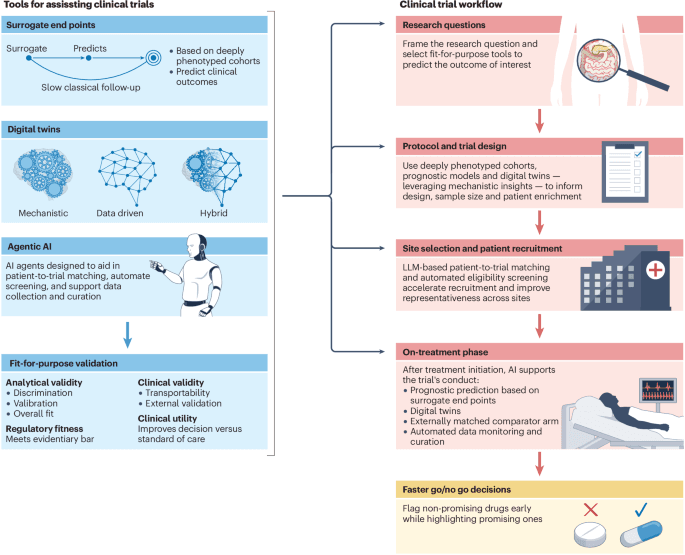
Clinical trials are expensive, slow, and frequently fail. With approximately 90% of drug candidates entering trials never reaching approval and roughly $300 billion spent annually on the 30,000 randomized controlled trials published each year, the pharmaceutical industry faces a persistent efficiency crisis. Now, a comprehensive framework published in Nature Reviews Bioengineering proposes a systematic approach to integrating artificial intelligence across the entire clinical trial lifecycle—potentially transforming how new therapies reach patients.
A Four-Stage Framework for AI Integration
The proposed framework addresses clinical trials' most stubborn challenges: high costs, recruitment difficulties, and prolonged follow-up periods. It integrates validated AI tools across four distinct stages of trial design and conduct: surrogate endpoints, digital twins, agentic AI systems, and externally matched comparator arms.
The framework doesn't advocate for wholesale replacement of traditional methods. Instead, it provides a structured approach for incorporating AI where validation supports its use. Specific examples cited include the iBox surrogate in kidney transplantation, annualized relapse rate in multiple sclerosis, heart digital twins for ventricular tachycardia, AI-assisted histology (AIM-MASH) in hepatology, and large language models for patient-to-trial matching.
These tools operate under three overarching principles: fit-for-purpose validation, continuous regulatory engagement, and human oversight. The framework explicitly addresses regulatory considerations from the EMA, FDA, and EU AI Act, recognizing that regulatory acceptance remains critical for any AI-enabled trial methodology.
Addressing the Recruitment Crisis
Less than half of clinical trials meet their pre-specified enrollment target upon completion—a statistic that underscores one of the industry's most pressing operational challenges. AI-enabled patient matching algorithms represent one potential solution, helping identify eligible participants more efficiently and potentially expanding trial eligibility through less restrictive inclusion criteria.
The framework references several successful randomized controlled trials as benchmarks, including DAPA-CKD, DAPA-HF, DESTINY-Breast04, and ADAURA. These trials demonstrate the evidentiary standards that AI-enabled approaches must meet to gain regulatory and clinical acceptance.
Implications for Drug Development
For pharmaceutical companies and health tech firms developing AI clinical trial solutions, this framework provides a validated roadmap for regulatory acceptance and market positioning. The potential business impact extends across patient recruitment platforms, trial design optimization tools, and data management systems.
Healthcare providers and research institutions could leverage these AI tools to accelerate drug development timelines while maintaining evidentiary standards. For patients, the promise is faster access to effective therapies, earlier elimination of harmful treatments, and improved trial matching that could expand participation opportunities.
The framework's emphasis on validation requirements, regulatory touchpoints, and proven use cases distinguishes commercially viable AI trial tools from unvalidated approaches—a critical distinction as the market for clinical trial AI solutions continues to expand. Whether this comprehensive approach can meaningfully reduce the 90% failure rate and $300 billion annual expenditure remains to be demonstrated through real-world implementation.
Sources
Google Search
Follow Health AI Central on Google
Choose Health AI Central as a preferred source, and Google is more likely to show our reporting in Top Stories.
Reporting & accountability
How we maintain accuracy
Health AI Central separates reported facts, analysis, and public-source data. Readers can review our standards, request a correction, or consult the relevant research methodology before relying on a claim.