

Texas Bets $5 Billion on Sensor-Packed Hospital Designed for Algorithms, Not Just Doctors
The University of Texas at Austin is building what it calls the nation's first AI-native hospital from the ground up, with up to 30,000 sensors and infrastructure designed to accommodate robots that don't yet exist.
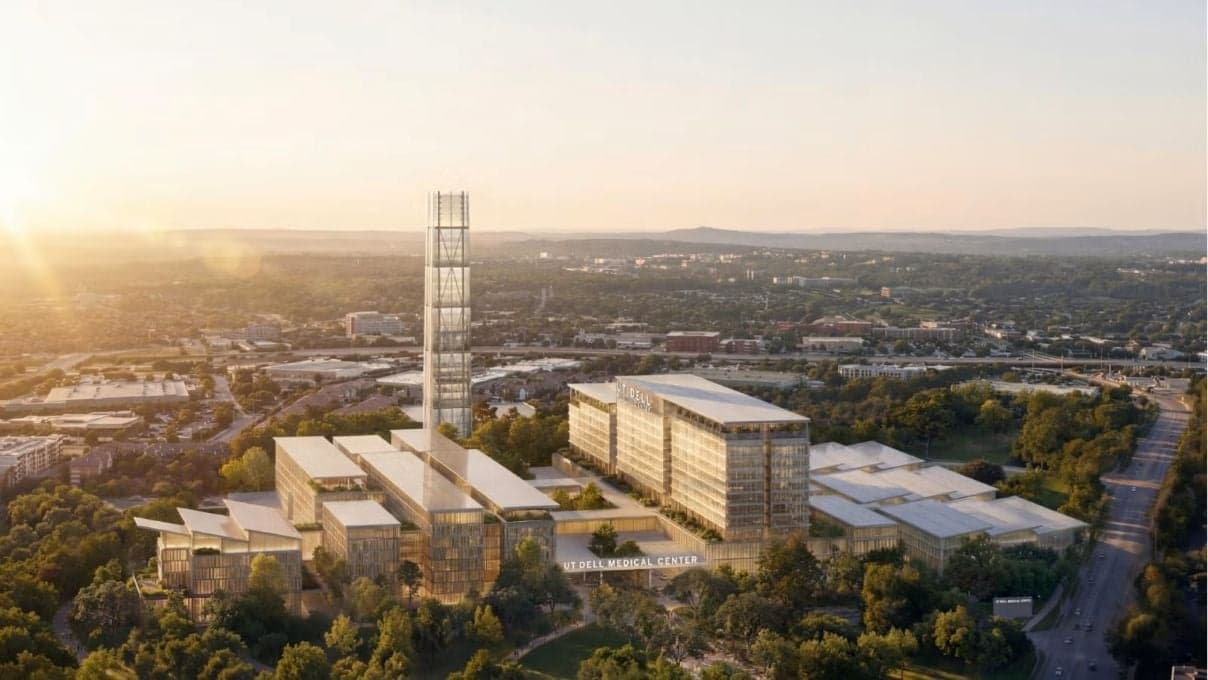
The University of Texas at Austin has officially launched UT Dell Medicine, a unified academic health system anchored by an ambitious $5 billion hospital project that aims to redefine what "smart healthcare" means in practice. Announced October 27, 2026, the initiative consolidates Dell Medical School, existing clinics formerly known as UT Health Austin, and the future UT Dell Medical Center into a single entity—with the hospital component designed from its foundation to integrate artificial intelligence, robotics, and pervasive sensor technology rather than retrofitting these capabilities into existing buildings.
The 300-500 bed UT Dell Medical Center, scheduled to open in 2030 on a 27-acre site within North Austin's UT Dell Campus for Advanced Research, represents a fundamentally different approach to healthcare infrastructure. While hospitals built five to seven years ago might feature basic camera systems, this facility plans to deploy between 20,000 and 30,000 sensors throughout the building, according to Mike Ryan, Chief Healthcare Technology, Digital and Data Strategist for the project.
What AI-Native Infrastructure Actually Looks Like
The "AI-native" designation goes beyond installing advanced equipment in traditional hospital layouts. According to the university, the design incorporates wider corridors to accommodate future robotics, separate pathways for autonomous systems, and building controls that can adapt to evolving biomedical equipment and algorithms that don't yet exist. The facility is being designed by Skidmore, Owings & Merrill, which has completed more than 50% of the schematic design phase, with construction beginning in 2026.
The hospital will focus on five specialty areas: cardiovascular care, cancer treatment, neurological services, transplant medicine, and advanced intensive care. A partnership with UT MD Anderson Cancer Center will integrate cancer services through shared electronic health records and billing systems, allowing coordinated care delivery and expanded access to clinical trials for Austin-area patients who currently must travel out of market for complex treatments.
The project is anchored by a $750 million gift from the Michael & Susan Dell Foundation, building on the foundation's original $50 million donation in 2013 that established Dell Medical School. Dr. Claudia Lucchinetti, Executive Vice President for Medical Affairs at UT Austin, emphasized that the model addresses care fragmentation by organizing specialists around patient needs rather than forcing patients to navigate multiple disconnected systems during complex illness.
Scaling Up in a Competitive Market
UT Dell Medicine plans to double its clinical capability through physicians and advanced providers while tripling patient volumes over the next four to six years. The expansion positions the system as Austin's fourth major health network and its only academic health system, joining HCA Healthcare's St. David's facilities, Baylor Scott & White, and Ascension Seton in a competitive regional market.
The infrastructure approach reflects a broader question facing healthcare systems nationwide: whether to retrofit legacy facilities with AI capabilities or build purpose-designed environments. UT Austin's ground-up strategy prioritizes "future-proofing"—creating physical and digital architecture that can accommodate technologies still in development, from advanced robotics to algorithmic tools that require massive real-time data streams from thousands of ambient sensors.
The 2030 timeline gives the university nearly four years to refine its technology integration strategy as AI healthcare applications continue to evolve, potentially offering a blueprint for other academic medical centers weighing similar investments in next-generation infrastructure.
Sources
Google Search
Follow Health AI Central on Google
Choose Health AI Central as a preferred source, and Google is more likely to show our reporting in Top Stories.
Reporting & accountability
How we maintain accuracy
Health AI Central separates reported facts, analysis, and public-source data. Readers can review our standards, request a correction, or consult the relevant research methodology before relying on a claim.