

Specialty EHR Giant Ditches Proprietary AI for Dual-Vendor Marketplace in Front-Office Automation Bet
Nextech's strategic pivot to embedded third-party AI platforms signals a fundamental shift in how healthcare IT vendors approach conversational automation—and what specialty practices can expect from their EHR investments.
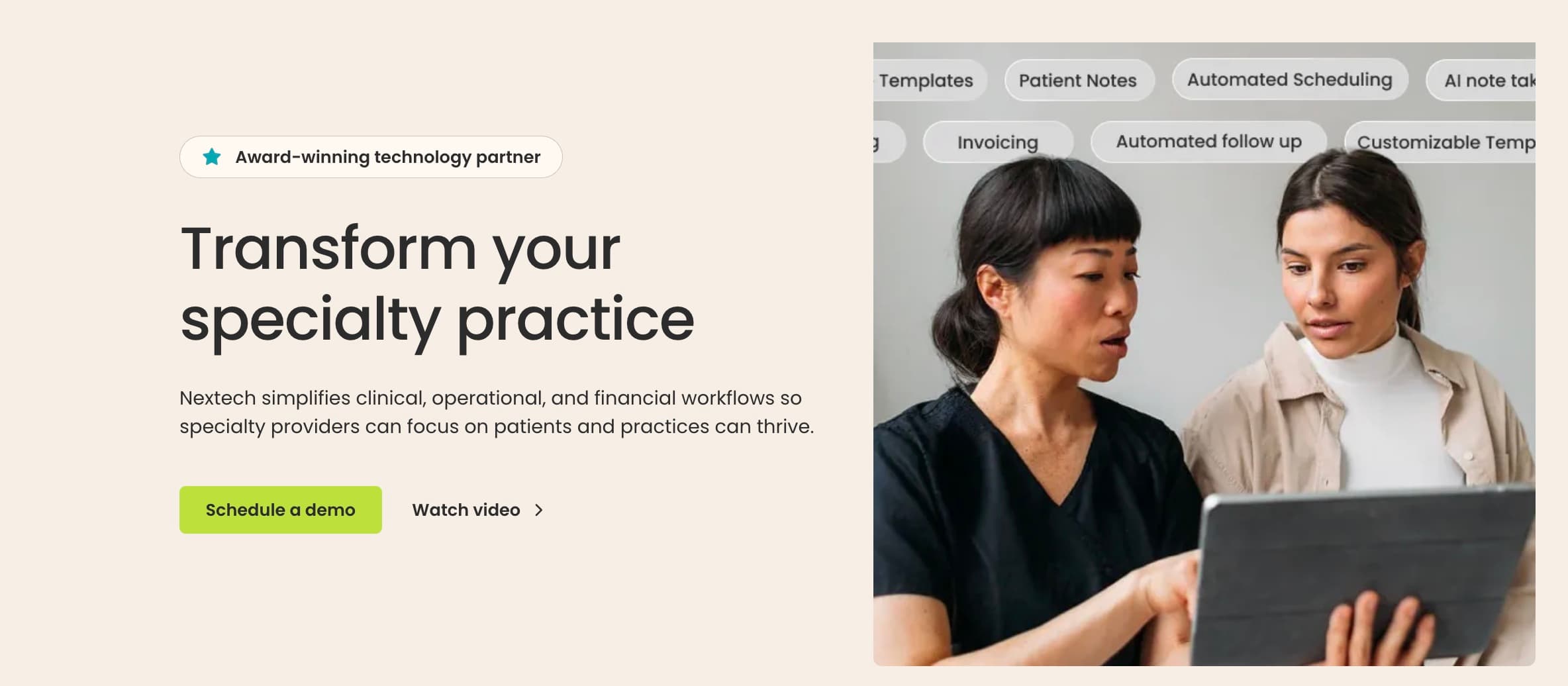
Nextech, a leading electronic health record and practice management platform serving specialty practices, announced in October 2026 a strategic departure from the proprietary AI playbook: rather than building its own conversational automation tools, the company is embedding two enterprise-grade AI vendors—Assort Health and EliseAI—directly into its core clinical systems. The move, unveiled at the American Academy of Ophthalmology's 2026 Annual Meeting in New Orleans, represents a calculated bet that specialty practices need choice, not lock-in, when addressing front-office access bottlenecks that cost practices millions in lost appointment revenue.
A Choice-Based Architecture for Agentic AI
Under multi-year strategic alliances, both Assort Health and EliseAI will integrate natively into Nextech's Select/Cloud and Practice+ PM/EHR platforms with bi-directional data flow, allowing specialty clinics in ophthalmology, dermatology, orthopedics, and other disciplines to select between two distinct AI access platforms matched to their patient demographics and operational workflows. The architecture eliminates the need for practices to abandon existing EHR infrastructure while gaining 24/7 patient access capabilities—a historically unmonetized window that the partnerships aim to convert into measurable appointment volume.
Assort Health brings performance metrics built on 300 million specialty patient interactions and deployment across 40% of Fortune 20 healthcare enterprises, reporting a 97% inquiry resolution rate and 5% lift in completed appointment volume. The platform claims to deliver a 115% increase in front-office labor capacity and 79% referral-to-appointment conversion, translating to up to $4.3 million in incremental revenue per 100 providers.
EliseAI enters the partnership handling 20 million patient conversations monthly and having surpassed 100 million total interactions to date. The company crossed $200 million in annual recurring revenue in 2026—its fifth consecutive year of 100% year-over-year growth—and recently achieved a $4 billion valuation following a $350 million Series E funding round.
From Proprietary Tools to Curated Marketplaces
Nextech's dual-partner strategy marks a significant architectural shift in healthcare IT: rather than developing proprietary AI tools that lock practices into single-vendor ecosystems, the company is positioning itself as a curated marketplace for specialized AI vendors. The model validates the enterprise viability of purpose-built conversational AI platforms while establishing integration standards for agentic automation in ambulatory workflows—a potential template for other EHR vendors facing pressure to deliver AI capabilities without diverting engineering resources from core clinical functionality.
For specialty practices grappling with unanswered calls, extended hold times, and after-hours coverage gaps amid persistent administrative staffing shortages, the embedded AI platforms target a specific pain point: patient leakage caused by access friction. By automating scheduling and inquiry resolution around the clock, the partnerships aim to recover appointment volume that would otherwise be lost to competitor practices with better phone availability.
Market Implications
EliseAI's $200 million ARR milestone and sustained triple-digit growth trajectory signal that conversational AI has matured into a standalone revenue category within healthcare IT, no longer a speculative add-on but a measurable driver of practice economics. The company's ability to handle multimodal automation at scale—across text, voice, and digital channels—positions it as infrastructure for patient access rather than a point solution.
For patients, the immediate impact centers on reduced appointment abandonment and referral leakage, particularly critical in specialty care where initial access delays compound clinical outcomes and satisfaction scores. Eliminating daytime phone queue friction and extending access beyond business hours addresses a longstanding gap in ambulatory care delivery.
The partnerships position Nextech to compete not on proprietary AI differentiation but on integration quality and vendor curation—a strategic gamble that the specialty EHR market values flexibility over feature exclusivity.
Sources
Companies in this article

Reporting & accountability
How we maintain accuracy
Health AI Central separates reported facts, analysis, and public-source data. Readers can review our standards, request a correction, or consult the relevant research methodology before relying on a claim.