

South Korea's Smart Grid Becomes Lifeline: How AI Reading Your Electric Bill Has Saved 15 Lives
Korea Electric Power Corporation's AI system analyzes household electricity patterns to detect medical emergencies among isolated residents, slashing welfare check times by 86% across 179 municipalities.
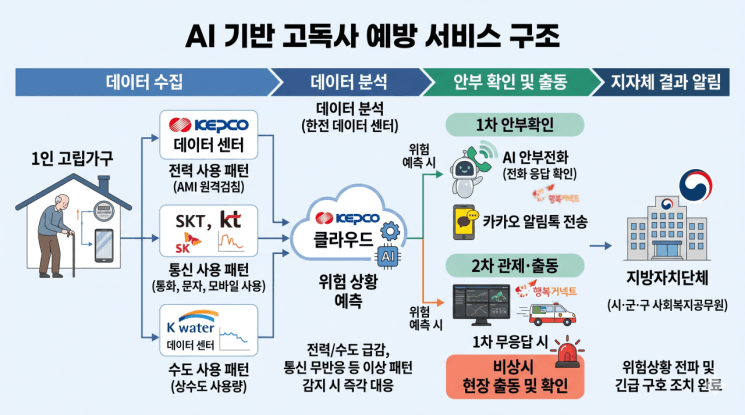
When electricity usage suddenly flatlines in a single-person household, it might signal more than an unpaid bill. In South Korea, it could trigger a life-saving emergency response. Korea Electric Power Corporation (KEPCO) has transformed ordinary smart meter data into a passive health surveillance system that has already rescued 15 people living alone, according to a report from The Asia Business Daily.
The AI-powered platform analyzes electricity consumption patterns from advanced metering infrastructure (AMI) to identify anomalies that may indicate medical crises, falls, or unattended deaths among isolated residents. By integrating data from smart meters with information from three major telecommunications carriers and the Korea Water Resources Corporation, the system detects deviations from individual baseline usage without requiring additional in-home sensors or patient compliance.
Passive Monitoring at Utility Scale
Unlike wearable devices or dedicated health monitoring equipment, KEPCO's approach leverages infrastructure already installed in homes across South Korea. The AI learns each household's typical electricity consumption patterns and flags unusual activity—or concerning inactivity—automatically alerting control centers and local governments when intervention may be needed.
The system's reach has expanded rapidly, with 179 local governments now implementing the technology. This widespread adoption reflects both the scalability of the utility-data approach and the pressing need for elderly monitoring solutions in a country with high rates of single-person households and an aging population.
Efficiency Gains and Cost Savings
Beyond the 15 lives saved, KEPCO reports an 86% reduction in the time welfare officials spend conducting manual resident welfare checks. This operational efficiency translates to substantial economic impact: the corporation estimates approximately 690 billion won (roughly $517 million USD) in national and social cost savings.
The efficiency gains stem from the system's ability to continuously monitor thousands of households simultaneously, directing human intervention only when algorithms detect genuine cause for concern. This targeted approach allows social services and healthcare outreach programs to allocate limited resources more effectively while maintaining—or improving—safety outcomes for vulnerable populations.
Expanding Applications Beyond Emergency Detection
KEPCO has outlined plans to extend the platform's capabilities beyond emergency response. Future applications include identifying energy welfare gaps, developing alternative credit assessment models based on utility usage patterns, and implementing AI-powered electricity bill alerts.
These expansions suggest a broader vision for utility data as a window into household wellbeing and economic stability, though such applications will likely intensify ongoing discussions about privacy boundaries and the appropriate scope of utility data repurposing.
Implications for Digital Health Monitoring
The South Korean model demonstrates that effective remote patient monitoring doesn't necessarily require patients to wear devices, remember to charge sensors, or actively participate in data collection. For healthcare systems managing aging-in-place programs, this passive infrastructure approach offers a compelling alternative to compliance-dependent technologies.
Health tech companies and policymakers in markets with similar demographic challenges may find opportunities in multi-utility data fusion strategies. However, the success of such systems will depend not only on technical capabilities but also on establishing clear frameworks for data governance, privacy protection, and appropriate use of infrastructure surveillance for health purposes.
Sources
Google Search
Follow Health AI Central on Google
Choose Health AI Central as a preferred source, and Google is more likely to show our reporting in Top Stories.
Reporting & accountability
How we maintain accuracy
Health AI Central separates reported facts, analysis, and public-source data. Readers can review our standards, request a correction, or consult the relevant research methodology before relying on a claim.