

NVIDIA's New AI Model Thinks Like a Radiologist to Read CT Scans in 3D
Open-source NV-Reason-CT processes entire CT volumes with explainable chain-of-thought reasoning, achieving state-of-the-art performance on diagnostic benchmarks while building on methodology that saved radiologists time without compromising accuracy.
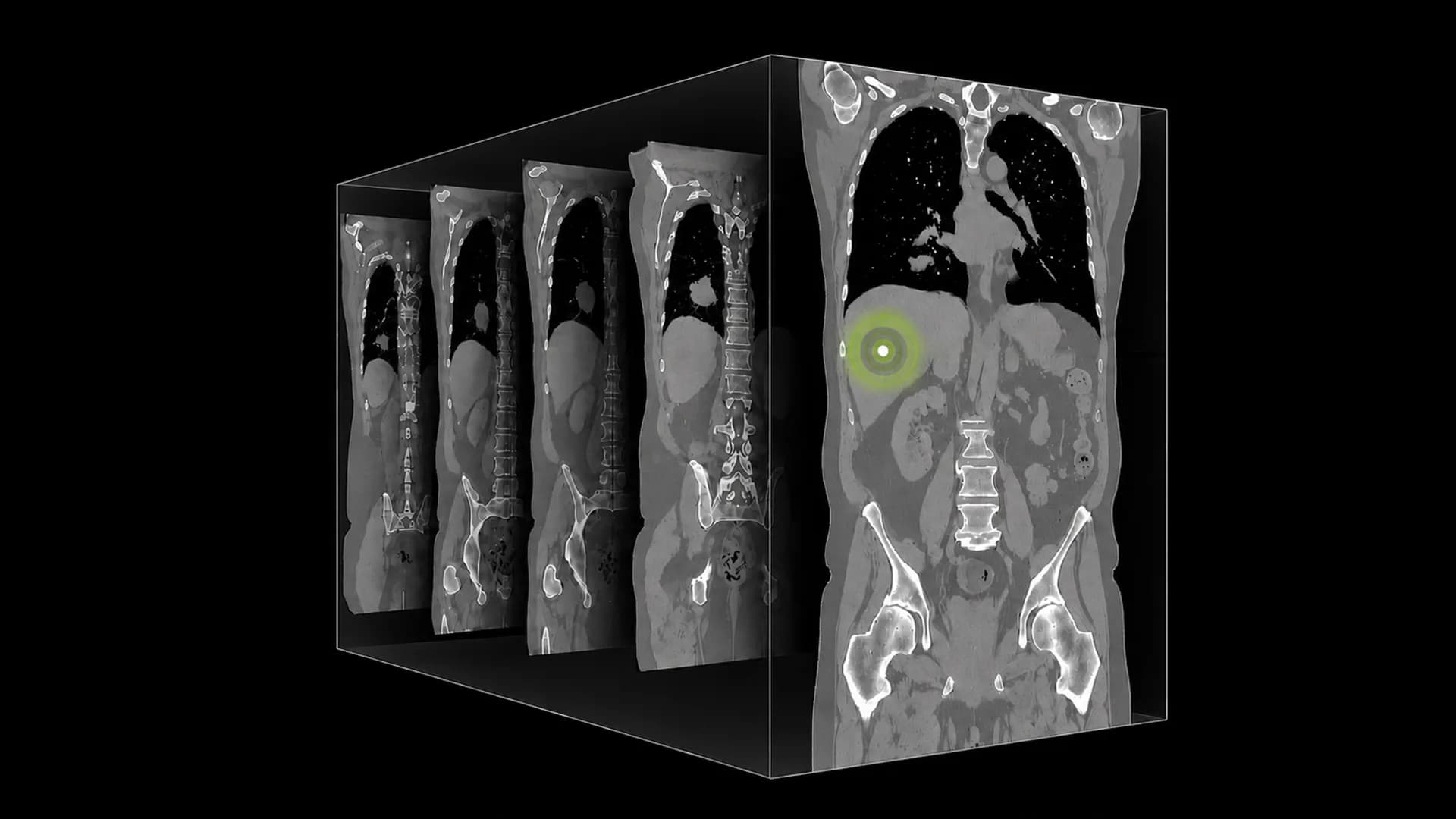
NVIDIA has released NV-Reason-CT, an open-source artificial intelligence model that brings a fundamentally different approach to analyzing CT scans: processing the full three-dimensional volume of imaging data while generating step-by-step reasoning that mirrors how radiologists think through diagnoses.
The model addresses a critical limitation in medical imaging AI. While a single abdominal CT study comprises 300-600 axial slices creating a complex 3D dataset, most AI systems analyze these as independent 2D frames. NV-Reason-CT instead processes CT volumes natively as true 3D input at 192³ voxels with 2mm isotropic resolution, according to NVIDIA's announcement.
Architecture That Mimics Radiologist Workflow
NV-Reason-CT combines a 3D Vision Transformer encoder with the Qwen3.5-4B language model, creating what NVIDIA calls a vision language model (VLM) specifically designed for volumetric medical imaging. The architecture processes 13,824 vision token context through 8x8x8 patch tokens, using 3D Multi-Resolution Positional Encoding to maintain spatial relationships throughout the analysis.
The model covers 30 chest abnormalities and 29 abdominal abnormalities including lung nodules, pneumothorax, hepatic lesions, and renal cysts. It generates structured reports, systematic reasoning traces, and supports multistep clinical dialogue—allowing radiologists to interrogate findings and verify diagnostic logic rather than accepting black-box outputs.
NVIDIA trained the model using approximately 550,000 structured question-answer examples across chest and abdominal regions, drawing from datasets including CT-RATE, NIH CT datasets, and CancerVerse. The training employed a two-stage methodology: supervised fine-tuning on radiologist reasoning annotations followed by Group Relative Policy Optimization reinforcement learning with anatomy-aware reward functions.
Benchmark Performance and Clinical Context
On the CT-RATE benchmark, NV-Reason-CT achieves state-of-the-art results, outperforming existing 3D contrastive models and frontier medical AI systems including VoxelFM, Pillar-0, CT-CLIP, Merlin, ClinFusion-8B, and MedGemma 1.5, according to NVIDIA's testing.
The model builds on methodology validated in NV-Reason-CXR, a predecessor system for chest X-rays. That earlier work was accepted at RSNA 2024 in a multireader clinical study demonstrating radiologist time savings while maintaining diagnostic accuracy—suggesting potential real-world efficiency gains for the CT model.
NVIDIA explicitly positions NV-Reason-CT as an open research and development foundation, not an autonomous diagnostic system or FDA-cleared clinical product. The company released it as open-source, creating a new baseline for medical imaging AI that health tech companies can build upon for specialized use cases.
Implications for Radiology Workflows
The model's explainable, auditable AI assistance addresses workflow challenges in radiology's most data-dense imaging modality. The chain-of-thought reasoning and conversational capability enable radiologists to integrate AI insights into clinical decision-making without black-box uncertainty—particularly valuable given radiologist workforce shortages and increasing imaging volumes.
For health tech companies, NV-Reason-CT establishes architectural requirements that 2D-based approaches cannot match, while providing a state-of-the-art foundation model that both accelerates development timelines and raises performance expectations for proprietary systems. The two-stage training methodology offers a replicable framework for companies with access to expert radiologist annotations.
While not yet a clinical product, the model's development signals progress toward more reliable, explainable AI assistance that could reduce interpretation errors, decrease time to diagnosis, and improve consistency in CT scan analysis—particularly in under-resourced settings where specialist radiologist access is limited.
Sources
Reporting & accountability
How we maintain accuracy
Health AI Central separates reported facts, analysis, and public-source data. Readers can review our standards, request a correction, or consult the relevant research methodology before relying on a claim.