

Hybrid AI Architecture Tackles Ultrasound's Biggest Image Quality Problem Without Inventing Fake Anatomy
South Korean researchers combine Vision Transformers with CNNs to eliminate speckle noise while avoiding the hallucinated features that make generative AI dangerous in clinical settings.
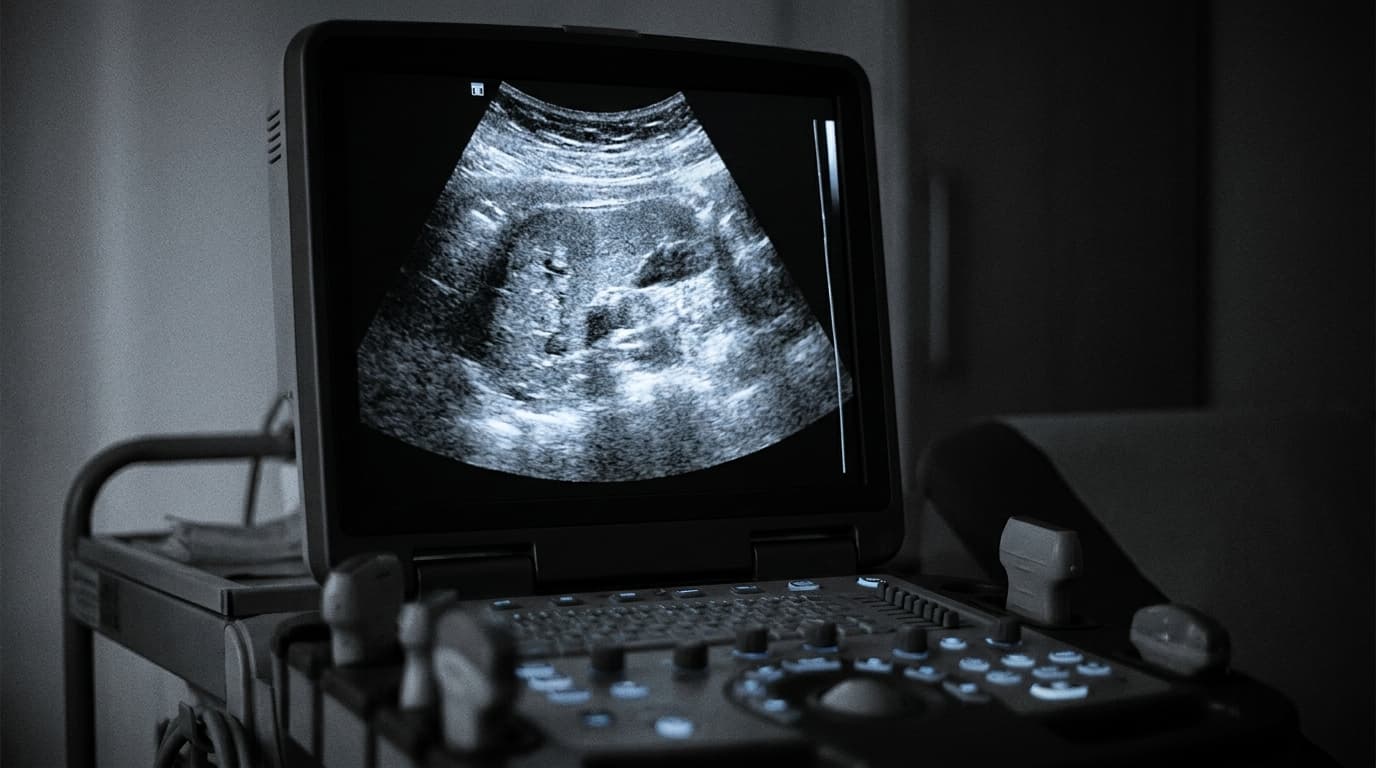
Illustration: AI-generated
Ultrasound imaging remains the workhorse of medical diagnostics worldwide, particularly in resource-limited settings, but its Achilles' heel has always been speckle noise—the grainy artifacts that obscure anatomical boundaries and compromise diagnostic confidence. Now, researchers from South Korea have developed a hybrid artificial intelligence system that sharpens blurry ultrasound images without creating the phantom features that make purely generative AI models risky for clinical use.
A Marriage of Two AI Architectures
The research team from Kongju National University and the National Institute for Mathematical Sciences, led by Yongheon Choi and Minha Yoo, designed a novel architecture that pairs Vision Transformers (ViT) for global context extraction with convolutional neural networks (CNNs) for local feature reconstruction. According to their study published in Biomedical Engineering Letters, the system achieved state-of-the-art performance metrics—PSNR of 23.7204, SSIM of 0.8837, and LPIPS of 0.1634—outperforming all compared methods on paired ultrasound data.
The innovation lies in how the two architectures communicate. Attention patterns from the ViT encoder are converted into spatial weighting signals that guide the CNN decoder's reconstruction work, particularly around anatomical boundaries. Critically, this mechanism requires no anatomical annotations, addressing a major deployment bottleneck that typically requires costly and time-consuming labeled medical datasets.
Preventing AI Hallucinations in Clinical Imaging
The researchers' approach directly confronts a dangerous problem with unsupervised generative models in medical imaging: hallucination. By using paired supervision—training on low-quality and high-quality versions from the same ultrasound acquisition—the system learns to enhance real features rather than inventing plausible-looking but fictitious anatomy that could lead to false diagnoses.
The team trained their model on 803 paired ultrasound images (512×512 pixels) acquired using an E-CUBE 12R research platform, with 751 images for training and 52 for testing. The study acknowledges a significant limitation: the small dataset was acquired from the study authors themselves, with no institutional review board approval since no external subjects were scanned.
Implications for Point-of-Care Diagnostics
For healthcare providers in rural clinics, emergency departments, intensive care units, and developing nations where ultrasound often serves as the primary or only imaging modality, enhanced image quality could improve diagnostic confidence and enable earlier detection of subtle lesions. The technology may also reduce the need for repeat examinations, particularly valuable for bedside and point-of-care ultrasound applications.
However, significant validation hurdles remain before clinical deployment. The annotation-free attention mechanism offers promise for health AI companies seeking to avoid dataset labeling costs, but scalability concerns persist. Validation across diverse patient populations, multiple ultrasound platforms, and various pathological cases will be essential before regulatory approval can be pursued.
The hybrid architecture demonstrates that combining transformer and CNN strengths may prove more effective than pure transformer or pure CNN approaches for medical image enhancement tasks—a finding that could influence the broader trajectory of clinical AI development beyond ultrasound imaging alone.
Sources
Reporting & accountability
How we maintain accuracy
Health AI Central separates reported facts, analysis, and public-source data. Readers can review our standards, request a correction, or consult the relevant research methodology before relying on a claim.