

Combining X-Rays with Patient Records Boosts AI's Ability to Detect Severe Gum Disease
New multimodal deep learning system achieves 81% diagnostic accuracy by fusing dental imaging with clinical metadata, outperforming image-only approaches in detecting advanced periodontal bone loss.
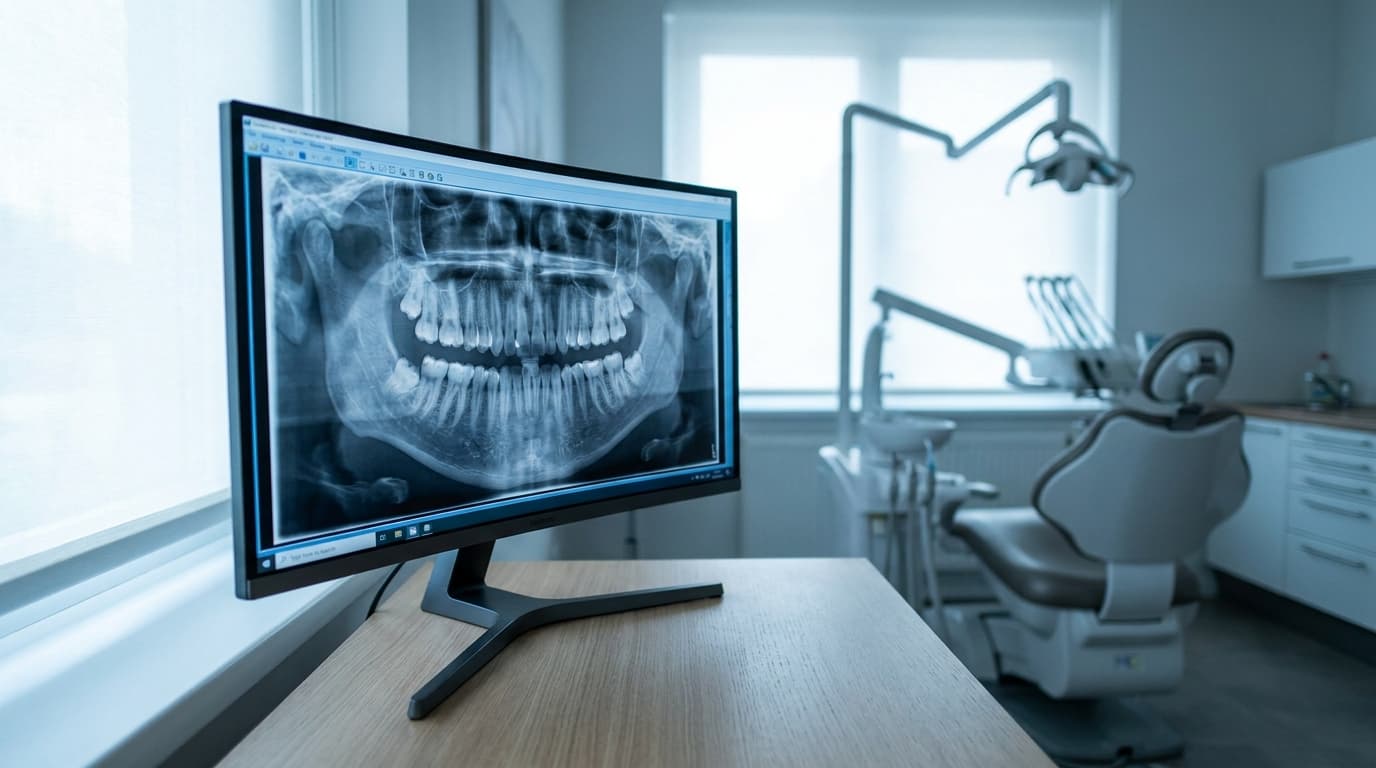
Illustration: AI-generated
Artificial intelligence systems that analyze dental X-rays alongside patient medical data can assess gum disease severity far more accurately than those relying on images alone, according to research published in BMC Medical Imaging. The multimodal approach, developed by scientists at An-Najah National University in Palestine, achieved 67% overall accuracy and 81% macro AUC-ROC across nearly 1,000 radiographs—with particularly striking improvements in identifying the most severe cases of periodontal bone loss.
Multimodal Fusion Outperforms Single-Data Approaches
Researchers Adnan Salman from the Computer Science Department and Ibtehal Raghib Bishtawi from the Faculty of Dentistry and Dental Surgery trained their system on 988 annotated panoramic radiographs from Shanghai Stomatological Hospital. The architecture combined a DenseNet-121 neural network for processing X-ray images with a multilayer perceptron for handling patient metadata, merging both information streams at the feature level.
The results demonstrated statistically significant advantages for the combined approach. When detecting severe periodontal disease (Level 3 cases), the multimodal system achieved 60% recall compared to just 14% for metadata-only analysis—a difference confirmed through rigorous statistical testing with 20 repeated stratified random splits and Holm-Bonferroni correction. The multimodal model outperformed image-only analysis on macro F1-score and macro AUC-ROC metrics with p-values below 0.001.
Ablation studies revealed that neither age alone nor other clinical variables in isolation significantly improved performance. The diagnostic boost required the full metadata set, suggesting that comprehensive electronic health record integration would be necessary for clinical deployment rather than simple demographic data capture.
When AI Struggles, Human Experts Often Disagree Too
Perhaps the most intriguing finding emerged from the team's error analysis. The researchers selected 88 cases and asked dental experts to review them independently. In cases where the AI model made correct predictions, human annotators showed moderate agreement with a kappa of 0.585. But in cases where the model failed, expert agreement dropped dramatically to a kappa of just 0.208.
This pattern suggests that many AI misclassifications occurred in genuinely ambiguous cases where even trained specialists disagree—indicating that some performance limitations may reflect inherent diagnostic uncertainty in panoramic radiographs rather than pure algorithmic failure. The finding has important implications for understanding the true performance ceiling of automated systems and for regulatory evaluation of dental AI products.
Clinical Implications and Next Steps
The system's reliance on widely available panoramic radiographs rather than specialized imaging makes it potentially scalable to general dental practices. With 67% overall accuracy and particularly strong performance on severe cases, the technology appears best suited as a clinical decision support tool for triage and flagging high-risk patients rather than as an autonomous diagnostic system.
The researchers generated Grad-CAM visualizations to show which image regions influenced decisions, addressing interpretability concerns critical for clinical adoption. The study received no specific grant funding and the authors declared no competing interests.
External validation on diverse patient populations remains necessary before clinical deployment, particularly given that the training data came from a single institution. However, the rigorous validation methodology—including multiple comparison corrections and comprehensive ablation studies—sets a methodological standard for dental AI research and demonstrates clear advantages of multimodal approaches over traditional image-only analysis.
Sources
Reporting & accountability
How we maintain accuracy
Health AI Central separates reported facts, analysis, and public-source data. Readers can review our standards, request a correction, or consult the relevant research methodology before relying on a claim.