

Nobel Winner's 100-Person Lab Tackles AI Protein Design's Billion-Dollar Manufacturing Problem
David Baker's University of Washington team can now computationally design full antibodies from scratch, but translating digital proteins into stable drugs remains the industry's defining challenge.
Artificial intelligence can now design therapeutic proteins with atomic precision—a capability that earned David Baker the 2024 Nobel Prize in Chemistry. Yet the University of Washington researcher warns that computational prowess alone won't revolutionize medicine. The real bottleneck? Understanding the biology well enough to manufacture these digital creations as stable, safe therapeutics.
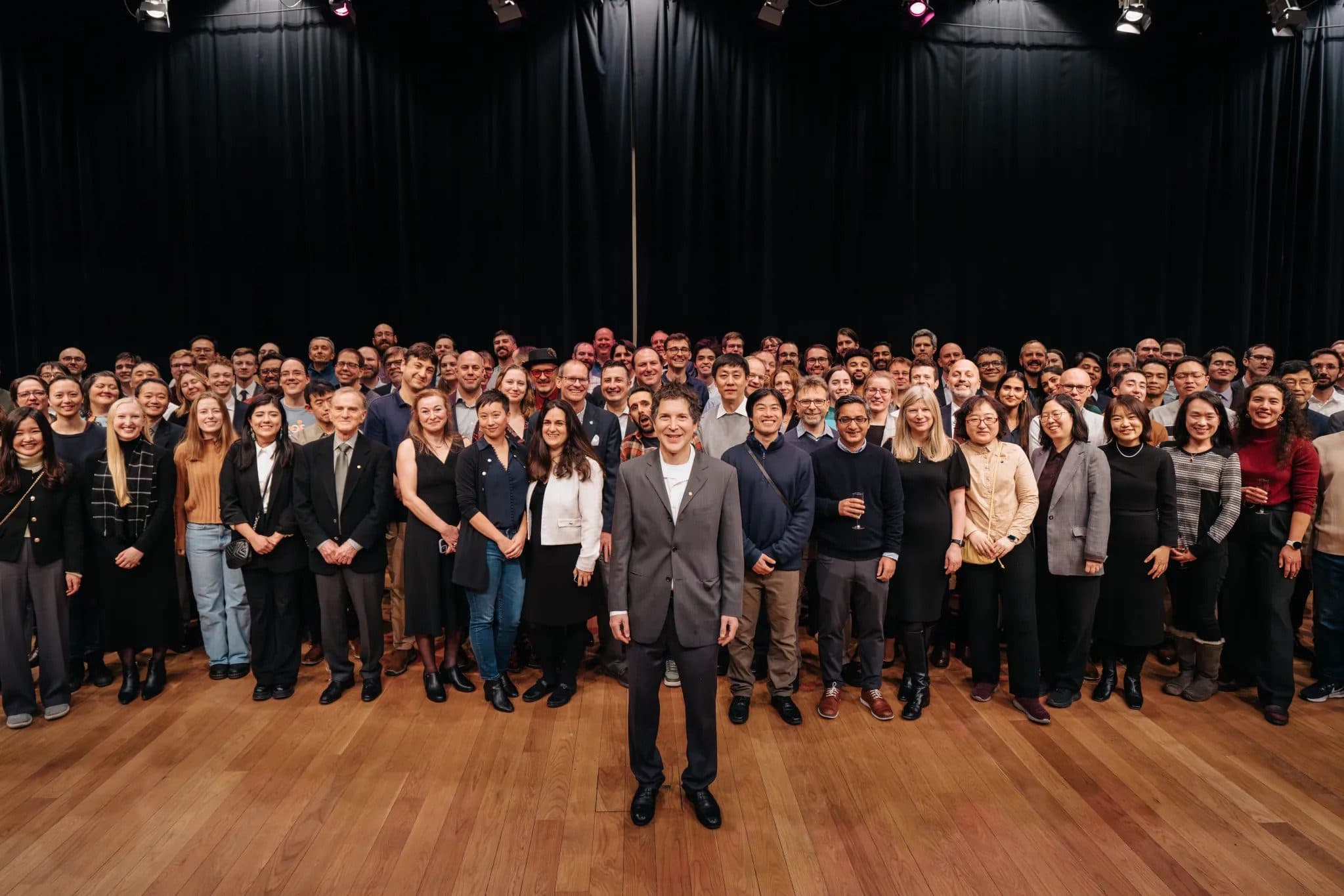
Baker's Institute for Protein Design (IPD) has assembled what he calls a "communal brain" of over 100 researchers tackling this challenge. Their November 2023 breakthrough in Nature demonstrated that AI models could design full-length antibodies targeting user-specified epitopes—no experimental screening required. But designing a protein on a computer and producing it at pharmaceutical scale are vastly different problems, a gap that Xaira Therapeutics aims to bridge with over $1 billion in funding.
From Astronomical Possibilities to Atomic Precision
The design space for proteins is staggeringly vast. A modest 100-amino-acid protein has 20^100 possible sequences, yet only a microscopic fraction fold into stable, functional structures. For decades, researchers chipped away at this problem through incremental advances: William DeGrado demonstrated in 1988 that non-natural sequences could achieve stable folds, while Steve Mayo published the first computationally predicted protein validated experimentally in Science during the 1990s.
Baker's 2003 Science paper with Brian Kuhlman marked a turning point, expanding design capabilities to flexible backbones representing entirely new folds. The lab's Rosetta molecular modeling suite simulates proteins atom-by-atom using biophysical properties—hydrogen bonds, backbone torsion angles, free energy calculations—enabling researchers worldwide to engineer proteins for applications ranging from vaccines to biosensors.
Baker shared his 2024 Nobel with Google DeepMind's Demis Hassabis and John Jumper for AlphaFold, the AI system that predicts protein structures from sequences. Nearly 200 current and former Baker lab members gathered in Stockholm for the Nobel Week celebration, underscoring the collaborative scale of modern protein engineering.
The Billion-Dollar Translation Challenge
Xaira Therapeutics' 2024 launch with Baker as scientific advisor signals industry confidence that AI-designed proteins can capture a share of the hundred-billion-dollar antibody drug market. The company's leadership roster includes Marc Tessier-Lavigne (former Stanford president and Genentech chief scientific officer) as CEO, Nobel laureate Carolyn Bertozzi on the board, alongside former FDA Commissioner Scott Gottlieb and ex-Johnson & Johnson CEO Alex Gorsky.
Yet Baker's emphasis on biological understanding reflects hard-won lessons. Computational design has matured rapidly, but manufacturability, stability, and safety validation remain stubbornly empirical. PyRosetta, developed by Jeffrey Gray's Johns Hopkins team, has democratized access to design tools, yet translating digital proteins into clinical candidates still requires deep expertise in protein expression, formulation, and immunogenicity.
What This Means for Drug Development
For AI drug discovery companies, Xaira represents a critical test case: can computational design overcome the manufacturing gap that separates promising algorithms from marketable therapeutics? The answer will likely determine whether de novo protein design becomes a pharmaceutical mainstay or remains a research curiosity.
Healthcare providers should anticipate accelerated therapeutic development timelines as AI bypasses traditional antibody screening, though clinical validation will keep most applications years away. Patients stand to benefit from expanded treatment options for cancer and autoimmune diseases, but Baker's caution suggests progress will be incremental rather than transformative overnight—a realistic timeline for an industry where biological complexity consistently humbles computational confidence.
Sources
Companies in this article
Reporting & accountability
How we maintain accuracy
Health AI Central separates reported facts, analysis, and public-source data. Readers can review our standards, request a correction, or consult the relevant research methodology before relying on a claim.