

Hospital-Built AI Approaches Commercial Performance After Three Months of Emergency Room Feedback
Oslo University Hospital's in-house brain bleed detection platform jumped from 79% to 90% sensitivity through continuous radiologist retraining, demonstrating that institutional AI can approach established vendor benchmarks.
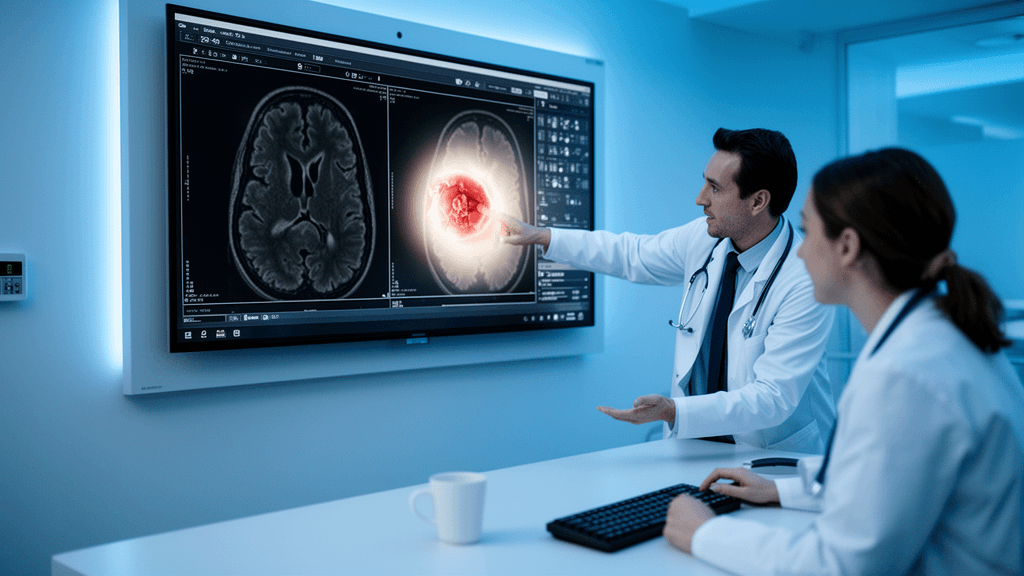
An artificial intelligence system developed and refined within a Norwegian hospital achieved substantial accuracy gains during a three-month emergency department deployment, demonstrating that institutional AI platforms with continuous learning capabilities can approach the performance of established commercial products through iterative refinement.
Radiologists at Oslo University Hospital deployed the VIOLA-AI intracranial hemorrhage detection platform across 2,167 acute head CT scans between June and August 2024, according to research published in BMC Methods. The system's sensitivity climbed from 79.2% to 90.3%, while specificity rose from 80.7% to 89.3% and area under the curve improved from 0.873 to 0.949, the study reports.
Real-World Performance Through Iterative Refinement
The VIOLA-AI model operated within NeoMedSys, a cloud-native platform featuring machine learning operations layers, database management frameworks, and web-based annotation tools that enabled radiologists to provide continuous feedback. The system processed scans in a mean time of three minutes, compared to 35 minutes (ranging from three minutes to five hours) for signed radiology reports, according to the research team led by Liu, Q., Nesvold, J.E., and colleagues.
The platform initially trained on combined public datasets—100 cases from INSTANCE and 152 training plus 35 test cases from BHSD—alongside 241 local hospital cases. During deployment, radiologists annotated 40 additional cases under supervision, with a six-year experienced radiologist performing annotations overseen by a senior neuroradiologist with more than 10 years of experience. A hold-out test set of 220 cases (70 bleed-positive, 150 bleed-negative) remained strictly reserved for final evaluation.
The study was designed as a prospective pragmatic investigation and enrolled patients aged 6 to 96 years (36.5% female) presenting to Norway's largest emergency department with indications for acute head CT scanning. The online evaluation set comprised 304 cases, split between 154 bleed-positive and 150 bleed-negative scans, with the negative cases deliberately selected as hard examples that had previously triggered false positives in earlier model versions.
Communication gaps initially prevented some scans from being pushed to NeoMedSys, though all were pushed at a later date so all images were analyzed by VIOLA-AI, the research team notes.
Approaching Commercial Benchmarks
The final performance metrics approach those of commercial systems cited in the study, including Qure.ai qER (81–93.6% sensitivity) and Aidoc (88.7–96.2% sensitivity). The final VIOLA-AI sensitivity of 90.3% and specificity of 89.3% sit slightly below the pooled sensitivity and specificity of 92% and 94% reported in a recent meta-analysis of AI models for detecting and annotating intracranial hemorrhage on head CT, according to the research.
Common false positives included calcified meningiomas, motion artifacts, choroid plexus calcifications, basal ganglia calcifications, and falx or dura calcifications, the research reports. False negatives typically involved subtle or small bleeds, anatomically challenging regions, and hemorrhages assigned probability scores below the 0.5 threshold.
Implications for Hospital-Developed AI
The study positions the technology as an assisting tool for research and quality management rather than autonomous diagnostic tool, with the 32-minute reduction in mean processing time demonstrating potential for faster triage in emergency settings. The research team acknowledges performance gaps between hold-out test results and real-world online evaluation, setting a transparency benchmark that may influence regulatory expectations.
The findings suggest that hospital-developed AI tools can achieve clinically meaningful improvements through tight integration with existing PACS infrastructure and continuous learning from radiologist feedback. The results illustrate that in-house hospital platforms leveraging institutional data and clinical expertise for iterative refinement can approach the performance ranges of established intracranial hemorrhage detection vendors.
The study appears in BMC Methods, Volume 3, Issue 1, Article 30, 2026, with DOI: 10.1186/s44330-026-00083-6.
Sources
Companies in this article
 Qure.aiMumbai, India · Founded 2016Qure.ai develops AI-powered radiology solutions to automate interpretation of X-rays and CT scans, enabling faster and more accurate diagnoses globally.View company profile →
 AidocTel Aviv, Israel · Founded 2016Aidoc empowers health systems to improve patient outcomes and operations with enterprise-grade healthcare AI.View company profile →
Google Search
Follow Health AI Central on Google
Choose Health AI Central as a preferred source, and Google is more likely to show our reporting in Top Stories.
Reporting & accountability
How we maintain accuracy
Health AI Central separates reported facts, analysis, and public-source data. Readers can review our standards, request a correction, or consult the relevant research methodology before relying on a claim.