

Five-Minute MRI Scans Now Measure Body Fat and Muscle Quality Thanks to New FDA-Cleared AI
AIRS Medical's SwiftSight Body Composition receives FDA clearance to deliver automated analysis of visceral fat, muscle mass, and liver fat without radiation exposure.
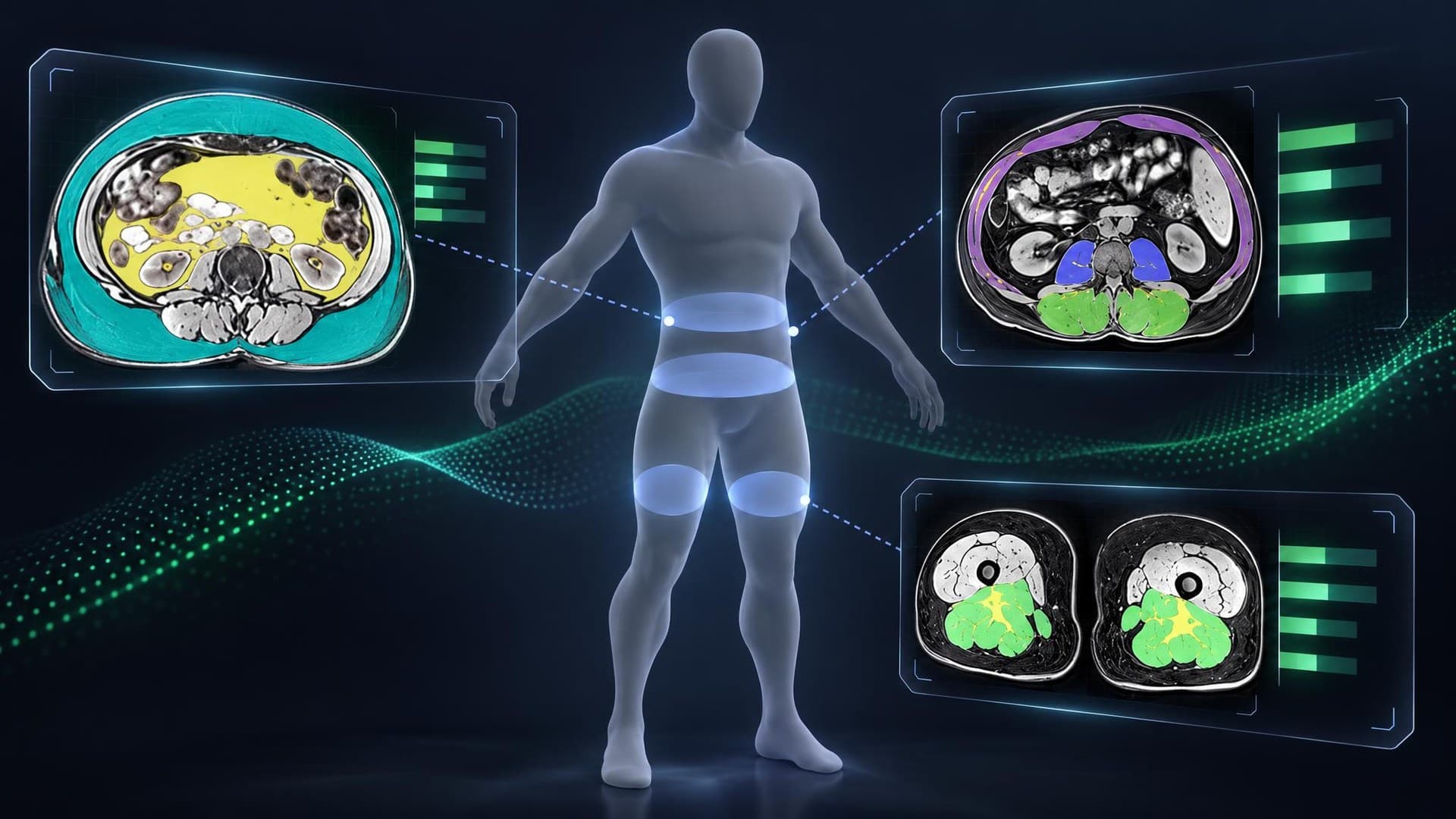
The FDA has cleared a new artificial intelligence tool that transforms standard MRI scanners into rapid body composition analyzers, potentially opening a new market for imaging centers while offering patients a radiation-free alternative to traditional body composition assessments.
AIRS Medical announced on October 5, 2026, that its SwiftSight Body Composition software received 510(k) clearance, enabling automated quantification of muscle and fat distribution in under five minutes. The clearance marks the company's expansion beyond brain imaging into the preventive health and wellness market, with SimonMed Imaging signed as the first deployment customer.
What the AI Software Measures
SwiftSight Body Composition analyzes multiple anatomical regions including the abdomen, liver, and thighs. According to the company, the software quantifies visceral and subcutaneous fat, assesses abdominal muscles (abdominal wall, psoas, and paraspinal muscles), and evaluates thigh muscles (quadriceps, hamstrings, and adductors).
The platform also measures muscle quality through myosteatosis—the infiltration of fat into muscle tissue—and assesses bilateral muscle balance. For liver assessment, the software quantifies fat using proton density fat fraction (PDFF) across three regions of interest.
"This clearance represents a significant milestone in our mission to make quantitative MRI accessible and actionable," said Jina Park, Chief Strategy Officer at AIRS Medical. The company's SwiftSight-Brain product, which received FDA clearance in September 2025, includes a normative database of 32,615 adults ages 18-97 from major scanner manufacturers at both 1.5T and 3T field strengths as of September 30, 2026.
Commercial and Clinical Applications
The rapid scan time and automated reporting position the technology for integration into preventive health programs, weight management clinics, metabolic assessments, and rehabilitation services. For imaging providers, the software creates a potential new revenue stream from existing MRI infrastructure without requiring additional modalities or manual analysis workflows.
Ajit Shankaranarayanan, PhD, Chief Product Officer at AIRS Medical, noted that the technology enables "standardized, quantitative insights that can transform how we approach preventive health and personalized medicine."
The radiation-free nature of MRI-based body composition analysis offers advantages for longitudinal monitoring compared to CT-based alternatives, potentially supporting frequent assessments of muscle loss, fat distribution changes, and liver fat accumulation in patients undergoing metabolic interventions or aging-related health programs.
Expanding Platform and Market Presence
AIRS Medical has accumulated multiple FDA clearances for its SwiftMR platform, with approvals in October 2021, May 2022, October 2023, March 2026, and July 2026. The company also holds CE Mark approval under EU MDR, along with clearances from Korea's MFDS and Japan's PMDA, with distribution in over 40 countries.
The company plans to introduce diffusion tensor imaging (DTI) capabilities in November 2026 and quantitative joint applications in 2027. AIRS Medical will showcase its expanded portfolio at RSNA 2026 in Chicago from November 29 to December 2, 2026, at booth #4921.
Sources
Reporting & accountability
How we maintain accuracy
Health AI Central separates reported facts, analysis, and public-source data. Readers can review our standards, request a correction, or consult the relevant research methodology before relying on a claim.