

Federal Agency Bets $33.7 Million on Robot Surgeons That Operate Without Human Hands
Philips wins major ARPA-H funding to develop AI systems that autonomously treat strokes, targeting the 88% of eligible patients who never receive life-saving procedures.
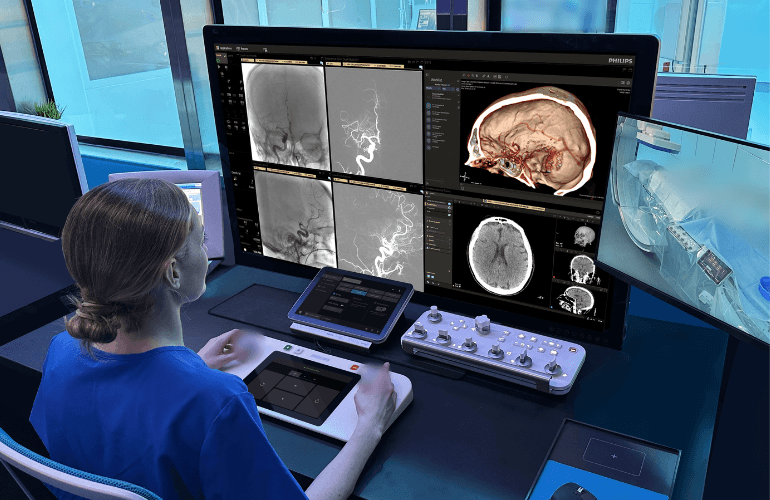
Royal Philips has secured up to $33.7 million in federal funding to develop autonomous robotic systems capable of performing stroke surgery without direct human control, marking a significant milestone in the evolution of AI-enabled medical intervention. The award from the Advanced Research Projects Agency for Health (ARPA-H) positions the Dutch medical technology giant at the forefront of efforts to address a critical treatment gap: only approximately 12% of Americans who need thrombectomy procedures for large vessel occlusion strokes currently receive them.
The funding comes through ARPA-H's Autonomous Interventions and Robotics (AIR) program, which aims to enable robots to perform life-saving procedures autonomously. Philips will collaborate with Johns Hopkins University, Boston University, and clinical partner J Mocco of Weill Cornell Medicine to develop systems focused on endovascular navigation, robotic device control, image-based procedural guidance, workflow automation, and remote intervention capabilities.
Addressing a Massive Treatment Gap
Hundreds of thousands of Americans suffer clot-caused strokes annually, yet the vast majority who could benefit from thrombectomy—a procedure to remove blood clots blocking major brain vessels—never receive the treatment. The 88% gap represents both a public health crisis and a substantial market opportunity for companies developing solutions that can extend specialist care beyond major medical centers.
Bert van Meurs, Chief Business Leader for Image-Guided Therapy at Philips, acknowledged the award positions the company to tackle this access challenge through technological innovation. The autonomous systems under development could potentially enable hub-and-spoke care models where expert operators remotely control procedures across multiple sites, or eventually, where AI systems perform interventions with minimal human oversight.
Competitive Landscape in Autonomous Surgery
Philips faces direct competition from Siemens Healthineers, which received up to $31.1 million over five years from the same ARPA-H program for similar remote endovascular robotics development. The parallel funding awards signal federal commitment to fostering competition in this emerging sector while hedging technological bets across multiple approaches.
The AIR program has distributed awards to several other innovators pursuing adjacent technologies, including Megnendo for magnetic guidewire systems, UC San Diego for flexible vascular robots, Kitware for virtual simulation testbeds, Stanford University for intravascular magnetic clot extraction devices, and UC Berkeley for crawling tissue sampling robots. This portfolio approach suggests ARPA-H recognizes that autonomous surgical systems will require breakthroughs across multiple technical domains.
Path to Clinical Reality
While the funding represents a substantial vote of confidence in autonomous surgical AI, significant regulatory, liability, and clinical validation hurdles remain before systems can operate without human oversight in real-world settings. The technology must demonstrate safety and efficacy standards that satisfy both the FDA and the medical community, particularly for time-sensitive interventions where minutes can determine patient outcomes.
For healthcare providers, successful development could reshape stroke care economics and expand access to underserved areas lacking neurointerventional specialists. However, the timeline for clinical deployment and the ultimate degree of autonomy these systems will achieve remain open questions as the technology moves from research funding to prototype development.
Sources
Companies in this article

Reporting & accountability
How we maintain accuracy
Health AI Central separates reported facts, analysis, and public-source data. Readers can review our standards, request a correction, or consult the relevant research methodology before relying on a claim.