

AI Pinpoints Brain Aging Region by Region, Outperforming Traditional Scans for Alzheimer's Risk
Deep learning analysis of 50,000 brain scans reveals localized aging patterns predict cognitive decline more accurately than whole-brain measurements.
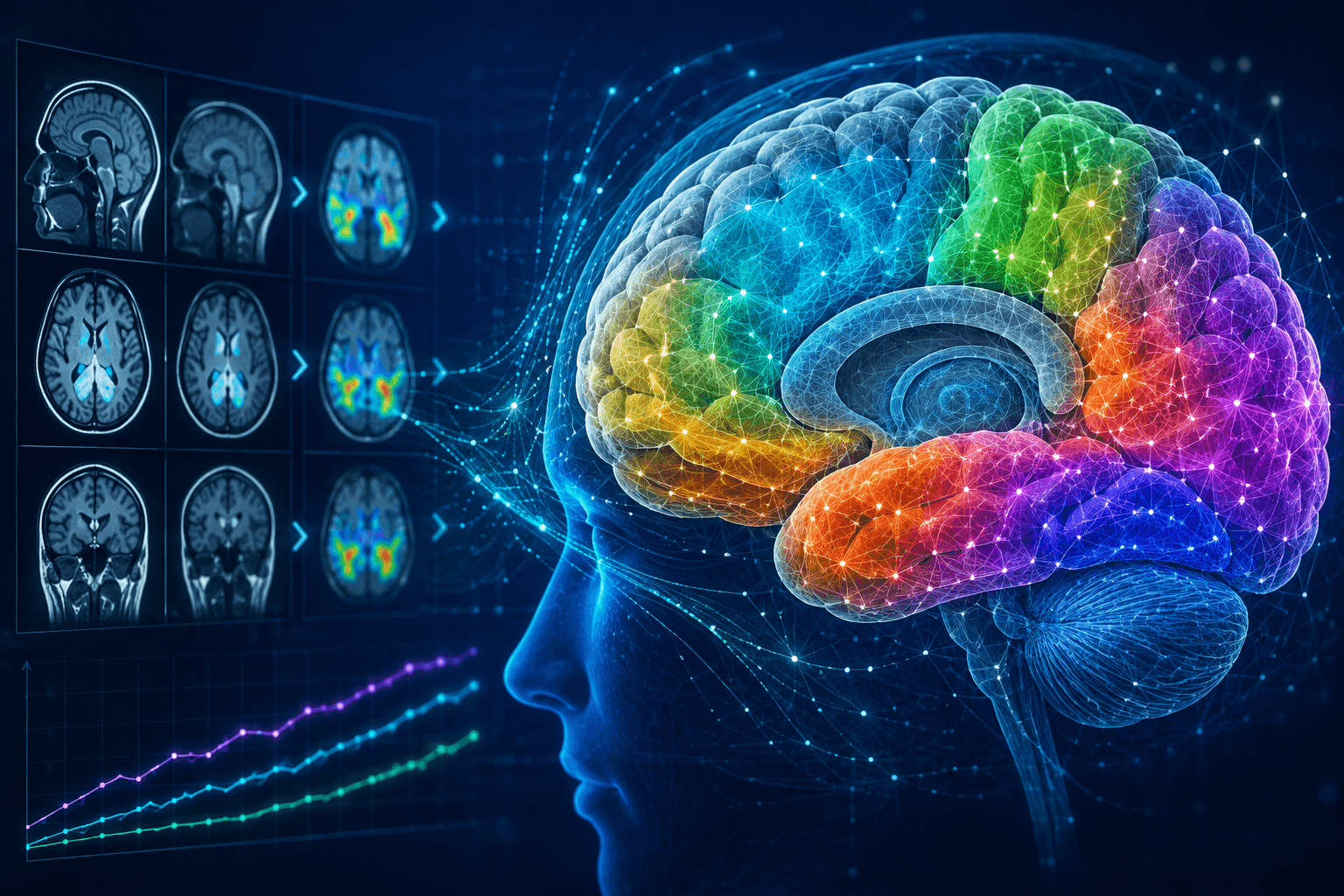
A deep learning model is transforming how clinicians assess brain aging by mapping deterioration region by region rather than treating the brain as a single aging unit. The breakthrough, published in the Proceedings of the National Academy of Sciences, analyzed more than 50,000 brain scans and found that localized brain age predictions correlate more strongly with cognitive performance than traditional global brain age measures—a finding with immediate implications for early Alzheimer's detection and personalized neurology.
The research challenges the prevailing approach of calculating a single "brain age" number and instead demonstrates that different cortical regions age at dramatically different rates within the same individual. This heterogeneity matters clinically: regional aging patterns align with specific cognitive domains, suggesting that where the brain ages fastest may determine which cognitive functions decline first.
From Global Metrics to Precision Mapping
Traditional brain age estimation uses machine learning to compare an individual's whole-brain imaging data against normative aging curves, producing a single number that indicates whether someone's brain appears older or younger than their chronological age. While useful, this global brain age (GBA) approach obscures critical regional variation.
The new local brain age (LBA) model takes a fundamentally different approach, generating age predictions for specific cortical regions across the brain's surface. By analyzing imaging data from tens of thousands of participants across the adult lifespan, the deep learning system learned to identify aging signatures unique to different brain areas. The result is a detailed map showing which regions are aging faster or slower than expected—information that disappears when averaged into a single global metric.
Critically, these localized predictions demonstrated stronger associations with actual cognitive performance than global measures, validating that regional specificity adds clinically meaningful information beyond what whole-brain metrics capture.
Clinical Pathways and Commercial Opportunities
The research arrives as accelerated brain aging emerges as a significant risk factor for Alzheimer's disease, creating urgency around better predictive tools. Local brain age mapping offers healthcare providers a more precise instrument for identifying at-risk patients earlier in the disease trajectory, potentially enabling interventions before significant cognitive symptoms appear.
For radiology practices and neurology clinics, the methodology could enable personalized monitoring strategies that focus on an individual's most vulnerable brain regions rather than applying uniform screening protocols. Patients whose temporal lobes show accelerated aging, for example, might receive different surveillance and intervention recommendations than those with frontal lobe vulnerability.
The technology also opens commercial pathways for health tech companies developing AI-powered diagnostic software. Regional brain analysis tools that outperform traditional global metrics present compelling value propositions for FDA clearance applications and integration into clinical radiology workflows, particularly as reimbursement models increasingly reward precision diagnostics that stratify patient risk more accurately.
The Precision Neurology Paradigm
This shift from global to local brain age assessment represents more than incremental improvement—it signals a transition toward precision neurology where interventions can be tailored to individual aging patterns. As the competitive landscape for AI-driven neuroimaging diagnostics intensifies, tools offering regional specificity may gain significant advantages in clinical adoption and outcomes differentiation.
The model's ability to map heterogeneous aging patterns across the cortex provides a foundation for next-generation cognitive risk assessment platforms, potentially reshaping how clinicians approach early detection and personalized treatment planning for neurodegenerative diseases.
Sources
Reporting & accountability
How we maintain accuracy
Health AI Central separates reported facts, analysis, and public-source data. Readers can review our standards, request a correction, or consult the relevant research methodology before relying on a claim.