

AI Now Codes One in Ten U.S. Hospital Stays in Under 90 Seconds—And Matches Human Experts
AKASA's autonomous inpatient coding platform has reached national scale, processing 10% of U.S. hospital discharges with validated accuracy while compressing revenue cycles strained by workforce shortages.
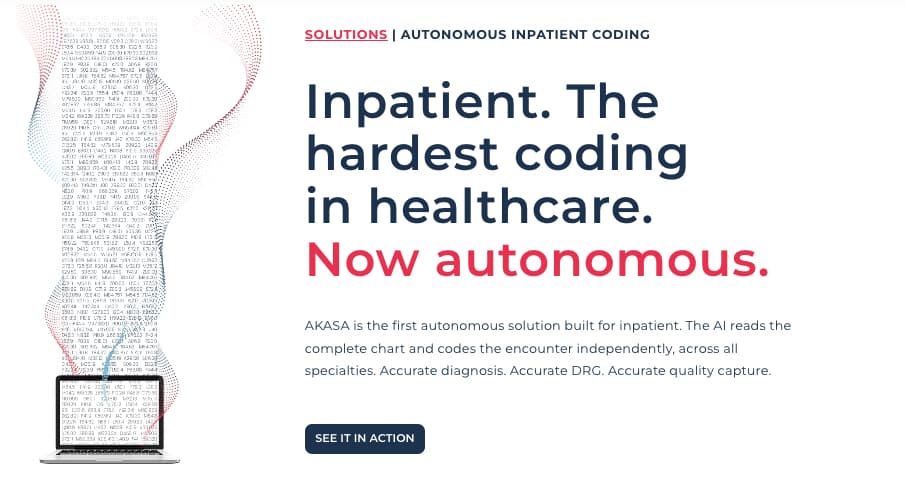
The healthcare revenue cycle automation market has crossed a critical threshold: artificial intelligence is no longer just assisting human medical coders—it's replacing entire workflows at national scale. AKASA, a healthcare revenue cycle AI company, has commercially launched an autonomous platform for inpatient medical coding and clinical documentation integrity (CDI) that now processes approximately one in every ten U.S. inpatient hospital discharges across health systems representing more than $180 billion in aggregate net patient revenue.
The platform completes end-to-end chart coding in under 90 seconds post-discharge, compared to 30-60 minutes for human coders, while matching or exceeding expert human coder accuracy across key compliance metrics including MS-DRG assignment and principal diagnosis selection, according to blinded third-party validation studies.
From Computer-Assisted to Fully Autonomous
AKASA's launch marks a maturation shift in revenue cycle AI—from computer-assisted coding (CAC) tools that flag suggestions to fully autonomous execution that replaces manual workflows. The platform's validation methodology tested AI performance against experienced human coders on encounter data representing 65-85% of typical hospital inpatient volume, measuring parity on federally mandated compliance metrics including MS-DRG assignment, principal diagnosis selection, present-on-admission (POA) indicators, and quality/severity-of-illness capture.
The company reports that inpatient discharge volume processed grew nearly six-fold year-over-year, reflecting both new health system adoption and expansion within existing clients. Named adopters include Cleveland Clinic, which has deployed prebill review and is exploring autonomous mid-cycle applications, and Nebraska Methodist Health System. The broader autonomous coding and billing market expanded 125% year-over-year to $450 million, according to Capstone Partners data from September 2026.
Addressing Critical Operational Pressure Points
The platform's rapid adoption reflects acute operational pain in hospital revenue cycle departments. Human coder workforce shortages—medical coding is a specialized, hard-to-fill role—cause hospital accounts to sit unreviewed three to four days post-discharge, delaying billing and extending accounts receivable (A/R) cycles. AKASA's autonomous engine compresses these timelines while reducing labor dependency and compliance risk from coding errors that trigger audit clawbacks and payer denials.
The system employs custom-tuned generative models fine-tuned on each health system's historical case-mix index, clinical criteria, documentation patterns, and specialty nuances. It covers acute inpatient coding across all clinical specialties, with outpatient facility encounter automation scheduled to follow. The platform also integrates CDI functions upstream, identifying documentation gaps, query opportunities, and missing secondary diagnoses before coding assignment.
Implications for Market and Governance
AKASA's scale and third-party clinical validation establish a benchmark for autonomous coding credibility, likely accelerating health system confidence in deploying AI for high-stakes, compliance-sensitive revenue cycle functions. The validation approach—blinded testing across broad encounter cohorts measuring parity with expert human performance on compliance metrics—may become a de facto standard as CMS and commercial payers increase scrutiny of AI-generated coding for audit and reimbursement integrity.
The launch intensifies competitive pressure on legacy CAC vendors and revenue cycle business process outsourcing (BPO) providers, signaling that the market for revenue cycle AI has moved beyond augmentation to full workflow replacement at national scale.
Sources
Reporting & accountability
How we maintain accuracy
Health AI Central separates reported facts, analysis, and public-source data. Readers can review our standards, request a correction, or consult the relevant research methodology before relying on a claim.