AI Model Achieves 97% Accuracy in Detecting Leading Cause of Blindness Before Symptoms Appear
New hybrid deep learning framework combining convolutional networks with vision transformers overcomes persistent challenges in automated diabetic retinopathy screening across diverse patient populations.
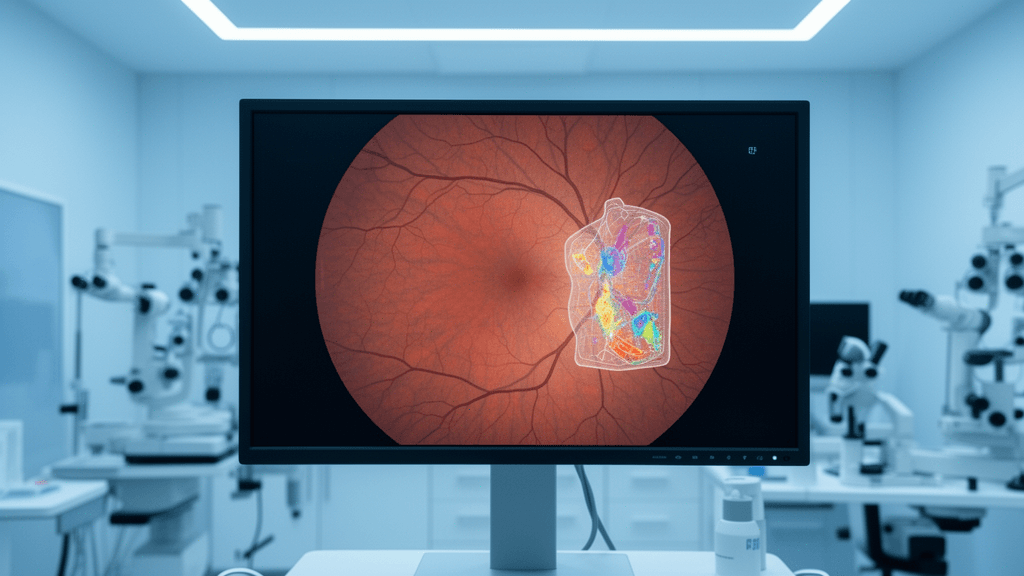
Diabetic retinopathy, the leading cause of blindness in diabetic patients, presents a diagnostic paradox: by the time patients notice symptoms, irreversible vision damage has often occurred. Now, researchers Hamza Shahbaz and Noman Ali have developed a hybrid artificial intelligence model that achieved 97.23% accuracy in detecting and classifying the disease across its severity spectrum—a significant advance over previous automated screening approaches that struggled with reliability across varied clinical settings.
The breakthrough addresses a critical gap in diabetes care, where early detection before symptomatic presentation enables interventions that can prevent blindness. High blood glucose causes retinal blood vessel swelling and blockage, but patients display no discernible symptoms during early stages when treatment is most effective.
Hybrid Architecture Solves Persistent AI Challenges
The researchers' model combines EfficientNetB0 convolutional neural networks with Dual-Branch Vision Transformers, integrating local feature extraction with global contextual modeling. This architectural approach directly tackles limitations that have plagued diabetic retinopathy AI: class imbalance between disease severity levels, computational burden, and poor generalization across different imaging equipment and patient populations.
Testing on 1,446 independent retinal fundus images, the model achieved precision, recall, and F1 scores ranging from 95-97% across disease classes, with area under the receiver operating characteristic curve exceeding 97%. During training, the system reached 98% accuracy by epoch 33, with recall values of 0.99-1.00 across all severity classes and a weighted F1 score of 0.99.
The model was trained on the DRDM1 hybrid dataset compiled from six public repositories—APTOS 2019, MESSIDOR, EyePACS, DDR, DeepDRiD, and IDRiD—using a 70% training, 15% validation, 15% testing split. This multi-source approach enhances generalization across heterogeneous clinical environments, a critical advantage over previous single-source models.
Technical Innovation in Image Processing
The researchers implemented a sophisticated preprocessing pipeline including Gaussian blurring with a 5×5 spatial kernel, CIELAB color space conversion, and Contrast Limited Adaptive Histogram Equalization with a clipping limit of 1.5 and 8×8 tile grid. Images were standardized to 300×300 pixels and combined using a weighted blending formula.
To address class imbalance—a persistent challenge in medical imaging AI—the team applied targeted geometric augmentation only to minority classes below a 1,500-image threshold. The augmentation strategy included random rotations up to 180 degrees, coordinate shifts up to 15%, zoom variations from 0.75x to 1.25x, shear distortions of 10 degrees, brightness adjustments from 1.0 to 1.6x, and horizontal and vertical flipping.
The model utilized Multi-Head Self-Attention modules for long-range dependency modeling, trained with the AdamW optimizer at a learning rate of 0.0001 and batch size of 32 images over 33 epochs.
Outperforming Previous Approaches
The 97.23% accuracy represents a substantial improvement over previous hybrid models. Earlier architectures combining VGG19 and ResNet50V2 (VR-Fuse-Net) achieved 91.82% accuracy with a 92.39% F1 score. Single-backbone architectures including ResNet, DenseNet, VGG, MobileNet, and Capsule Networks showed degraded reliability across varied imaging settings, with prior studies struggling with overfitting, restricted cohort sizes, and diminished transferability.
The validation accuracy reached approximately 91%, though the gap between training and validation performance suggests areas for continued refinement.
Implications for Clinical Deployment
The model's ability to classify multi-class severity—not just binary disease presence—supports risk stratification and appropriate referral urgency in clinical workflows. This capability could expand access to diabetic retinopathy screening in resource-limited settings, primary care clinics, and underserved populations where specialist ophthalmologists are scarce, enabling timely interventions such as laser photocoagulation, anti-VEGF injections, and glycemic control optimization that prevent irreversible blindness.
The dual-branch approach maintained computational feasibility while outperforming established architectures, offering a practical blueprint for medical imaging AI development across imbalanced datasets beyond diabetic retinopathy.
Sources
Follow Health AI Central
Keep up with health AI where you already read
On LinkedIn
The day’s strongest health AI stories in your feed, one or two each weekday.
On Google
Choose Health AI Central as a preferred source, and Google is more likely to show our reporting in Top Stories.
Reporting & accountability
How we maintain accuracy
Health AI Central separates reported facts, analysis, and public-source data. Readers can review our standards, request a correction, or consult the relevant research methodology before relying on a claim.