

When AI Knows What It Doesn't Know: Confidence-Aware System Boosts Radiologists' Diagnostic Accuracy in Prospective Trial
A South Korean study demonstrates that AI systems designed to defer to human judgment when uncertain can improve diagnostic accuracy without triggering automation bias, offering a blueprint for trustworthy clinical deployment.
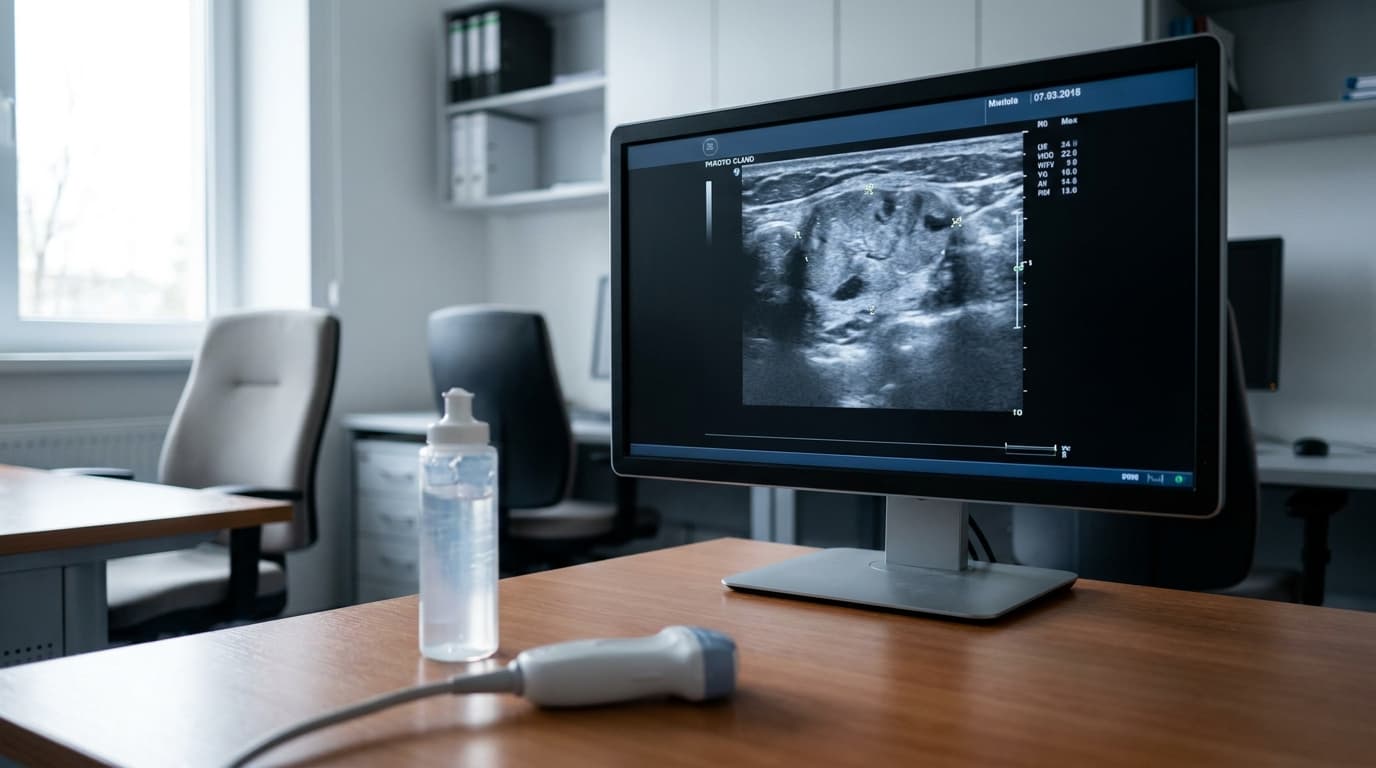
Illustration: AI-generated
Distinguishing between two benign salivary gland tumors on ultrasound has long challenged radiologists, but a prospective clinical trial in South Korea suggests that artificial intelligence may offer meaningful assistance—when it knows its limits. Researchers at Korea University College of Medicine report that a confidence-aware AI system improved radiologists' diagnostic accuracy from 76.3% to 81.6% when differentiating pleomorphic adenoma from Warthin's tumor in parotid gland ultrasound images.
Published in BMC Medicine, the study stands out not just for its results but for its rigorous methodology: a prospective, two-phase observer-performance trial with external validation and pre-specified deployment configuration—a rarity in medical AI research that often relies on retrospective datasets alone.
A Hybrid System That Knows When to Step Back
The AI architecture combines a YOLO-family object detection model with a ConvNeXt-based classification model in a hybrid pipeline. The critical innovation lies in its confidence threshold: when detection confidence drops below 0.80, the system automatically falls back to whole-image classification rather than forcing a potentially unreliable prediction.
Researchers tested 35 different detection-classification combinations during development, finding that hybrid approaches outperformed standalone components in 22 of 35 pairings. The system was trained on 949 ultrasound images from Korea University Ansan Hospital and validated on 427 images from a separate institution, Korea University Anam Hospital.
Three board-certified radiologists evaluated 107 external cases—321 total interpretations—both with and without AI assistance. The results demonstrated statistically significant improvement in diagnostic accuracy (odds ratio 1.54, 95% CI 1.12–2.13, p=0.008) and inter-reader agreement, with Fleiss' kappa improving from 0.475 to 0.611.
Radiologists Discriminate, Don't Automate
Perhaps most importantly, the study documented that radiologists exercised genuine judgment rather than blindly following AI suggestions. They adopted correct AI predictions 76.2% of the time while following incorrect predictions only 51.1% of the time—a statistically significant difference that contradicts concerns about automation bias in clinical decision support.
The system incorporated explainability features including Grad-CAM heatmaps for classification and D-RISE explanations for detection, potentially enabling radiologists to evaluate AI reasoning before accepting recommendations.
However, the results weren't uniformly positive across tumor types. While sensitivity for Warthin's tumor increased by 18.1 percentage points with AI assistance, sensitivity for pleomorphic adenoma decreased by 9.3 percentage points. This class-specific performance asymmetry underscores that AI doesn't uniformly improve diagnostic patterns but reshapes them in ways that require careful pre-deployment validation.
Blueprint for Trustworthy Clinical AI
For healthcare systems considering AI deployment, this study offers a methodological template: prospective design, external institutional validation, human observer outcomes rather than algorithm-only metrics, and transparent reporting of performance trade-offs. The confidence-aware fallback mechanism represents a practical engineering pattern for building clinical AI that recognizes its limitations.
The research team, from the Department of Biomedical Informatics at Korea University College of Medicine working with Korea University Ansan and Anam Hospitals, received IRB approval at both institutions, with consent waived for retrospective components.
While the 5.3 percentage point accuracy gain and improved consistency could theoretically reduce unnecessary biopsies, surgical referrals, and diagnostic delays, the study did not measure downstream clinical outcomes or cost-effectiveness—questions that remain for future investigation.
The demonstration that AI can meaningfully assist radiologists in challenging diagnostic tasks while preserving human judgment offers a pragmatic path forward for clinical AI deployment, one where technology augments rather than replaces clinical expertise.
Sources
Reporting & accountability
How we maintain accuracy
Health AI Central separates reported facts, analysis, and public-source data. Readers can review our standards, request a correction, or consult the relevant research methodology before relying on a claim.