

The 53% Problem: Why Most Hospital AI Tools Are Failing Doctors Despite Massive Adoption
A Nature Medicine analysis reveals that over 90% of US health systems have deployed artificial intelligence, but fewer than half find it highly useful—exposing a dangerous gap between AI hype and clinical reality.
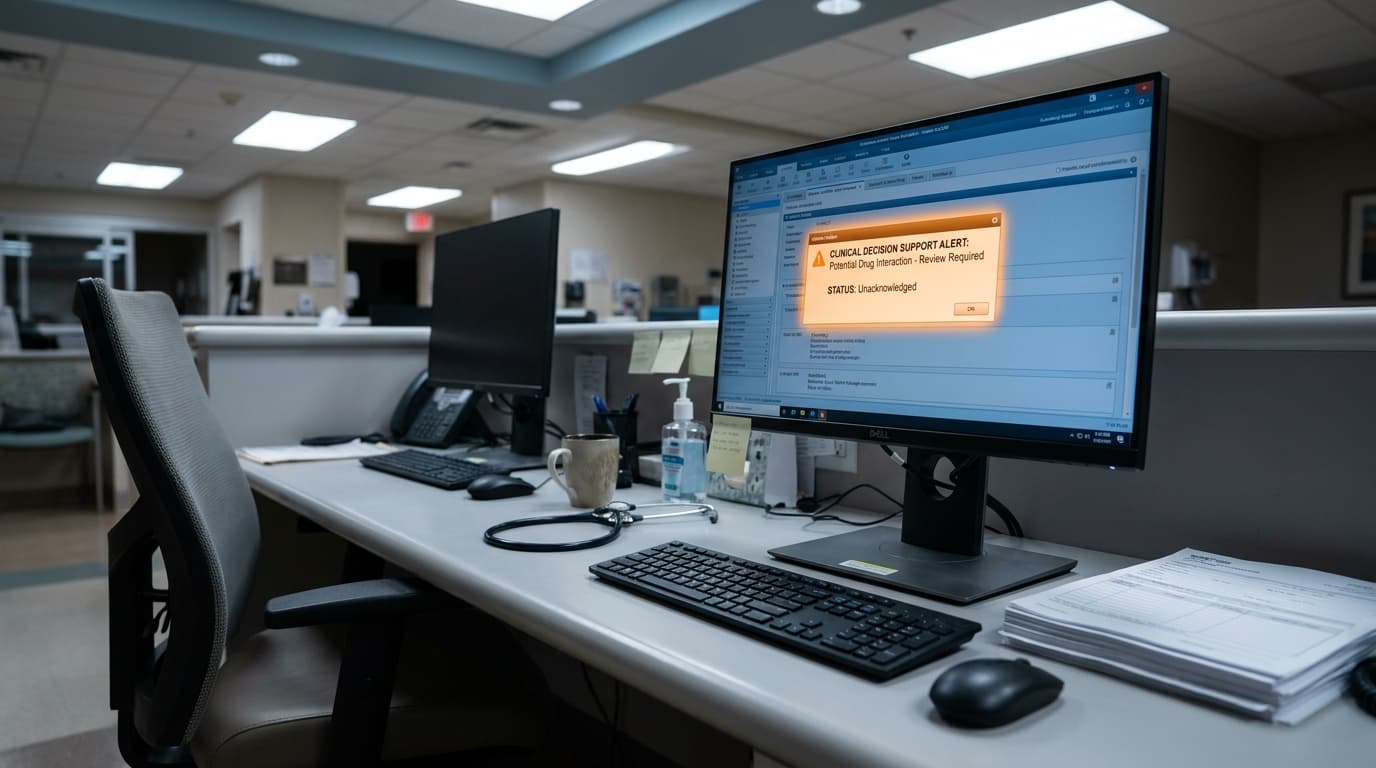
Illustration: AI-generated
Artificial intelligence has swept through American hospitals at breakneck speed, with more than 90% of US health systems now deploying AI tools for tasks ranging from radiology interpretation to clinical documentation. Yet a sobering reality check published in Nature Medicine reveals that only 53% or less of these institutions find their AI investments highly useful—a disconnect that raises urgent questions about patient safety and the true value of medical AI.
The publication synthesizes lessons from diverse global AI implementations, painting a picture of an industry racing ahead of evidence. While developers tout impressive benchmark performance metrics, the gap between laboratory accuracy and clinical utility has become impossible to ignore.
The Implementation Reality Check
The challenge isn't whether AI can work in theory—it's whether it works in practice. Research from Yan et al. on China's eye-care AI system found that feasibility required embedding the technology at every stage of the care pathway, not just dropping it into existing workflows. Similarly, Tiwari et al. documented that deploying diabetic retinopathy AI across India, Thailand, and Australia demanded vastly different implementation strategies for each context.
This local adaptation requirement poses particular challenges for low- and middle-income countries. As Kabukye et al. highlight, these regions need "frugal" AI solutions that account for limited computational resources and specialist shortages—constraints often ignored by developers focused on high-resource settings.
The scale of deployment is staggering: over 800 healthcare institutions in China have implemented the DeepSeek model following its release, while the US FDA has launched a pilot program for deploying AI clinical decision support tools before formal authorization. Yet speed of adoption may be outpacing safety considerations.
Safety Concerns and Performance Drift
Lång argues that safety demonstration must precede clinical benefit consideration, especially for screening programs affecting millions of patients. This concern isn't theoretical—Shah et al. documented performance drift in the ChatEHR AI system due to model iterations and changes in electronic record documentation practices, revealing how AI tools can silently degrade over time.
One pilot evaluation showed AI clinical decision support adoption declined over four weeks as clinician engagement decreased, suggesting that even initially promising tools may fail when they don't align with real-world workflows. Schaekermann et al. emphasize that AI tools must earn clinician and patient trust through prospective real-world studies, not just retrospective validation.
The patient perspective remains critically underrepresented. Singh et al., writing in Lancet Digital Health 2025, documented that patients with lived experience identify implementation barriers that developers consistently overlook—a gap that could lead to unintended consequences and safety risks.
The Path Forward
The US has committed $62.7 million to the ADVOCATE program, which will deploy autonomous AI devices for cardiovascular care while collecting prospective evidence—a model that prioritizes real-world validation over rapid deployment. This approach acknowledges what the 53% usefulness ceiling makes clear: benchmark performance means nothing if tools don't deliver clinical value.
Healthcare organizations need governance structures for ongoing AI performance monitoring and clear responsibility allocation for responding to safety concerns. Clinicians must demand prospective evidence of workflow integration and clinical outcomes before adoption. And developers must shift from accuracy-focused validation to implementation-ready solutions that adapt to local contexts and demonstrate measurable clinical benefit.
The AI revolution in healthcare is real, but the current implementation gap suggests the industry is building on unstable foundations. Until the focus shifts from deployment speed to demonstrated value, patients may bear the risks while hospitals chase diminishing returns.
Sources
Reporting & accountability
How we maintain accuracy
Health AI Central separates reported facts, analysis, and public-source data. Readers can review our standards, request a correction, or consult the relevant research methodology before relying on a claim.