

Deep Learning Model Achieves Expert-Level Accuracy in Detecting Kawasaki Disease Heart Complications in Children
Chinese researchers report that a YOLOv8-based AI system matches specialist performance while cutting coronary artery measurement time from 19 seconds to under 2 seconds.
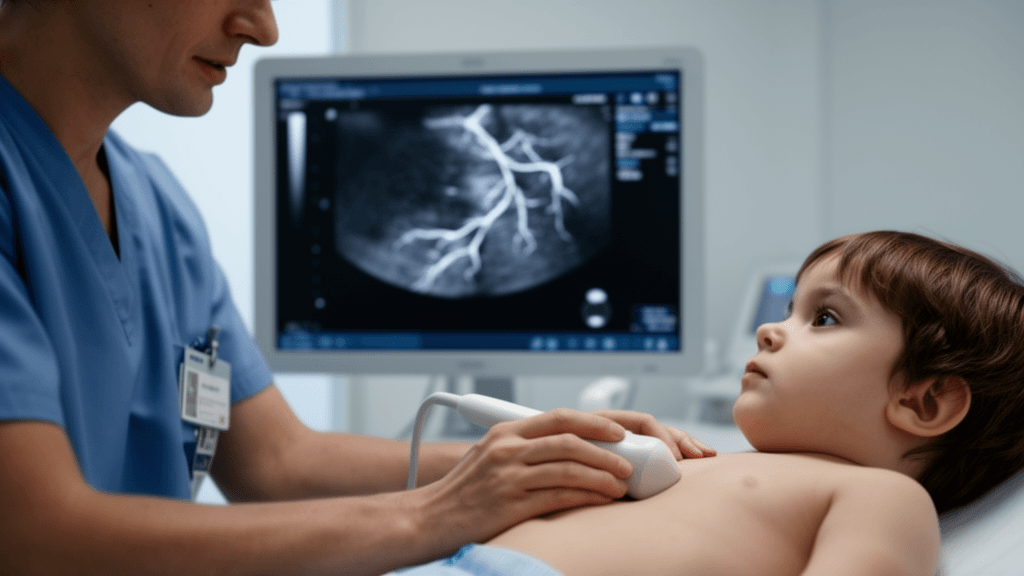
A deep learning system has demonstrated the ability to detect and measure coronary arteries in pediatric heart ultrasounds with accuracy matching expert cardiologists, according to research published in Pediatric Research. The achievement addresses a critical diagnostic challenge in Kawasaki disease, the leading cause of acquired heart disease in children in developed countries.
The AI model, developed by Chinese clinicians and engineers, achieved greater than 90% precision for most coronary vessels while reducing measurement time from 16–19 seconds to under 2 seconds per assessment. The system showed near-perfect agreement with expert sonographers, with a Kappa statistic of 0.904.
Bridging the Expertise Gap in Pediatric Cardiology
The research team trained their YOLOv8-based model on 8,766 coronary artery images derived from 2,314 clinical echocardiographic examinations of children with suspected or diagnosed Kawasaki disease. The data was collected between January 2021 and January 2024, with 3,000 high-quality images curated specifically for training purposes.
Performance varied by vessel type, with the right coronary artery showing the strongest results: 96.4% recall, 94.0% precision, and 99.2% mean average precision. The left main coronary artery achieved 93.4% recall and 90.1% precision with 97.0% mean average precision, while the left anterior descending artery recorded 90.1% recall, 85.2% precision, and 94.1% mean average precision. The left circumflex artery showed the lowest performance across all branches, though specific numbers were not provided.
The study revealed significant performance gaps between expert and general physicians that the AI could help address. Expert physicians detected the right coronary artery in 98.4% of exams compared to 92.7% for general physicians. The disparity was even more pronounced for the left circumflex artery, with detection rates of 57.7% for experts versus just 37.3% for general physicians.
Technical Innovation Meets Clinical Standards
The researchers employed a custom geometric pipeline to convert AI detections into clinically meaningful vessel diameter measurements. This methodology incorporated scale normalization, a convex hull algorithm, auxiliary circles, and perpendicular line averaging to transform bounding boxes into precise measurements that align with American Heart Association standard views for pediatric coronary assessment.
All imaging was performed using Philips EPIQ7 and EPIQ5 ultrasound systems. The model was trained for up to 100 epochs on an NVIDIA RTX 3090 GPU, utilizing YOLOv8's three-component architecture consisting of a C2f backbone, multi-scale neck, and decoupled head.
Intraclass correlation coefficients exceeded 0.85 for all coronary branches when comparing AI measurements to expert assessments, indicating strong measurement reliability.
Implications for Kawasaki Disease Management
Kawasaki disease, first described by Dr. Tomisaku Kawasaki in 1967, can cause coronary aneurysms, blood clots, and myocardial infarction in children when left untreated. The condition requires careful long-term monitoring of coronary arteries, making reliable and efficient measurement capabilities essential.
The AI system's 8–10× speed advantage could enable higher patient throughput and facilitate more frequent surveillance imaging for Kawasaki disease patients who require years of follow-up. The technology may prove particularly valuable in community hospitals and resource-limited settings where pediatric echocardiography expertise is scarce, potentially reducing diagnostic delays and improving cardiovascular risk stratification for affected children.
The study's single-center design and reliance on a single ultrasound vendor represent limitations that will need to be addressed before widespread clinical deployment.
Sources
Reporting & accountability
How we maintain accuracy
Health AI Central separates reported facts, analysis, and public-source data. Readers can review our standards, request a correction, or consult the relevant research methodology before relying on a claim.