

Singapore's Agnes 2.5 Pro Beta Delivers Competitive AI Reasoning at $0.10 Per Million Tokens
New model achieves 49 on Intelligence Index with strong scientific reasoning performance, though verbosity and specific benchmark weaknesses may affect production economics.
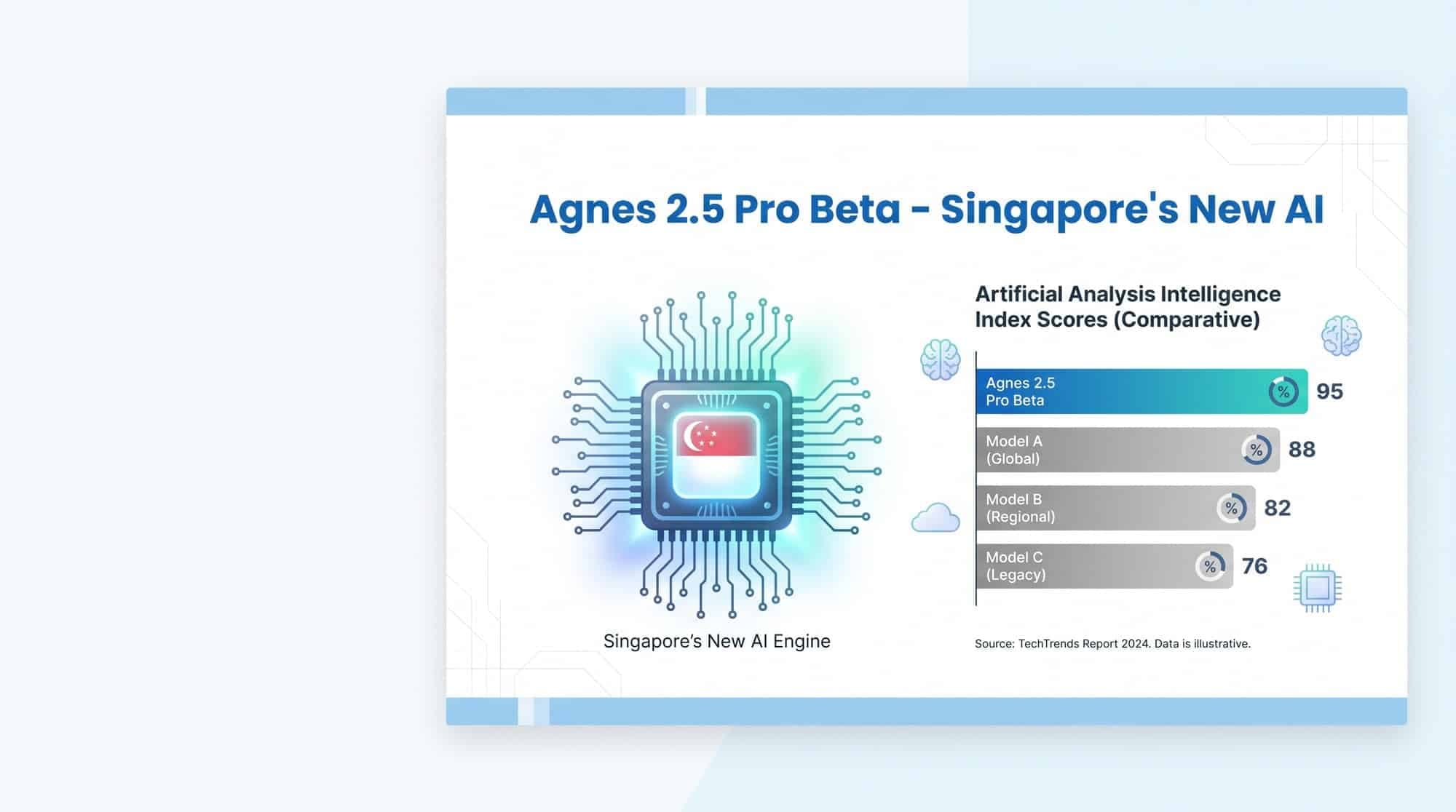
Singapore's Sapiens AI has entered the competitive AI landscape with Agnes 2.5 Pro Beta, a reasoning-focused model launched August 26, 2026, that delivers sophisticated analytical capabilities at $0.10 per million input tokens and $0.30 per million output tokens—a price point that undercuts frontier models by approximately 78-90%. With a score of 49 on the Artificial Analysis Intelligence Index, the model positions itself at #6 out of 174 models in its class, landing between industry leaders while offering significant cost advantages.
Performance Profile: Strengths and Documented Limitations
Agnes 2.5 Pro Beta demonstrates notable strength across key reasoning and knowledge benchmarks. The model achieved 91% accuracy on GPQA Diamond, a graduate-level science reasoning assessment, and 78% on AA-LCR (long-context reasoning). Its 70% score on Terminal-Bench v2.1 reflects capability in agentic coding and terminal use, while a 67% non-hallucination rate on AA-Omniscience demonstrates reasonable factual reliability.
However, the source explicitly documents specific weaknesses that organizations should consider during evaluation. The model scores just 16% on CritPt (physics reasoning) and 17% on AA-Omniscience Accuracy—performance that Artificial Analysis notes is "well above the class median but still indicates room to grow on long-tail factual knowledge." Additionally, the model achieves only 36% on τ3-Banking, an agentic tool use benchmark for finance applications.
A critical practical consideration: Artificial Analysis flags Agnes 2.5 Pro Beta as "very verbose," generating approximately 150 million tokens to complete the full Intelligence Index—more than double the median of 66 million tokens. For production applications where output costs matter, this verbosity significantly impacts total cost of ownership despite the attractive per-token pricing.
Three-Model Family Architecture
Agnes 2.5 Pro Beta represents the newest member of a three-model family, each targeting different deployment scenarios:
Agnes 2.5 Pro Alpha (July 24, 2026): The open-weights research release published on Hugging Face under Apache 2.0 license, enabling self-hosting and commercial deployment. Priced at $0.45 input / $0.90 output per million tokens through hosted API.
Agnes 2.5 Pro (August 1, 2026): The commercial stable release with proprietary weights. Maintains identical benchmark performance to Alpha at the same $0.45 / $0.90 pricing.
Agnes 2.5 Pro Beta (August 26, 2026): The performance leader, jumping to Intelligence Index 49 (from 39) while cutting input pricing by 78% and output pricing by 67% compared to its siblings.
All three models remain available through the same API hub, allowing developers to select based on licensing requirements, stability preferences, and budget constraints.
Technical Specifications and Capabilities
The model is designed for production workloads requiring reasoning depth beyond flash-class models, with the source specifically identifying use cases including complex code generation, scientific reasoning, long-context document analysis, and agentic workflows.
Key specifications include:
- Context window: 1 million tokens (approximately 1,500 A4 pages)
- Maximum output: 65,536 tokens per request
- Input modalities: Text and image URL
- Output modality: Text
- Output speed: 159.5 tokens per second—the fastest among comparable reasoning models
- Cache discount: 90% on cached input ($0.01 per million tokens on cache hits)
- API compatibility: OpenAI Chat Completions, OpenAI Responses, Anthropic Messages
The 90% cache discount represents a significant economic advantage for production workloads. Agent loops that re-send identical system prompts and tool definitions on every call can achieve near-zero marginal cost for repeated context at $0.01 per million cached tokens.
Competitive Positioning
Agnes 2.5 Pro Beta occupies an unusual market position: priced like an entry-level model but benchmarking like a mid-tier frontier system. Its Intelligence Index of 49 places it roughly 2.7 times higher than the median of 18 for reasoning models in its price tier.
Against direct competitors, the model trades intelligence points for substantial cost reductions. Compared to GPT-5.6 Luna (max) at Intelligence Index 52, Agnes trails by 3 points but costs half the input price and a quarter of the output price. Against Claude Sonnet 5 (max) at 55, the performance gap widens to 6 points while the pricing advantage stretches to 20x on input and 33x on output.
Among models scoring in the 40s on the Intelligence Index, Agnes 2.5 Pro Beta is the cheapest by a wide margin and the only one delivering output above 150 tokens per second. It lands 5 points below DeepSeek V4 Flash on intelligence while charging less than half the input price and a third of the output price.
Sapiens AI: Singapore's Frontier AI Initiative
Agnes AI is the commercial brand of Sapiens AI, a Singapore-headquartered startup founded by Bruce Yang, who has appeared on Forbes Asia's 30 Under 30 list. The company raised a $10 million Series A on February 13, 2026, led by LOOK FORWARD VCC, bringing total funding to $20 million.
The Straits Times described Agnes as "Singapore's homegrown answer to DeepSeek" in May 2026 coverage, reflecting the company's strategic positioning. Sapiens AI focuses on consumer-facing AI for emerging markets including Indonesia, the Philippines, Brazil, and the Middle East.
The financial trajectory is notable: Sapiens AI reported approaching $20 million in annual recurring revenue as of March 2026, just four months after the Series A—substantially faster monetization than most open-weight labs have achieved. This reflects the company's dual strategy of paid API access combined with a viral free tier.
Singapore's broader AI ecosystem provides context for this development. The country launched its National AI Strategy 2.0 in late 2024 and released a Model AI Governance Framework for Generative AI through IMDA (Infocomm Media Development Authority) in 2025. AI Singapore, the government-backed research program, has been a long-standing pillar of national AI infrastructure. Agnes AI represents one of the first Singapore-headquartered labs to produce a model that benchmarks competitively with frontier Chinese and US releases.
Free Tier and Production Considerations
While Agnes 2.5 Pro Beta itself is a paid model, Sapiens AI operates one of the most generous free tiers in the commercial AI market for its Flash model family. Free models include agnes-2.0-flash and agnes-2.5-flash for text and image input, with no credit card required for signup and no time limit on free access. The company states access to its own models is "indefinitely free." A single omni-modal API covers text, image, and video, and image generation models are also free across all output-resolution tiers.
The free tier is subject to rate limits rather than pricing constraints, which can produce errors under burst load. The company recommends exponential backoff for retries. Industry observers note that the free tier trains on user data, making it unsuitable for production traffic containing sensitive information—a consideration similar to other open-weight providers' no-cost tiers.
Strategic Implications
Agnes 2.5 Pro Beta represents part of Singapore's broader national AI infrastructure initiative, positioning the city-state as a competitive force in global AI development. The model's emergence highlights an evolving market dynamic where cost-effective alternatives challenge frontier model dominance for specific use cases.
For developers and organizations evaluating the model, the value proposition centers on the combination of competitive reasoning performance, aggressive pricing, high output speed, and substantial cache discounts. However, the documented verbosity, specific benchmark weaknesses in physics reasoning and long-tail factual accuracy, and lower performance on specialized financial agentic tasks require careful consideration during use case selection. Organizations should conduct domain-specific validation and cost modeling that accounts for the model's verbose output characteristics before production deployment.
Sources
Reporting & accountability
How we maintain accuracy
Health AI Central separates reported facts, analysis, and public-source data. Readers can review our standards, request a correction, or consult the relevant research methodology before relying on a claim.