

Samsung Medical Center Debuts Dual-Robot Surgery Team Combining AI and Remote Control in Operating Room First
South Korean hospital demonstrates coordinated humanoid assistants handling instruments and cameras during simulated procedure, targeting 2029 clinical trials as staffing solution.
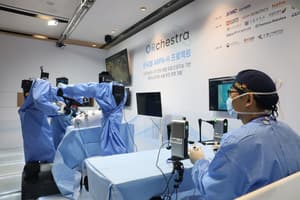
Samsung Medical Center has unveiled a proof-of-concept surgical system pairing two humanoid robots—one controlled remotely by a human operator, one guided by artificial intelligence—to assist a single surgeon during a simulated gallbladder procedure on goat liver. The demonstration, which the hospital characterizes as the first coordinated deployment of robots under both teleoperation and AI control working alongside human clinicians, represents a milestone in efforts to address chronic operating room staffing shortages.
The system is being developed through the ORchestra consortium, led by Samsung Medical Center in partnership with Rainbow Robotics and AIDIN ROBOTICS, under South Korea's Advanced Research Projects Agency for Health (ARPA-H) program. The five-year, 13.84 billion won ($10 million) government-funded initiative is currently in its second year, with first-in-human clinical trials targeted for 2029 pending regulatory approval.
Robots Divide Labor Between Instruments and Visualization
During the demonstration, one humanoid robot managed surgical instruments and tissue retraction while the second controlled the endoscope, allowing the surgeon to perform the procedure without human assistants present. The endoscope robot employs visual servoing technology to autonomously track instruments, while both systems incorporate remote center of motion capabilities designed to maintain a fixed entry port and prevent incision tearing.
According to Jung Yong-gi, a head and neck surgeon at Samsung Medical Center leading the research, the AI training approach relies on action-triplet data sets that pair surgical scenes with specific instruments and actions. This framework enables the AI to predict the next surgical step "almost perfectly from a single scene," Jung reported. Current performance metrics show a 100% gripping rate for five instruments, a 98.7% delivery rate, and motion initiation within two seconds—though the team is targeting sub-one-second response times.
The AIDIN ROBOTICS multi-jointed hand features tactile sensors in each finger joint that capture data 50 times per second, providing granular feedback on instrument handling. When faced with ambiguous commands, the robot confirms instructions before executing, a safety feature designed to prevent unintended actions.
Multi-Hospital Data Strategy Aims for Generalizable Foundation Model
Rather than training AI on individual surgeon preferences, the consortium is building a foundation model using standardized, de-identified surgical data collected across four hospitals after data review board approval. Nine specialists are currently participating in the data collection effort, which focuses on capturing complete task cycles—from instrument request and delivery through use, retrieval, and cleanup—rather than isolated single-task automation.
Jung emphasized that the "replacement rate," or the share of human roles the robot can assume, serves as the key metric for return on investment. He noted that staffing a single position around the clock requires approximately five people, suggesting that robot costs would need to remain competitive with equivalent human staffing expenses for the business model to work.
Regulatory Pathway and Commercialization Timeline
The system is expected to receive Class III device designation, requiring Good Laboratory Practice large-animal preclinical studies, Good Manufacturing Practice certification, Ministry of Food and Drug Safety approval, and Institutional Review Board review before human trials can proceed. Samsung Medical Center stated that the robots would not increase patient costs, indicating the economic model relies on institutional efficiency gains rather than new revenue streams.
Rainbow Robotics and AIDIN ROBOTICS are positioned as commercialization partners, with hospitals anticipated to purchase or lease the systems once regulatory clearance is obtained. The consortium will face a competitive review later this year to determine advancement to the second phase of government funding.
The project directly targets documented staffing shortages in operating rooms, particularly acute in regional and smaller hospitals struggling to recruit skilled surgical assistants. If validated through clinical trials, the technology could enable "solo surgery" models for routine procedures, potentially expanding surgical capacity in underserved areas while standardizing assistant performance across institutions.
Sources
Google Search
Follow Health AI Central on Google
Choose Health AI Central as a preferred source, and Google is more likely to show our reporting in Top Stories.
Reporting & accountability
How we maintain accuracy
Health AI Central separates reported facts, analysis, and public-source data. Readers can review our standards, request a correction, or consult the relevant research methodology before relying on a claim.