

Microsoft's New AI Aims to Solve Healthcare's Model Selection Problem in Milliseconds
Tech giant unveils specialized decision-making model designed to route tasks between AI systems, potentially streamlining clinical workflow bottlenecks.
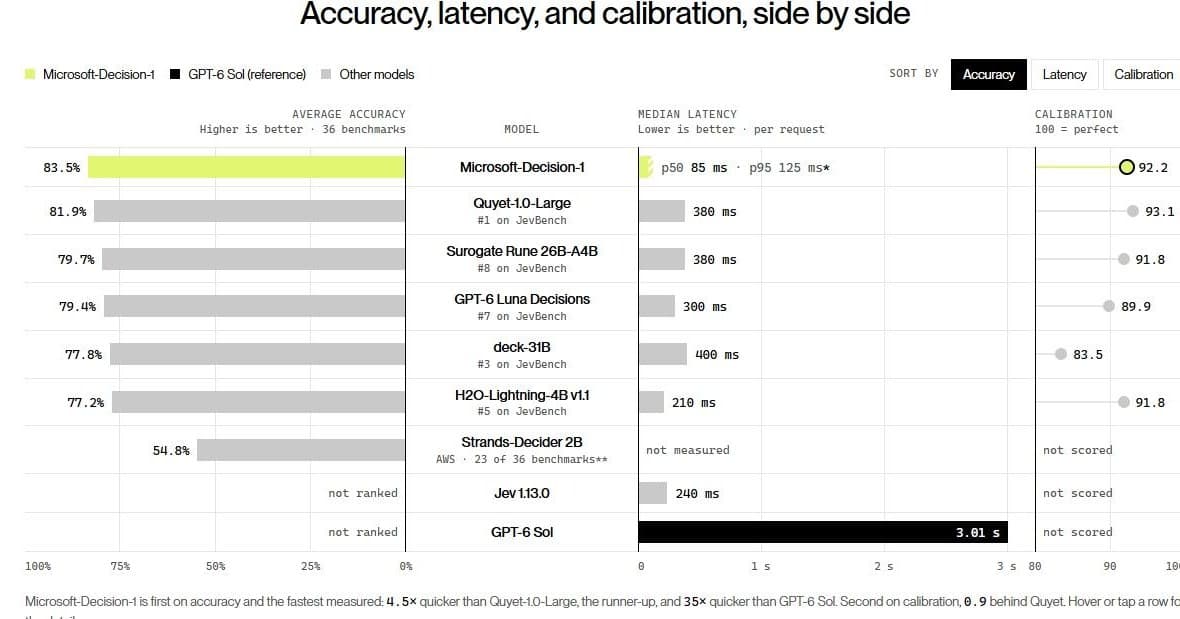
Microsoft has entered the emerging "decision model" space with the launch of Microsoft-Decision-1, a specialized AI system designed to make rapid choices between different AI models and analyze content at speeds the company claims outpace competitors. The announcement comes just days after OpenAI revealed its own Decisions API, signaling a new frontier in artificial intelligence architecture that could have significant implications for healthcare organizations managing increasingly complex AI ecosystems.
A New Category of AI for Operational Choices
Unlike large language models that generate text or AI agents that perform multi-step tasks, decision models represent a distinct category optimized for a single purpose: making quick, accurate selections. Microsoft-Decision-1 is designed to handle tasks such as routing requests to the most appropriate AI model for a given job or rapidly analyzing image content to determine next steps.
According to Microsoft's announcement, the model outperformed competitors in both speed and accuracy during comparative testing, though specific benchmark metrics were not disclosed. The technology addresses a growing operational challenge as organizations deploy multiple specialized AI systems and need efficient ways to direct workflows between them.
Potential Healthcare Applications and Unknowns
For healthcare systems juggling multiple clinical AI tools—from diagnostic imaging algorithms to clinical documentation assistants—decision models could optimize operations by accelerating triage decisions and reducing computational overhead. A lightweight decision layer might route radiology cases to specialized imaging AI models, direct patient queries to appropriate clinical tools, or select optimal algorithms for pathology analysis based on case characteristics.
However, significant questions remain unanswered for healthcare applications. The source provides no information about API access, pricing structure, or integration requirements with existing health IT infrastructure. Perhaps most critically for medical use cases, no healthcare-specific validation data or accuracy benchmarks relevant to clinical decision-making have been disclosed.
The Race for AI Infrastructure Dominance
Microsoft's rapid response to OpenAI's Decisions API announcement—launching just days later—underscores intensifying competition in AI infrastructure. As healthcare organizations move beyond experimenting with single AI models toward deploying comprehensive AI-powered workflows, the underlying technology for managing these systems becomes increasingly strategic.
The emergence of specialized decision models suggests the AI landscape is fragmenting into purpose-built tools rather than relying solely on general-purpose systems. For healthcare AI developers, this evolution may enable more efficient multi-model architectures, but it also introduces new layers of complexity in system design, validation, and regulatory consideration.
Whether Microsoft-Decision-1 will find traction in healthcare settings depends on factors the current announcement leaves unaddressed: demonstrated accuracy in medical contexts, compliance with healthcare data regulations, and practical integration pathways for clinical environments. As this technology matures, healthcare organizations will need concrete performance data and implementation guidance before incorporating decision models into patient-facing workflows.
Sources
Reporting & accountability
How we maintain accuracy
Health AI Central separates reported facts, analysis, and public-source data. Readers can review our standards, request a correction, or consult the relevant research methodology before relying on a claim.