

Medicine's Reckoning: Why Leading Bioethicists Now Predict Doctors Will Lose to AI Within Four Years
A provocative JAMA perspective argues autonomous AI will outperform physicians—even those using AI assistance—on core diagnostic and treatment tasks by 2030, as millions of Americans already bypass doctors for ChatGPT medical advice.
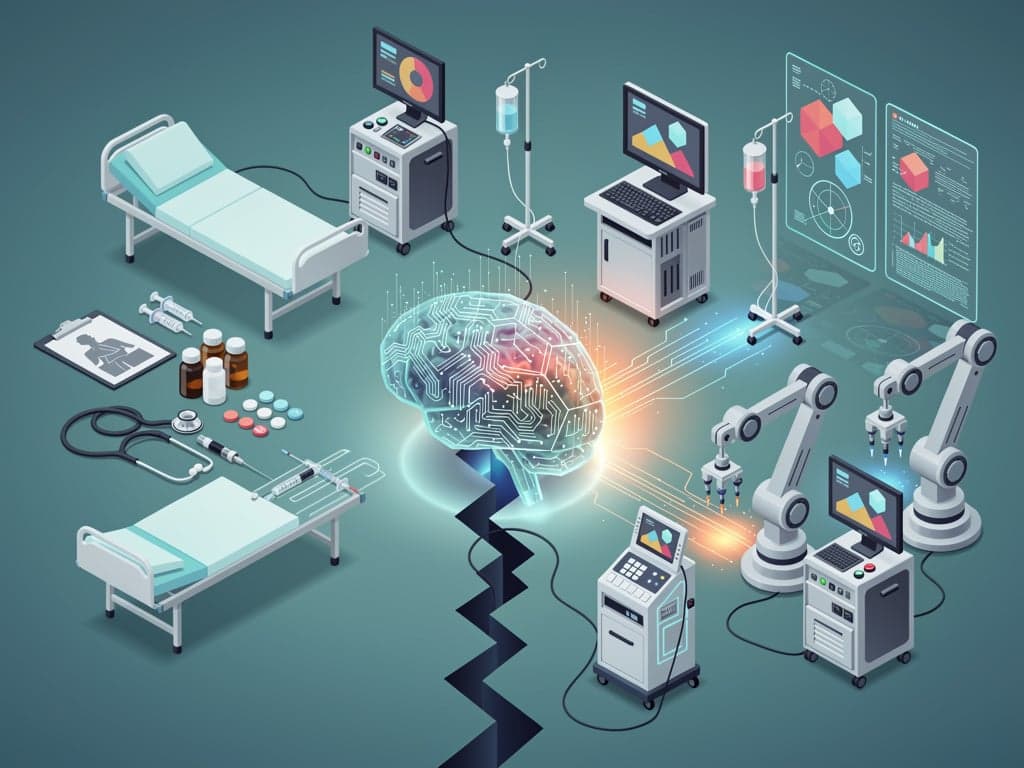
The medical profession is confronting an uncomfortable proposition: artificial intelligence may soon render physicians obsolete for the cognitive tasks that have long defined clinical expertise. A perspective published in JAMA and co-authored by prominent bioethicist Ezekiel Emanuel and venture capitalist Vinod Khosla predicts that autonomous AI will outperform both physicians working alone and physician-AI hybrid teams on five fundamental medical tasks by 2030—gathering patient information, diagnosing conditions, selecting tests, recommending treatments, and managing chronic diseases.
The claim has ignited fierce debate across organized medicine, with the American Medical Association and physician leaders pushing back against what they view as premature declarations of obsolescence. Yet the authors point to mounting evidence from controlled studies and the explosive growth of direct-to-consumer AI health platforms that suggest the transformation is already underway.
Performance Data Fuels the Controversy
The JAMA perspective draws on studies published since January 2024 that demonstrate AI's diagnostic superiority in experimental settings. A Microsoft diagnostic tool reached the correct diagnosis on complex cases four times more often than physicians within the same test-ordering budget, achieving this at 19 percent lower cost. Large language models identified the correct diagnosis first in 60 percent of challenging real-world cases, compared to just 16 percent for physicians.
Perhaps most striking, an autonomous agent called MIRA achieved 87.8 percent diagnostic accuracy versus 78.1 percent for board-certified physicians in simulations published in Nature. Google's AMIE system similarly outperformed primary care doctors on precision and guideline adherence during virtual consultations.
The authors argue that human oversight can actually degrade AI performance on these narrow cognitive tasks—a conclusion that challenges the prevailing assumption that physician-AI collaboration represents the optimal model.
A Shadow Medical System Emerges
While academic medicine debates the future, a largely unregulated direct-to-consumer AI health ecosystem has already taken root. More than 40 million Americans now query ChatGPT about health concerns daily. Doctronic has completed 24 million consultations and recently began issuing AI-generated prescription renewals in Utah. Function Health, valued at $2.5 billion, authorizes ChatGPT to interpret lab tests and full-body MRI results for members.
Companies like Ro and Hims prescribe medications for weight loss and anxiety following asynchronous online intake processes, while traditional healthcare organizations integrate AI tools at unprecedented speed. At the University of California, San Francisco, 70 percent of physicians now use ambient documentation scribes daily, with early trials showing reduced burnout scores. Revere Health recently cut approximately 200 positions—7 percent of its staff—largely in coding, billing, and documentation roles.
American Medical Association surveys indicate that roughly two-thirds of physicians used healthcare AI in 2024, representing a 78 percent increase from the prior year.
The Accountability Gap
Physician researchers have identified a troubling pattern: AI health companies "borrow medicine's authority" while accepting little of its accountability. When AI-generated diagnoses or prescriptions cause harm, patients face unclear recourse and liability frameworks remain undeveloped.
The AMA and Digital Medicine Society recently released a joint framework emphasizing physician centrality in AI-augmented care. AMA CEO John Whyte challenged the notion that patients would want emergency room treatment from a large language model for chest pain, while UCSF's Robert Wachter noted that AI excels at narrow tasks but struggles with the messy realities of incomplete data and complex patient emotions.
A Sermo poll found that 58 percent of doctors believe AI will diminish their role or render them obsolete, even as the Association of American Medical Colleges projects a shortage of 86,000 physicians by 2036. The profession now confronts fundamental questions about clinical identity, training curricula, and the preservation of uniquely human skills as AI systems demonstrate superior performance on discrete cognitive tasks that have historically defined medical expertise.
Sources
Companies in this article
 DoctronicNew York City, NY, USADoctronic provides AI-powered primary and urgent care with 24/7 availability. Users can chat with an AI doctor for free, access video visits with licensed physicians for $39, and receive prescription refills. The platform combines AI triage with human doctor consultations.View company profile →
 Function HealthFunction Health provides comprehensive preventive health testing with 160+ lab biomarkers annually, delivered through 2,000+ Quest Diagnostics locations nationwide. Members receive clinician-reviewed results, personalized action plans, and longitudinal tracking to detect early disease indicators without insurance requirements.View company profile →
Reporting & accountability
How we maintain accuracy
Health AI Central separates reported facts, analysis, and public-source data. Readers can review our standards, request a correction, or consult the relevant research methodology before relying on a claim.