

Healthcare's Cybersecurity Crisis Gets a New AI Weapon: Inside Sakana's Fugu-Cyber Model
Sakana AI's orchestration model achieves 86.9% vulnerability detection success, but gated access and premium pricing pose barriers for healthcare organizations battling ransomware and device security threats.
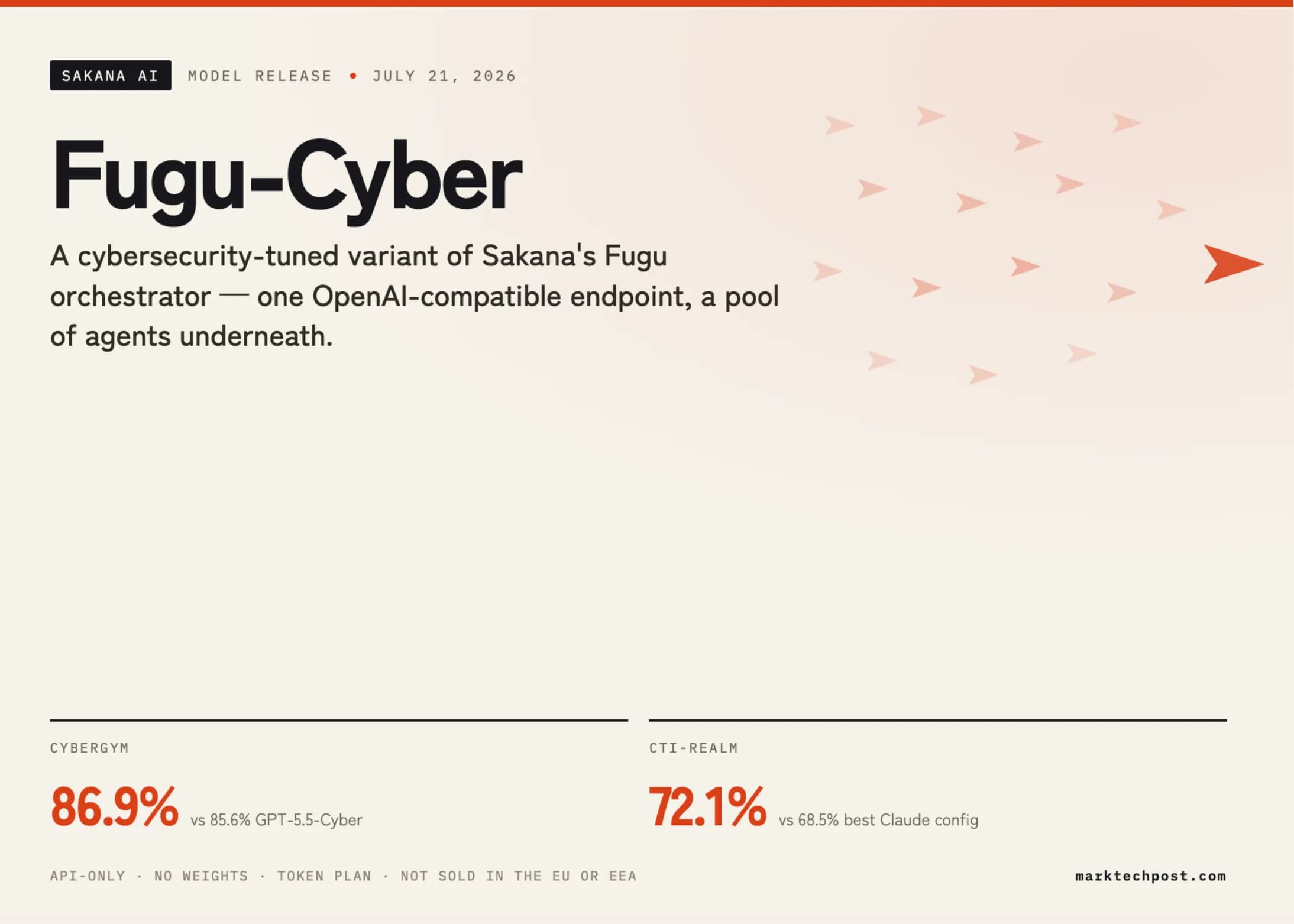
Healthcare cybersecurity has never been more critical—or more vulnerable. The 2025 Change Healthcare ransomware attack disrupted claims for 90 million patients and cost $2.3 billion, exposing how deeply cyberattacks can penetrate clinical operations. Now, Sakana AI has released Fugu-Cyber v1.0, a specialized orchestration model designed to detect vulnerabilities and threats with unprecedented accuracy. Released July 21, 2026, the model reports 86.9% success on CyberGym's vulnerability exploitation benchmark and 72.1% on Microsoft's CTI-REALM threat detection tests—marginally outperforming OpenAI's GPT-5.5-Cyber (85.6%) and Anthropic's Claude Mythos Preview (83.1%).
For healthcare organizations managing electronic health records, medical devices, and AI-powered clinical tools under HIPAA and FDA cybersecurity mandates, Fugu-Cyber represents both promise and complexity. Its orchestration architecture could strengthen security postures across health systems, but gated access, manual approval requirements, and a 20% cost premium raise questions about practical adoption.
How Fugu-Cyber Works: Orchestration Over Standalone Power
Unlike traditional frontier models, Fugu-Cyber functions as an orchestration endpoint on Sakana's Fugu platform. Rather than executing security tasks directly, it delegates sub-tasks to specialist models using the TRINITY framework—assigning Thinker, Worker, and Verifier roles dynamically. This architecture employs reinforcement learning-based coordination to build agentic scaffolds tailored to specific security challenges.
On CyberGym, the model receives vulnerability descriptions and unpatched codebases, then writes proof-of-concept exploits that crash pre-patch builds but spare post-patch versions—testing across 1,507 real-world vulnerabilities from UC Berkeley's OSS-Fuzz projects. On CTI-REALM, it maps MITRE ATT&CK techniques from threat reports, explores telemetry, iterates KQL queries, and generates validated Sigma rules for Linux, AKS, and Azure environments. Baseline CyberGym performance when the benchmark launched hovered around 20%, making Fugu-Cyber's 86.9% a substantial leap.
For healthcare, the Verifier role matters most: validating findings before action aligns with clinical IT's need for high-confidence security decisions, where false positives waste resources and false negatives risk patient safety.
Healthcare Applications and Adoption Barriers
Fugu-Cyber's capabilities map directly to healthcare's most pressing security needs. Medical device manufacturers could use it to scan firmware for vulnerabilities before FDA submissions. EHR platform developers could deploy it for continuous threat detection across FHIR servers and clinical data pipelines. Health-AI builders could validate security in machine learning models processing protected health information.
However, significant barriers complicate adoption. Access requires manual application review with use-case justification, verified contact information, and adherence to a defensive-use-only policy. The model is unavailable in the EU and EEA pending GDPR compliance—a problem for multinational health systems and academic medical centers. No open weights are released, limiting in-house security research.
Pricing adds another layer: $6 per million input tokens and $36 per million output tokens, with rates doubling above the 272K-token context threshold. Analyzing large clinical codebases—EHR integrations, medical imaging pipelines—will frequently trigger this premium, challenging fixed IT budgets. The model requires a separate Token Plan subscription beyond Sakana's standard $20–$200 tiers, adding administrative overhead.
The Bottom Line for Health-AI Builders
Fugu-Cyber's orchestration architecture and benchmark performance position it as a potentially powerful tool for healthcare cybersecurity, particularly for organizations facing escalating threats to patient data and clinical operations. The model's structured approach to vulnerability detection and threat intelligence could help health systems meet HHS 405(d) requirements and FDA cybersecurity guidance.
Yet the gated access model, EU unavailability, and cost structure demand careful evaluation. Healthcare security teams must weigh the 20% premium and manual approval process against alternative security-focused models, assess whether the 272K-token threshold aligns with their codebase sizes, and determine if the orchestration approach fits HIPAA-compliant workflows. For now, Fugu-Cyber represents a significant technical advance—but one whose practical impact on healthcare cybersecurity will depend on how Sakana addresses access and cost barriers in a sector where security failures carry life-or-death consequences.
Sources
Companies in this article

Reporting & accountability
How we maintain accuracy
Health AI Central separates reported facts, analysis, and public-source data. Readers can review our standards, request a correction, or consult the relevant research methodology before relying on a claim.