

Kakao Releases Open-Source Vision AI Models Claiming Edge Over Google and Meta
Korean tech giant's Kanana-2 vision encoders demonstrate superior performance across 42 benchmarks while delivering 60% faster processing for high-resolution images and document understanding tasks.
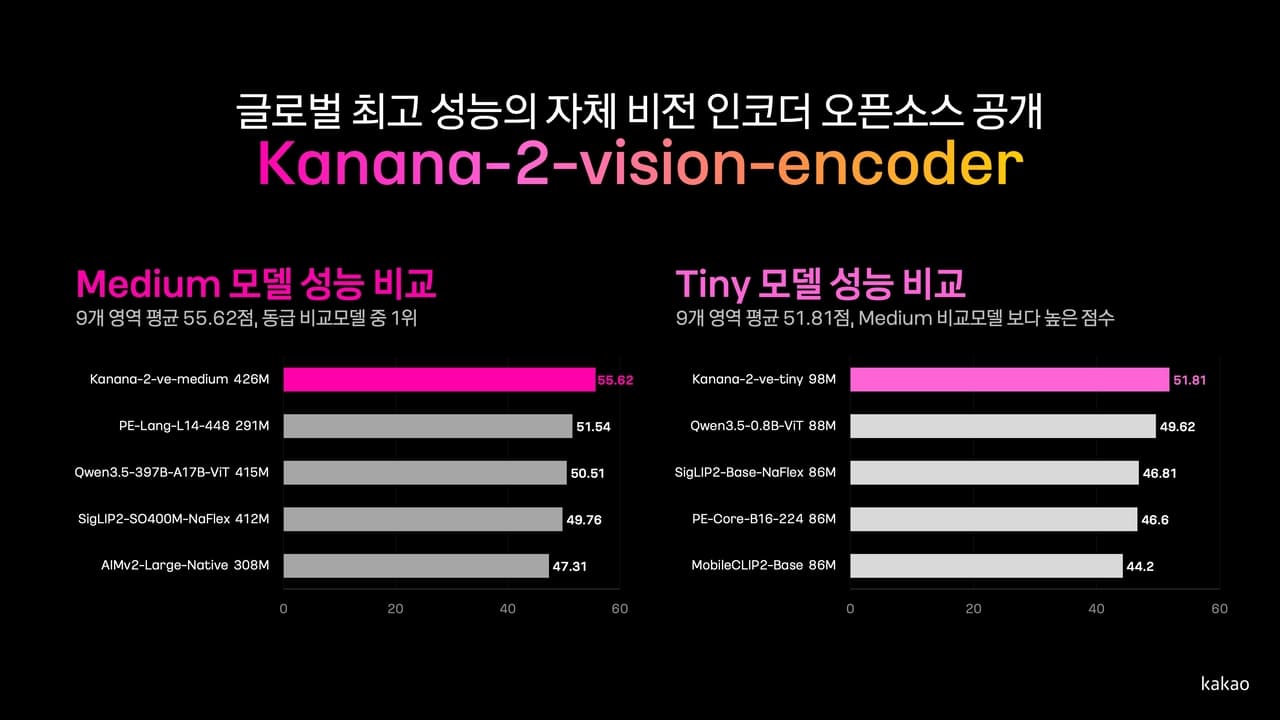
South Korean tech company Kakao has entered the competitive vision AI arena with the open-source release of its Kanana-2 vision encoder models. The models, released on Hugging Face under a commercial-use license, reportedly outperform vision encoders from Google, Meta, and Apple across dozens of benchmarks, with particular strength in optical character recognition and Korean-language document processing.
Performance Claims and Technical Specifications
Kakao released two variants of its Kanana-2 vision encoder: a "medium" model with 426 million parameters and a "tiny" model with 98 million parameters. According to the company, both models were tested across 42 benchmarks spanning nine categories, where they outperformed Google's SigLIP 2, Meta's Perception Encoder, Apple's AIMv2, and Alibaba's Qwen3.5-ViT.
The evaluation categories included general visual question answering, English text recognition and document understanding, Korean text recognition and document understanding, and spatial localization and fine-grained recognition within images.
The tiny model's performance is particularly noteworthy, as Kakao claims it matched or exceeded the capabilities of competing models with more than 400 million parameters despite having fewer than 100 million parameters itself. The performance gap was especially pronounced in spatial localization, Korean-language evaluation, and Korean text recognition and document understanding.
The company attributes this efficiency to knowledge distillation and model compression techniques, along with training improvements achieved using its proprietary Kanana-2 language model—a process Kakao says delivered roughly 4x better training efficiency compared with previous methods while also enhancing the model's ability to extract fine-grained visual information.
Noh Byeong-seok, performance leader for unified foundation models at Kakao, highlighted the models' strengths in optical character recognition (OCR), document comprehension, and spatial localization. The models also deliver more than 60% reduction in latency compared to leading global vision encoders when processing high-resolution images, according to the company.
Document Processing and Deployment Applications
Vision encoders serve as the "eyes" of AI systems, enabling them to understand images by extracting visual features such as objects, text, positions, and shapes. A language model then interprets these features to generate responses. Practical applications include reading food items and prices from menus, parsing document contents, or understanding what is happening in photographs.
Kakao attributed the Kanana-2 models' performance to improvements in optical character recognition and document comprehension, which it described as core capabilities for vision-language models. The company said its proprietary training techniques preserved fine-grained visual detail in small text and complex document layouts.
The encoders are optimized for high-resolution image processing, with knowledge distillation and model compression techniques applied across both variants. The tiny model was designed with on-device use in mind, making it viable for deployment scenarios where local processing is preferred.
Kakao released the models under its Kanana Open License, which permits both commercial and research use. This licensing approach provides developers with an alternative to proprietary vision encoders from larger technology companies, potentially reducing costs for organizations building multimodal AI systems.
Market Context and Availability
Kakao previewed the Kanana-2 models at its if(kakao)26 developer conference on October 13 before publishing them on Hugging Face on Wednesday. The company said it aims to lower the barrier to entry for researchers and businesses at home and abroad and to advance the broader multimodal AI research ecosystem.
The company's emphasis on Korean-language capabilities positions the models as particularly valuable for applications processing Korean text and documents, though the models also demonstrate strong performance on English text recognition and general visual understanding tasks.
"As the agentic AI era arrives, 'computer use' technology—which directly understands and interacts with PC and mobile screens—is drawing growing attention, and the role of vision encoders capable of accurately analyzing high-resolution images is expanding," said Noh. "We will consistently strengthen the competitiveness of our in-house AI models and contribute to the development of the AI ecosystem by continuing to open-source our technology."
The company noted that advances in its language model feed directly into improvements in its vision encoder, creating what it described as a virtuous cycle between the two technologies.
Sources
Reporting & accountability
How we maintain accuracy
Health AI Central separates reported facts, analysis, and public-source data. Readers can review our standards, request a correction, or consult the relevant research methodology before relying on a claim.