

Computer Vision Matches Human Surgeons in the OR—But Never Gets Tired, Stanford Study Finds
Eight-month JAMA Surgery validation shows AI documentation eliminates the 5-6 minute lag and overnight fatigue that plague manual operating room records.
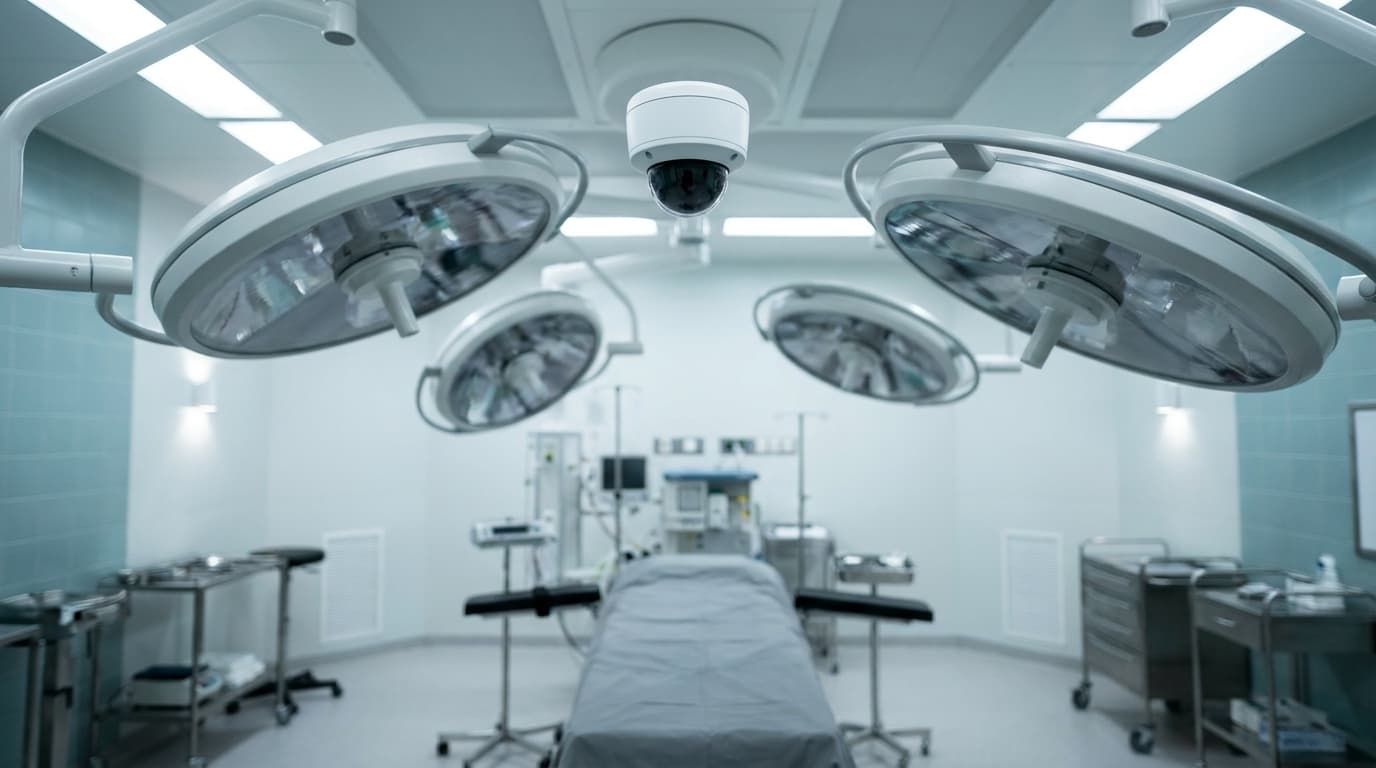
Illustration: AI-generated
Operating room documentation has long been a manual, error-prone process vulnerable to human fatigue and time delays. Now, a landmark Stanford Health Care study published in JAMA Surgery demonstrates that computer vision can automate surgical documentation with accuracy statistically equivalent to human entry—while eliminating the performance degradation that occurs during overnight shifts and marathon procedures.
The eight-month validation study, conducted across 15 rooms at Stanford Health Care, represents the first large-scale, multispecialty evaluation of ambient AI in the operating room. Researchers compared Aimbient's computer vision system against manual nursing documentation across seven surgical specialties, using blinded human video review as the ground truth reference standard.
Human-Level Accuracy Without Human Limitations
The study found no statistically significant difference in timestamp accuracy between Aimbient's automated system and manual human documentation for critical events like patient room entry and exit. However, the AI demonstrated a crucial advantage: consistency.
Manual nursing documentation exhibited an average asynchronous entry lag of 5-6 minutes, with accuracy deteriorating measurably during overnight shifts and lengthy organ transplant procedures. In contrast, Aimbient's system maintained instantaneous logging of patient movements as physical events occurred, delivering consistent 24/7 precision regardless of case duration or time of day.
"This is the first large-scale validation analyzing every consecutive operation across multiple specialties," the study authors noted, distinguishing the research from earlier single-procedure validations. The evaluation spanned general, vascular, transplant, urologic, gynecologic, and orthopedic surgery across 14 operating rooms and one procedure room.
From Retrospective Data to Real-Time Intelligence
The implications extend beyond simple documentation. Accurate, fatigue-resistant timestamping creates what Aimbient describes as "a foundational data layer for perioperative intelligence" spanning pre-operative scheduling, intraoperative tracking, and post-operative benchmarking.
For surgical leaders, this means reliable metrics for calculating first-case on-time starts, turnover times, and other operational benchmarks—without the 5-6 minute lag that compromises manual entry. Perioperative command centers gain real-time room state visibility for coordinating care teams, while predictive analytics can identify turnover bottlenecks and optimize block scheduling.
The system also frees nursing cognitive bandwidth from documentation tasks, allowing greater focus on direct patient care and safety monitoring during procedures.
Aimbient's computer vision models were trained on more than 15 million hours of real procedural data and are currently deployed across 650 surgical and procedural rooms. The company, formerly known as Surgical Safety Technologies, is led by founder and CEO Teodor Grantcharov, MD, PhD.
Setting a New Standard for Surgical AI Validation
The JAMA Surgery publication establishes important methodological precedents for ambient AI in procedural environments. By using blinded human video review as ground truth and evaluating every consecutive case rather than selected procedures, the study demonstrates that computer vision systems can achieve human-level accuracy in complex, multi-specialty clinical settings while outperforming humans on consistency metrics.
For health systems seeking to extract additional capacity from existing OR infrastructure without capital expansion, the shift from retrospective, manually-entered data to instantaneous, automated capture enables proactive rather than reactive operational management. For patients, improved OR efficiency through accurate timestamping and optimized scheduling may reduce surgical wait times and case cancellations.
The study represents a foundational validation for computer vision in the operating room—demonstrating not just equivalence to human documentation, but superiority in the consistency and reliability that operational intelligence demands.
Sources
Companies in this article

Follow Health AI Central
Keep up with health AI where you already read
On LinkedIn
The day’s strongest health AI stories in your feed, one or two each weekday.
On Google
Choose Health AI Central as a preferred source, and Google is more likely to show our reporting in Top Stories.
Reporting & accountability
How we maintain accuracy
Health AI Central separates reported facts, analysis, and public-source data. Readers can review our standards, request a correction, or consult the relevant research methodology before relying on a claim.