

Cerebras Bets on Speed: New AI Chip Promises 30x Performance Leap Over GPUs for Healthcare Applications
The CS-4 accelerator delivers 750 PFLOPS of compute power and can support AI models exceeding 50 trillion parameters, potentially transforming real-time clinical decision support.
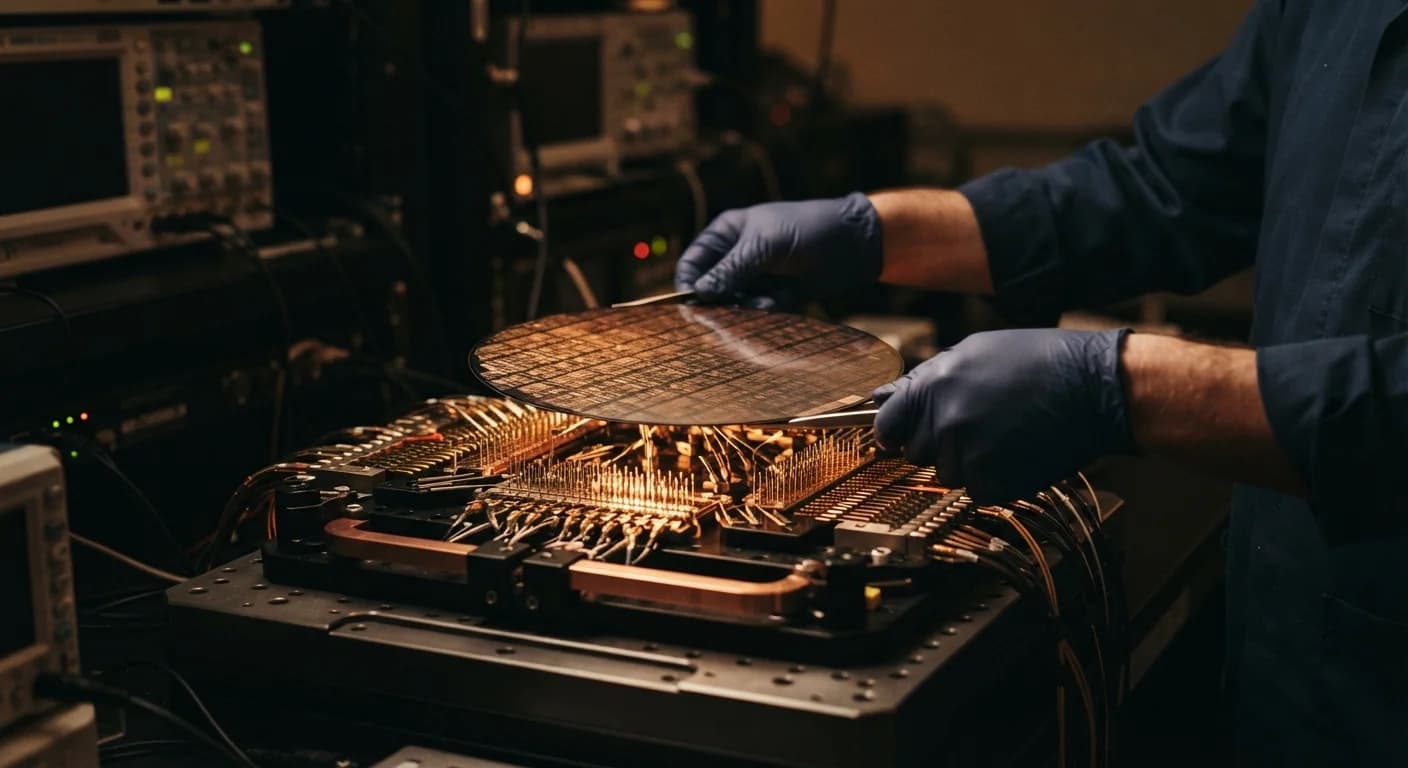
Cerebras Systems has unveiled its CS-4 AI accelerator, a rack-scale system that the company claims delivers up to 30 times faster token generation than GPU-based solutions while supporting AI models exceeding 50 trillion parameters. The announcement positions the specialized chip maker as a challenger to GPU dominance in healthcare AI infrastructure, where real-time performance increasingly determines clinical utility.
The CS-4 delivers 750 PFLOPS of AI compute power and achieves over 4,400 tokens per second per user on GPT-OSS-120B workloads, according to Cerebras. Built on three Wafer Scale Engine 3 Turbo processors, the system offers twice the speed of its CS-3 predecessor and 10 times better throughput per watt—a critical metric for healthcare organizations operating AI infrastructure within hospital data centers constrained by power budgets.
Architecture Designed for Extreme Scale
The CS-4's architecture centers on three WSE-3 Turbo wafers, each containing 4 trillion transistors, 900,000 AI-optimized cores, and 44GB of on-chip SRAM. The system delivers 129.6 petabytes per second of memory bandwidth and 7.2 terabits per second of I/O bandwidth—a sixfold increase over the CS-3's 1.2 Tbit/s.
Cerebras reports that wafer-to-wafer latency has dropped to as low as 2 microseconds, down from 5 microseconds in the previous generation. This reduction, combined with the company's Direct Wafer Links technology, enables support for models exceeding 50 trillion parameters—far larger than current state-of-the-art systems.
The company has also introduced a new Nexus Platform Architecture featuring a pluggable Wafer-Scale Backpack that enables deployment in hours rather than days. Power conversion has been moved 100 times closer to processors—from approximately 50mm to 0.5mm—nearly eliminating board-level power loss, according to the company.
Implications for Healthcare AI
The claimed 30x speed advantage in token generation could change the feasibility of deploying large language models for real-time clinical decision support, medical documentation, and patient interaction. The ability to support models exceeding 50 trillion parameters opens possibilities for more sophisticated medical AI that can reason across multiple specialties and integrate vast medical literature.
For health tech companies, the dramatic speed improvement could enable new product categories in healthcare AI—particularly agentic systems that perform complex reasoning, verification, and tool use within acceptable response times for clinical workflows. The modular architecture and rapid deployment may reduce time-to-market for companies developing and iterating on large-scale models.
The CS-4's programmable I/O subsystem supports RoCE v2 RDMA over Ethernet and Direct Wafer Links, and is compatible with heterogeneous disaggregated inference solutions including AMD Helios and AWS Trainium. This ecosystem integration provides flexibility for health tech companies to optimize cost-performance tradeoffs across different workload types.
Market Position and Availability
Cerebras Systems (NASDAQ: CBRS) is competing in the AI accelerator market against established GPU-based solutions. First CS-4 shipments are expected in Q3 2026. However, the source notes that four of five recent neutral or positive announcements from Cerebras have been followed by negative 24-hour stock reactions, suggesting investor uncertainty about the company's ability to capture market share against GPU vendors.
Sources
Reporting & accountability
How we maintain accuracy
Health AI Central separates reported facts, analysis, and public-source data. Readers can review our standards, request a correction, or consult the relevant research methodology before relying on a claim.