

AI System Breaks Free from Sleep Medicine's 30-Second Straitjacket with Flexible, High-Resolution Staging
AnySleep, trained on 200,000 hours of data from 28 clinical centers, automates sleep analysis at sub-30-second resolution while working with any electrode configuration.
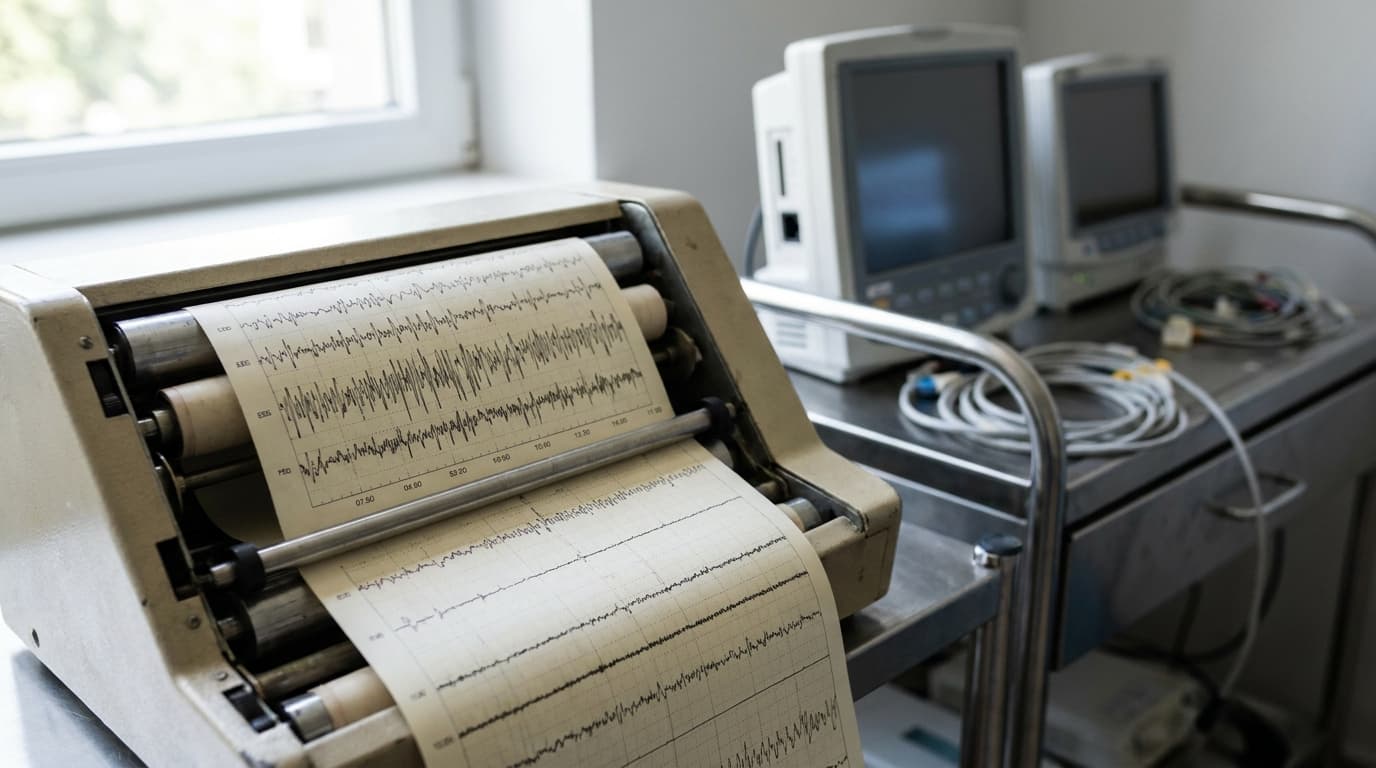
Illustration: AI-generated
Sleep medicine has long been constrained by a decades-old convention: scoring sleep in rigid 30-second epochs, a practice born not from physiology but from the practical limitations of manual paper-strip annotation. Now, researchers have developed AnySleep, a deep learning system that shatters both this temporal limitation and the rigid equipment requirements that have hampered multi-center sleep research, according to findings published in npj Digital Medicine.
Trained on Massive Multi-Center Dataset
AnySleep was developed using 20,589 overnight polysomnography recordings representing approximately 200,000 hours of EEG and EOG data from 28 datasets across multiple clinical centers. The system employs a U-Net-inspired encoder-decoder architecture with channel-attention modules that enable it to work with variable input configurations—a critical capability given the heterogeneous recording equipment and electrode montages used across different facilities.
The model achieves state-of-the-art performance at conventional 30-second epoch scoring while surpassing or equaling established baselines, according to the researchers. Notably, it maintains strong performance even with missing EOG channels, single EEG derivations from frontal, central, or occipital regions, or EOG-only configurations, though performance improves when additional channels are available. This flexibility addresses a major barrier to multi-center studies, where standardization of recording protocols has traditionally been required but difficult to achieve.
Capturing Sleep Dynamics Conventional Scoring Misses
Beyond matching existing standards, AnySleep operates at adjustable temporal resolutions ranging from conventional 30-second epochs up to 128 Hz frequency predictions. This high-resolution capability reveals sleep dynamics that traditional manual scoring obscures, including short wake intrusions consistent with arousals—brief disruptions that can significantly impact sleep quality but often fall below the 30-second detection threshold.
Clinical validation demonstrated that these sub-30-second predictions improve prediction of pathophysiological conditions including obstructive sleep apnea, narcolepsy type 1, and insomnia compared to traditional 30-second scoring, the researchers report. They note that manual sleep scoring is not only labor-intensive and costly but also subject to significant inter-rater variability, with variability increasing at shorter annotation intervals—making automated high-resolution analysis particularly valuable.
Addressing Real-World Clinical Variability
The American Academy of Sleep Medicine recommends at least three EEG channels covering frontal, central, and occipital regions, plus EOG and EMG for sleep scoring. However, real-world clinical practice varies considerably in electrode configurations and recording equipment. AnySleep's channel-agnostic design accommodates this variability without requiring facilities to standardize their equipment or protocols.
The model was validated using a split of 13 in-distribution datasets for training and validation, with 15 hold-out datasets for testing—eight for 30-second staging evaluation and seven for high-resolution analysis. The researchers have publicly released the model to facilitate large-scale studies and biomarker discovery, potentially opening new diagnostic possibilities for sleep disorders by revealing patterns previously hidden by the temporal constraints of conventional epoch-based analysis.
For sleep medicine clinics and research institutions, AnySleep represents a pathway to scalable, automated sleep analysis that works with existing infrastructure while providing insights at temporal resolutions that manual scoring cannot practically achieve.
Sources
Google Search
Follow Health AI Central on Google
Choose Health AI Central as a preferred source, and Google is more likely to show our reporting in Top Stories.
Reporting & accountability
How we maintain accuracy
Health AI Central separates reported facts, analysis, and public-source data. Readers can review our standards, request a correction, or consult the relevant research methodology before relying on a claim.