

The Original Biotech Company Is Tearing Up the Lab Playbook: Inside Genentech's AI-Powered Reinvention
CEO Ashley Magargee is betting $50 billion and a radical campus redesign on artificial intelligence partnerships with Nvidia and Anthropic to transform 50 years of drug discovery tradition.
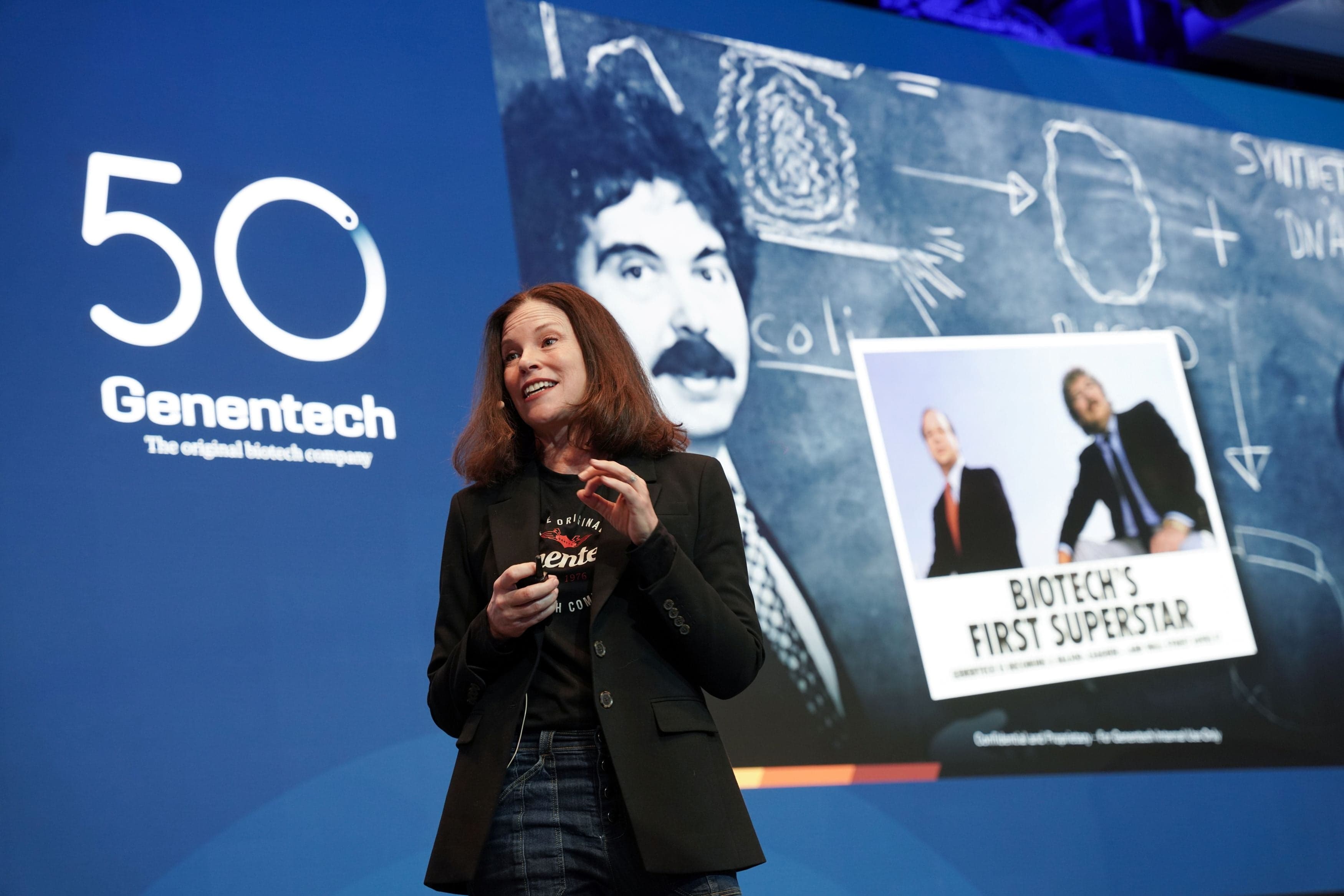
At 50 years old, Genentech isn't slowing down—it's ripping up the floorboards. The biotech pioneer that brought recombinant DNA technology to medicine is now questioning something as fundamental as the horizontal lab bench, a fixture of scientific research for over a century. The reason? Artificial intelligence is rewriting the rules of drug discovery, and CEO Ashley Magargee is determined that "the original biotech company" will lead the transformation rather than follow it.
AI Agents Enter the Lab
Under the leadership of Aviv Regev, Ph.D., a computational biologist who joined Genentech in 2020 and now heads Genentech Research and Early Development (gRED), the company is implementing what it calls a "lab in a loop" research framework. This AI-powered approach has spawned partnerships with tech giants Nvidia and Anthropic, with the latter's AI agents currently being tested on BCA protein assays—routine laboratory equipment that could potentially run autonomously.
The shift represents more than incremental automation. Magargee told Fierce Biotech that Genentech's proximity to Silicon Valley tech companies is driving fundamental questions about laboratory design itself. The company is considering whether vertical bench configurations might better serve AI-driven workflows than the traditional horizontal layouts that have defined wet labs for generations.
The restructuring hasn't come without personnel changes. Vice presidents Vishva Dixit, M.D., Man-Wah Tan, Ph.D., and Todd McDevitt, Ph.D., exited as part of the gRED reorganization, signaling the magnitude of the operational transformation underway.
A $50 Billion Bet on the Future
Parent company Roche is backing Magargee's vision with substantial capital. In 2024, Roche announced a $50 billion U.S. investment commitment that includes a new Innovation Center at Harvard's Enterprise Research Campus in Boston. The most visible manifestation of change will unfold at Genentech's home campus, where construction planned from 2027 to 2033 will relocate scientists to a new central gRED center as part of a generational 50-year master plan.
The investment comes as Genentech maintains its therapeutic focus on oncology, hematology, neuroscience, immunology, and ophthalmology while expanding into cardiovascular, renal, and metabolic diseases. The company's near-term pipeline includes giredestrant, an oral SERD for HR-positive early-stage breast cancer with an FDA decision expected by November 2024, along with fenebrutinib for multiple sclerosis and trontinemab for Alzheimer's disease.
Preserving Identity While Embracing Disruption
Founded by Herbert Boyer, Ph.D., and Robert Swanson, Genentech was acquired by Roche for $47 billion in 2009. Now, nearly two decades later, Magargee faces the challenge of preserving the company's pioneering identity while fundamentally altering how its scientists work.
For an industry watching pharmaceutical R&D costs spiral and timelines stretch, Genentech's experiment represents a high-stakes test case. If AI agents can successfully automate routine assays and computational biology can guide physical lab design, the 50-year-old biotech may prove that reinvention, not tradition, is the key to longevity in drug discovery.
Sources
Reporting & accountability
How we maintain accuracy
Health AI Central separates reported facts, analysis, and public-source data. Readers can review our standards, request a correction, or consult the relevant research methodology before relying on a claim.