

Can AI Predict Which Liver Cancer Patients Will Relapse After Treatment? New Model Offers Clues—and Cautions
A Chinese hospital's machine-learning tool achieved 79% accuracy predicting hepatocellular carcinoma recurrence, but the path from promising algorithm to clinical reality remains long.
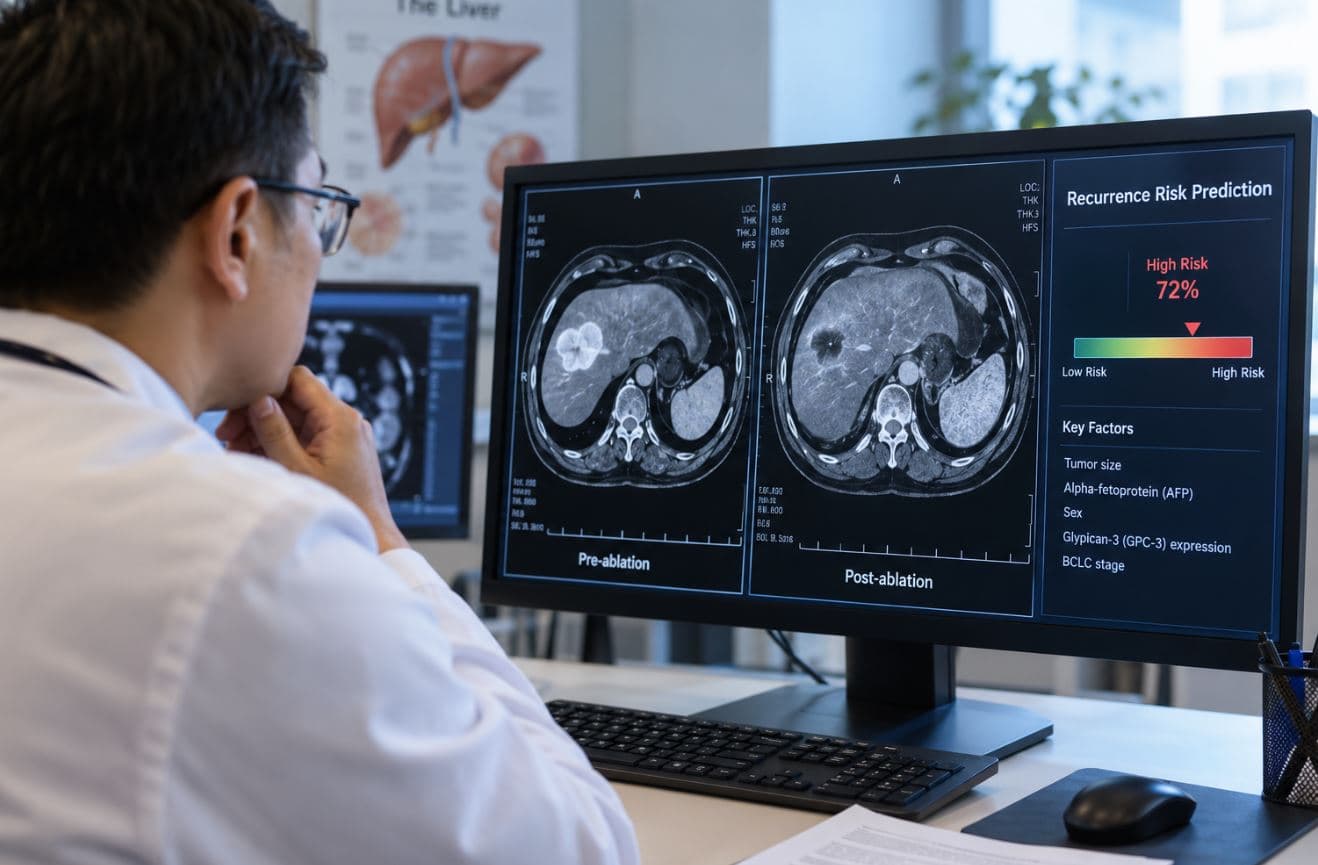
Researchers at a Beijing military hospital have developed a machine-learning model that shows promise in predicting which liver cancer patients face the highest risk of recurrence after ablation therapy—but the tool's journey from research finding to clinical application illustrates the substantial gap between algorithmic performance and real-world implementation.
The XGBoost-based model, developed by Li et al. and published in BMC Cancer, achieved an area under the curve (AUC) of 0.790 in predicting hepatocellular carcinoma (HCC) recurrence among 447 patients treated at the Fifth Medical Center of the Chinese People's Liberation Army General Hospital. The model performed strongest when predicting recurrence within the first year post-treatment, reaching an AUC of 0.809.
Five Variables, One Algorithm, Multiple Questions
The prediction model incorporates five clinical and biological factors: tumor size, alpha-fetoprotein (AFP) levels, patient sex, glypican-3 (GPC-3) protein expression, and Barcelona Clinic Liver Cancer (BCLC) stage. Researchers selected XGBoost after comparing it against logistic regression, random forest, and support vector machine algorithms, using an ensemble feature selection approach combining logistic regression, minimum Redundancy Maximum Relevance (mRMR), and Mutual Information methods.
The model demonstrated consistent performance across training (AUC 0.819), validation (AUC 0.813), and test sets (AUC 0.790), with no statistically significant performance differences across patient subgroups defined by sex, age, or tumor size (interaction P > 0.7). Time-specific analysis showed AUCs of 0.776 for recurrence between one and two years post-treatment, and 0.781 for recurrence after two years.
The study's single-institution design and 3:1:1 data split for training, validation, and testing means all patients came from the same hospital, limiting assessment of how the model might perform in different clinical settings with varying patient populations, treatment protocols, or biomarker measurement methods.
The External Validation Challenge
The model has not undergone external validation at independent institutions, a critical step before clinical deployment. For context, a 2022 multi-center study by An et al. achieved an AUC of 0.76 in external validation using XGBoost to predict early recurrence in 1,574 microwave ablation patients across four hospitals—suggesting that performance often declines when models encounter new clinical environments.
The inclusion of GPC-3 expression adds complexity that may limit generalizability, as tissue acquisition and protein measurement protocols vary across institutions. This requirement could create practical barriers to implementation in centers without standardized GPC-3 testing infrastructure.
Importantly, the study demonstrates discrimination—the model's ability to distinguish between patients who did and didn't experience recurrence—but does not show whether using the model to guide clinical decisions would improve surveillance timing, treatment outcomes, or patient quality of life compared to standard care protocols.
What This Means for Cancer Surveillance
For healthcare providers, this represents an investigational tool that requires prospective validation before clinical use. Clinicians should continue following established HCC surveillance guidelines until studies demonstrate that model-guided care delivers measurable benefits.
For AI developers, the research illustrates both opportunity and obligation: while single-center retrospective studies can identify promising approaches, the path to clinical utility demands multi-center validation, demonstration of decision impact, and solutions to biomarker standardization challenges. The superior first-year performance suggests time-specific models may offer advantages over static risk predictions—a design consideration for future development efforts.
Patients should understand that while such research represents progress toward personalized post-treatment monitoring, prediction models estimate population-level risk patterns and cannot determine with certainty whether an individual's cancer will recur.
Sources
Reporting & accountability
How we maintain accuracy
Health AI Central separates reported facts, analysis, and public-source data. Readers can review our standards, request a correction, or consult the relevant research methodology before relying on a claim.