

AI Reveals Hidden Danger: One in Five ICU Patients Cleared for Breathing Tube Removal Are Actually High-Risk
Machine learning model exposes critical blind spot in traditional ventilator weaning criteria, identifying patients with double the mortality rate who appear ready for extubation.
Nearly one in five mechanically ventilated patients who meet all standard criteria for safe breathing tube removal are actually at high risk for complications and death, according to a machine learning model that challenges decades of ICU practice. The finding suggests that traditional respiratory assessments miss critical whole-body factors that determine whether patients can successfully breathe on their own.
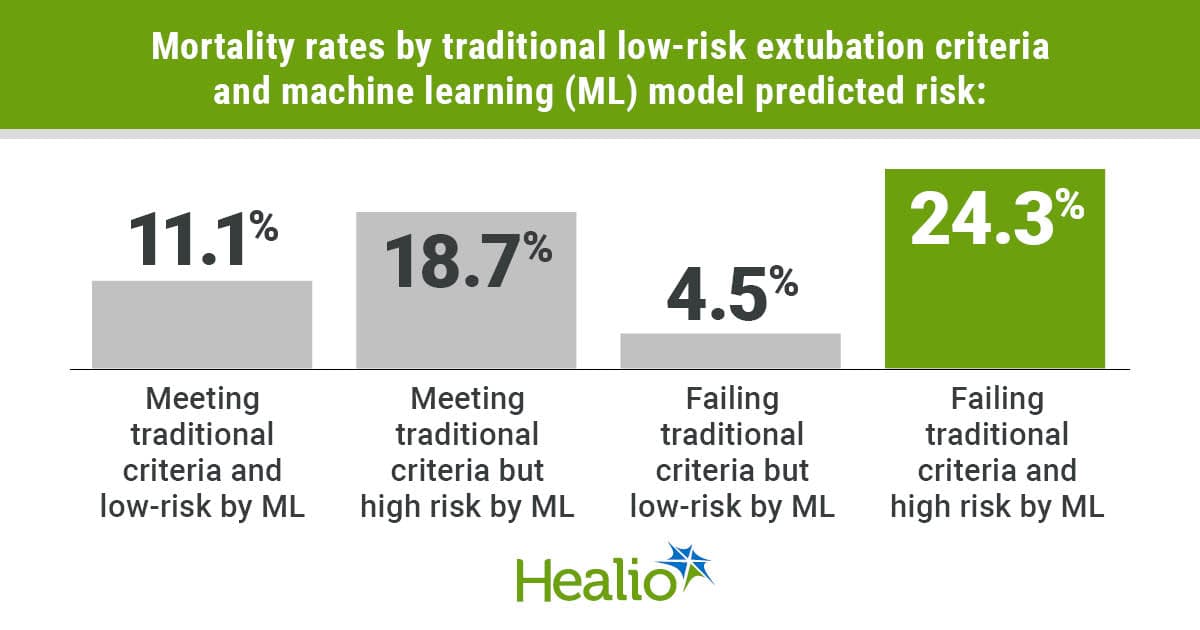
The study, presented at CHEST Annual Meeting 2024 in Phoenix, analyzed 23,379 adults from the MIMIC-IV electronic health record dataset. Lead researcher Jeril Lasington, MBBS, a medical resident at New York Medical College, St. Clare's and St. Mary's Hospitals, found that 18.7% of patients who passed conventional low-risk tests were flagged as high-risk by the algorithm—and their outcomes supported the model's predictions.
The Occult High-Risk Population
This "occult high-risk" group experienced reintubation rates of 15.4% and mortality rates of 18.7%—approximately double the rates seen in truly low-risk patients (7.3% and 11.1%, respectively). The discrepancy reveals a potential patient safety gap in current extubation protocols.
The machine learning model, trained using gradient boosting techniques on 52 pre-extubation features, achieved an area under the curve of 0.699 for predicting extubation failure, defined as reintubation within 72 hours. Traditional criteria focus narrowly on respiratory mechanics: oxygen requirements (FiO2 ≤50%), positive end-expiratory pressure (PEEP ≤8 cmH2O), and rapid shallow breathing index (RSBI <105).
But the AI identified different priorities. Using SHAP analysis to determine which factors most influenced predictions, researchers found that ventilation duration, ARDS diagnosis, pneumonia, sepsis, fluid balance, and body weight—none captured by standard weaning indices—were key predictors of failure.
A Tale of Two Patient Groups
Compared to truly safe patients, the occult high-risk group had dramatically different profiles: ventilation times averaging 123 hours versus 52 hours, ARDS rates of 49% versus 21%, pneumonia rates of 34% versus 6%, sepsis rates of 23% versus 9%, and congestive heart failure rates of 31% versus 20%.
The model's ability to integrate whole-body physiologic factors reveals why focusing solely on lung mechanics may miss important clinical information.
The Flip Side: Unnecessary Delays
The study also identified a substantial "over-flagged" population—39.4% of patients who failed traditional criteria but were deemed low-risk by the algorithm. This group had remarkably low reintubation (4.2%) and mortality (4.5%) rates, suggesting that current protocols may keep some patients on ventilators longer than necessary, potentially exposing them to ventilator-associated complications.
Clinical Implications
The research suggests that the occult high-risk group might benefit from additional interventions before or after extubation, such as diuresis, prophylactic high-flow oxygen, noninvasive ventilation, or closer monitoring. Conversely, the over-flagged group may represent an opportunity for earlier liberation from mechanical ventilation.
With baseline extubation failure rates of 8-15% and reintubation approximately doubling mortality risk, the stakes are considerable. The model's reliance on routinely collected data—requiring no additional testing—makes it potentially viable for real-time integration into ICU workflows, offering a path toward AI-augmented clinical decision-making that could simultaneously help prevent unnecessary complications and reduce ICU length of stay.
Sources
Reporting & accountability
How we maintain accuracy
Health AI Central separates reported facts, analysis, and public-source data. Readers can review our standards, request a correction, or consult the relevant research methodology before relying on a claim.